Choosing an LED display is not simply a matter of comparing screen sizes and prices. The right solution depends on where the display will be installed, how far the audience will be from the screen, what content will be shown, how bright the environment is, how often the display will operate, and how the system will be installed and maintained.
For commercial buyers, integrators, event companies, retailers, architects, and project managers, making the wrong choice can lead to unnecessary costs, poor image quality, difficult maintenance, or a display that does not perform as expected.
This guide explains how to choose LED display technology for different applications by evaluating the factors that have the greatest impact on visual performance, reliability, installation, and long-term cost.
At Meitec, LED display projects are approached from an application perspective rather than by focusing on a single specification. The company’s product portfolio includes COB LED displays, creative displays, rental systems, and standard indoor and outdoor LED displays for a variety of commercial environments.
1. Start With the Application
Before comparing technical specifications, define what the LED display actually needs to accomplish.
Different applications place very different demands on an LED screen.
For example, a conference room video wall may require extremely fine pixel pitch because viewers sit close to the display. An outdoor advertising billboard, by contrast, is normally viewed from much farther away and requires greater brightness and environmental protection rather than ultra-high pixel density.
Common LED display applications include:
- Retail stores and shopping malls
- Corporate showrooms
- Conference rooms
- Control centers
- Exhibition booths
- Concerts and stage productions
- Sports venues
- Transportation hubs
- Building façades
- Outdoor advertising
- Broadcast studios
- Creative architectural installations
Meitec’s LED display solutions cover commercial retail, outdoor advertising, exhibitions, events, and other application-oriented projects, illustrating why application requirements should come before product selection.
Ask four questions first:
Where will the screen be installed?
How close will viewers normally be?
What type of content will be displayed?
Will the screen be permanently installed or frequently moved?
Once these answers are clear, most other specifications become easier to determine.

2. Choose the Correct Pixel Pitch
Pixel pitch is one of the most important specifications in any LED display buying guide.
Pixel pitch refers to the distance between the centers of neighboring LED pixels and is normally expressed in millimeters, such as P0.9, P1.25, P1.5, P2.5, P3.9, or P6.
A smaller pixel pitch places more pixels within the same physical area, creating higher resolution and allowing audiences to view the screen comfortably from shorter distances.
For example, fine-pitch displays are often preferred for:
- Control rooms
- Boardrooms
- Broadcast environments
- Luxury retail
- Corporate showrooms
- Close-viewing indoor video walls
Larger pitches are usually more practical for applications where the audience stands farther away, including outdoor billboards, stadium displays, and large public information screens.
The smallest available pitch is not automatically the best choice.
Smaller pixel pitch normally increases pixel density and cost. If viewers are several meters away, paying for extremely fine resolution may deliver little practical improvement.
The goal is therefore to select the pitch that provides sufficient visual detail at the actual viewing distance without overspecifying the project.
Meitec’s Knowledge Base specifically identifies viewing distance, resolution requirements, and budget planning as important factors in pixel pitch selection. For additional technical resources, buyers can consult the company’s LED display buying guide and technical articles.
3. Determine Whether You Need Indoor or Outdoor LED
Indoor and outdoor LED displays operate under very different conditions.
Indoor LED Displays
Indoor screens generally do not need to compete with direct sunlight or withstand rain, dust, and severe temperature changes.
Instead, buyers usually prioritize:
- Fine pixel pitch
- Accurate color reproduction
- Comfortable brightness
- Wide viewing angles
- Low-noise operation
- Seamless cabinet alignment
- Front maintenance
- Attractive installation design
Typical applications include retail environments, meeting rooms, showrooms, airports, command centers, and shopping malls.
Outdoor LED Displays
Outdoor screens require greater environmental protection.
Important considerations include:
- High brightness
- Weather resistance
- Heat dissipation
- Waterproof cabinet construction
- UV resistance
- Stable power systems
- Temperature tolerance
- Convenient maintenance access
Outdoor displays must remain readable under changing ambient light while continuing to operate reliably in demanding environments.
Meitec’s outdoor advertising project in Bangkok, for example, required daytime visibility, weather-resistant performance, and reliable operation in a high-traffic commercial environment.
When selecting an outdoor screen, do not evaluate brightness alone. Cabinet protection, structural engineering, cooling, drainage, power distribution, and service access can be equally important.

4. Understand Brightness Requirements
Brightness is normally measured in nits, or cd/m².
However, higher brightness is not always better.
An indoor screen that is excessively bright can cause visual discomfort, particularly when viewers are close. Conversely, an outdoor display with insufficient brightness may look washed out during daylight.
The correct brightness depends on ambient lighting.
Indoor retail stores with strong lighting may require more brightness than meeting rooms. Window-facing installations may need additional output because they compete with daylight. Outdoor advertising screens require significantly greater brightness than most indoor displays.
It is also worth considering automatic brightness adjustment.
A screen operating outdoors does not necessarily need maximum brightness at night. Automatic adjustment can improve viewing comfort while helping reduce unnecessary power consumption.
5. Compare LED Packaging Technologies
Another important decision when you choose LED display products is the LED packaging technology.
Traditional SMD technology remains widely used in commercial LED displays, while COB technology has become increasingly relevant for fine-pitch indoor applications.
SMD LED Displays
SMD packages integrate LED components into individual surface-mounted devices.
They remain common across:
- Indoor advertising
- Outdoor displays
- Rental screens
- Stage installations
- Commercial displays
SMD technology offers a broad range of pixel pitches and is suitable for many conventional LED applications.
COB LED Displays
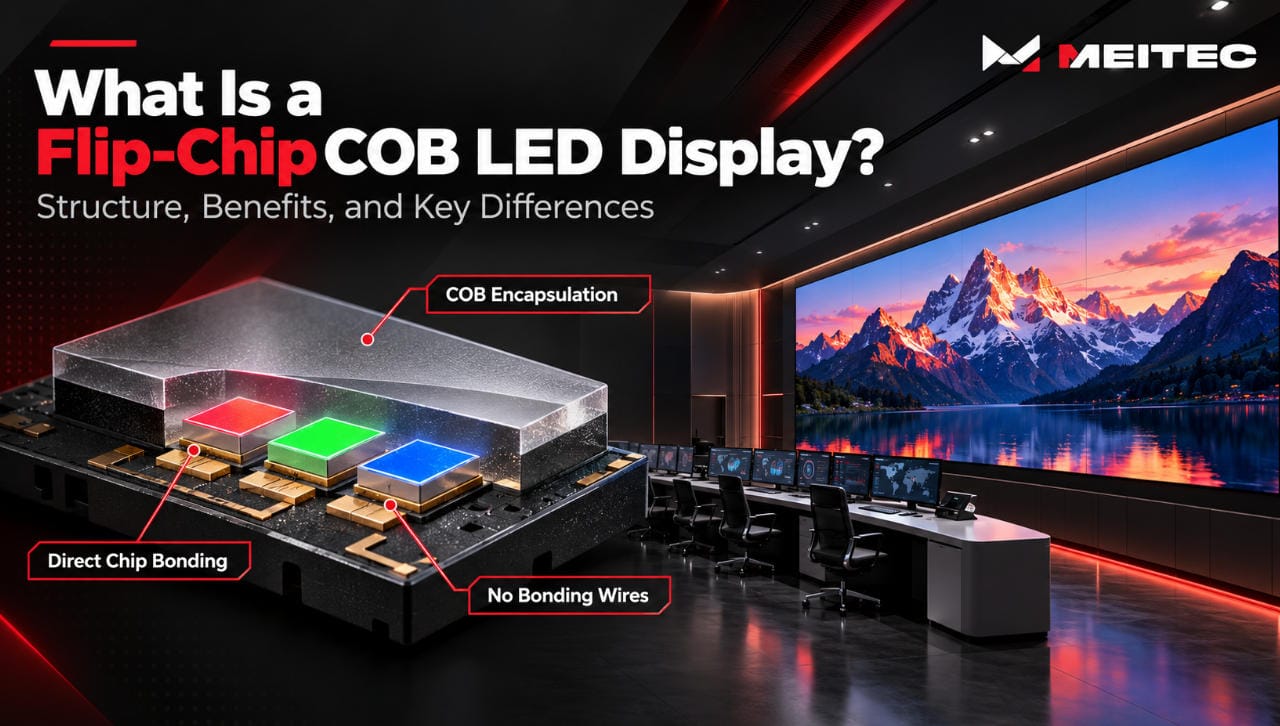
COB, or Chip on Board, mounts LED chips directly onto the substrate before applying protective encapsulation.
For fine-pitch applications, COB can offer advantages such as improved surface protection and suitability for high-density pixel layouts.
Meitec positions its COB LED displays for premium indoor applications requiring fine pixel pitch, high protection, and smooth visual performance.
COB can therefore be particularly relevant for corporate spaces, control rooms, premium retail environments, studios, and other close-viewing installations.
The best technology depends on application requirements rather than simply choosing whichever technology is newer.
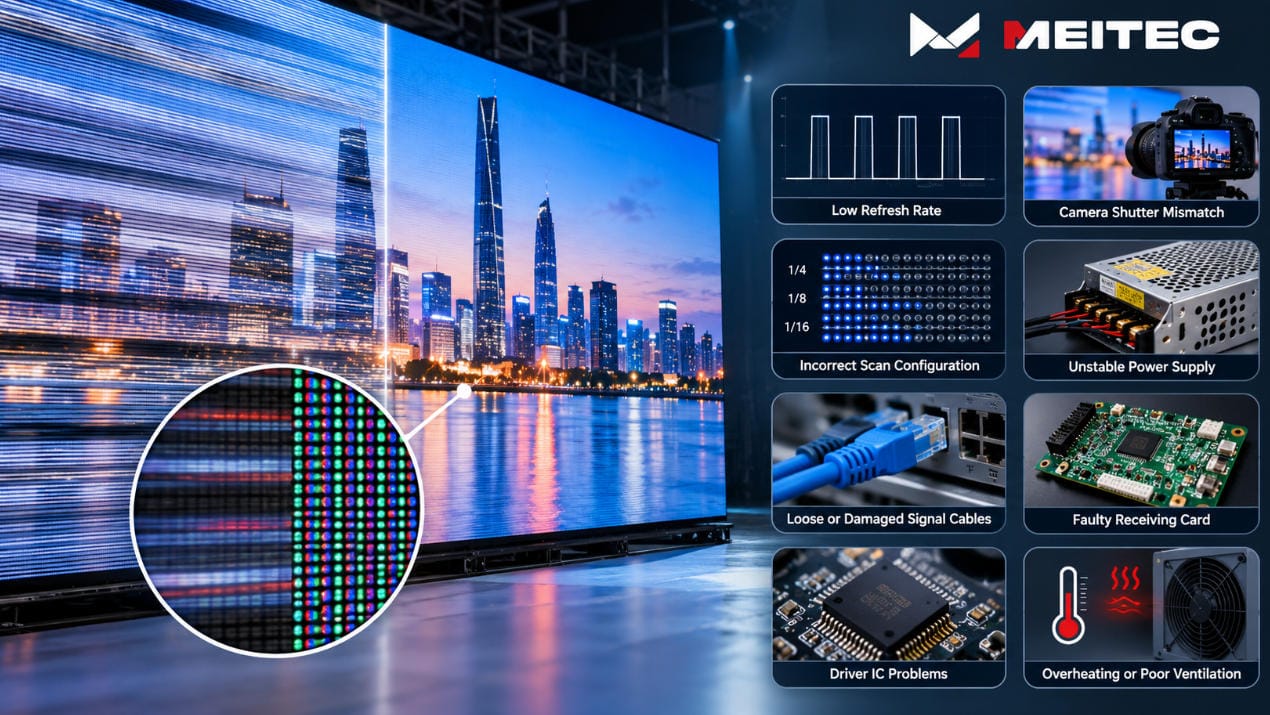
6. Check Refresh Rate and Camera Performance
Refresh rate describes how frequently the LED screen updates the displayed image.
For ordinary viewing, many professional LED displays can provide smooth visual performance. However, refresh rate becomes especially important when cameras are involved.
Applications such as:
- Broadcast studios
- Virtual production
- Conferences
- Concert filming
- Live streaming
- Sports broadcasting
- Product launches
may require higher refresh rates and carefully configured driver systems to reduce visible scanning lines or flicker on camera.
Meitec lists refresh rates of up to 3840 Hz among the performance characteristics available across its LED display offering.
If the screen will frequently appear on professional cameras, tell the supplier before finalizing the configuration.
7. Evaluate Viewing Angle and Screen Geometry
Not every audience stands directly in front of the display.
Retail installations, exhibition booths, public spaces, transportation facilities, and stadiums often have viewers approaching from different directions.
A wide viewing angle helps maintain consistent brightness and color across a broader audience area.
Geometry matters as well.
Traditional flat video walls are no longer the only option. Projects increasingly use:
- Curved LED walls
- Columns
- Corners
- Transparent screens
- Flexible displays
- Irregular shapes
- Immersive installations
If architectural integration is part of the project, cabinet dimensions, module flexibility, structural support, installation tolerances, and content design should be considered together.
Meitec’s Creative LED Display category is designed around customized formats including curved, shaped, transparent, and immersive installations.
8. Decide Between Fixed and Rental LED Displays
Another fundamental decision is whether the screen will remain permanently installed.
Fixed LED Displays
Fixed installations are commonly used for:
- Shopping malls
- Retail stores
- Corporate buildings
- Control rooms
- Outdoor advertising
- Transportation facilities
- Sports venues
For these projects, structural stability, long-term reliability, maintenance accessibility, power efficiency, and cabinet design are important.
Buyers evaluating conventional permanent installations can also review Meitec’s Standard LED Displays, which are positioned for indoor and outdoor advertising, commercial spaces, information display, and public visual communication.
Rental LED Displays
Rental LED screens have different priorities.
They are repeatedly assembled, dismantled, packed, transported, and installed.
Important features therefore include:
- Lightweight cabinets
- Fast locking systems
- Quick power and signal connections
- Corner protection
- Easy module replacement
- Strong cabinet construction
- Accurate alignment
Event companies should evaluate not only image quality but also how quickly crews can build and service the screen.
A slightly more expensive cabinet can sometimes reduce labor costs across dozens or hundreds of installations.
9. Consider Front or Rear Maintenance
Maintenance access is frequently underestimated during purchasing.
Traditional LED cabinets may require technicians to work behind the display. This can become difficult when screens are installed directly against walls or where architectural space is limited.
Front-service designs allow modules, power supplies, or receiving cards to be accessed from the front.
This can be valuable for:
- Retail stores
- Meeting rooms
- Control centers
- Narrow corridors
- Wall-mounted installations
- Space-constrained commercial environments
Before ordering, determine exactly how technicians will reach every serviceable component after installation.
A screen that looks excellent but cannot be conveniently maintained may create significant long-term operational problems.
10. Look Beyond the Purchase Price
One of the biggest mistakes in LED display procurement is comparing suppliers only by price per square meter.
The initial screen price represents only part of the total investment.
A more complete calculation should include:
- LED modules and cabinets
- Control system
- Power distribution
- Steel structure
- Installation
- Transportation
- Spare parts
- Video processing equipment
- Content management equipment
- Electricity consumption
- Maintenance
- Technical support
- Future replacement components
This is the total cost of ownership.
A lower quotation may not represent better value if the system consumes more energy, requires frequent maintenance, uses inconsistent components, or provides limited technical support.
The objective should be to find the most appropriate performance-to-cost ratio for the expected operating life of the project.
11. Evaluate Manufacturing and Quality Control
Specifications on a quotation cannot tell you everything about an LED display.
Manufacturing consistency also matters.
Professional buyers should ask suppliers about:
- Incoming component inspection
- LED module testing
- Aging tests
- Cabinet assembly
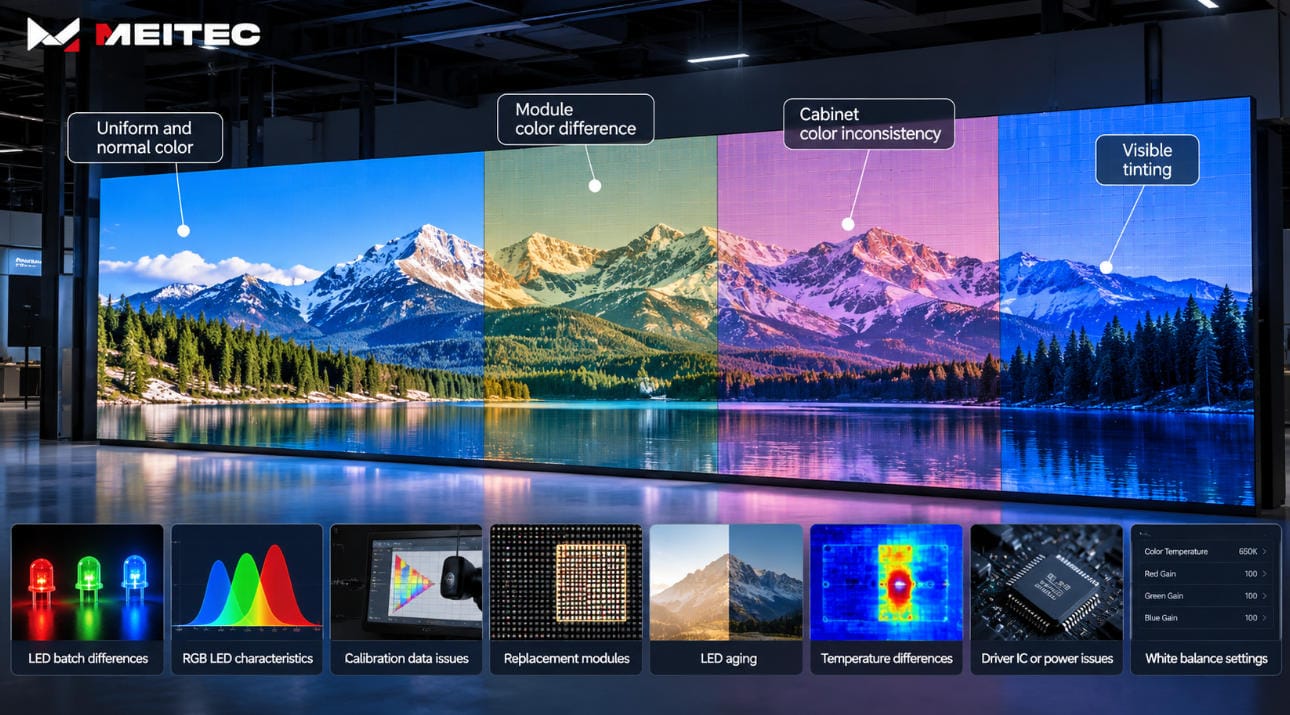
- Color calibration
- Waterproof testing for outdoor products
- Electrical safety
- Final inspection
- Packaging standards
- Traceability
- Spare-part availability
Quality control becomes particularly important for large screens because small inconsistencies between cabinets can become visually obvious after installation.
Meitec states that its LED display supply process includes factory selection and quality control, supported by an experienced technical team and project-oriented service. The company’s website also maintains dedicated quality-control and project-case sections, giving buyers additional information beyond basic product specifications.
12. Review Real Project Experience
A supplier’s project history can provide useful evidence of practical experience.
Look for projects similar to your own application.
If you need an outdoor billboard, examine outdoor installations rather than only indoor showroom photographs. If you are planning an exhibition booth, look for projects demonstrating fast installation and creative configurations.
Meitec’s published project examples currently include an outdoor commercial billboard in Bangkok, an immersive exhibition booth in Dubai, and a fine-pitch COB retail installation in Shenzhen. These examples cover different environmental and application requirements.
Case studies can help answer questions that product data sheets cannot, including how products are actually applied and what challenges were considered during project planning.
13. Ask the Right Questions Before Ordering
A good supplier should understand your project before recommending a product.
When requesting a quotation, provide as much information as possible:
- Indoor or outdoor installation?
- Required screen dimensions?
- Minimum viewing distance?
- Fixed installation or rental?
- Wall-mounted, hanging, or ground-supported?
- What content will be displayed?
- Will professional cameras record the screen?
- What is the ambient lighting level?
- Is front maintenance required?
- What power supply is available locally?
- Are there structural or weight restrictions?
- What is the expected daily operating time?
- What is the project budget?
- When must installation be completed?
These details allow an experienced supplier to recommend a configuration based on the actual application rather than sending a generic quotation.
Choosing the Right LED Display: Final Checklist
If you are trying to choose LED display technology for a commercial project, avoid making the decision based on pixel pitch or price alone.
A successful LED display combines several factors:
Application: What does the screen need to accomplish?
Viewing distance: How close will the audience be?
Pixel pitch: What resolution is genuinely necessary?
Brightness: What ambient lighting conditions must the display overcome?
Environment: Is the installation indoor or outdoor?
Technology: Is SMD, COB, rental, standard, or a creative format appropriate?
Installation: How will cabinets be mounted and accessed?
Maintenance: Can technicians replace key components efficiently?
Reliability: How is the product tested before shipment?
Supplier capability: Can the manufacturer support design, installation, troubleshooting, and future maintenance?
Total cost: What will the screen cost throughout its service life?
There is no single LED display specification that is ideal for every project.
The correct solution is the one that balances visual performance, operating environment, installation requirements, reliability, maintenance, and budget.
Working with an experienced LED display solution provider can make this process significantly easier. Meitec provides COB, creative, rental, indoor, outdoor, and customized LED display solutions for commercial projects worldwide, supporting customers from product selection through project implementation and after-sales service.
By clearly defining your application and evaluating the specifications that genuinely affect performance, you can select an LED display that delivers the right visual experience while protecting your long-term investment.