Industry Insights | LED Display Market | August 2026
The global LED display industry is entering a period of structural change.
Demand for large-format digital displays continues to expand across advertising, retail, entertainment, sports, corporate environments, transportation and public spaces. At the same time, technological development is moving the industry toward finer pixel pitches, higher image quality, more energy-efficient systems and increasingly specialized display formats.
Between 2026 and 2030, the LED display market is therefore likely to develop along several parallel paths rather than follow a single growth trajectory.
Outdoor digital signage will remain an important demand driver, while fine-pitch LED, COB technology, rental displays and creative LED solutions are expected to gain further attention in specific applications.
However, market forecasts should be interpreted carefully. Different research organizations use different definitions of the LED market, and figures for the overall LED industry, LED displays, LED video walls and outdoor LED displays are not directly interchangeable.
1. Global LED Display Market Outlook
One of the challenges when analyzing the LED display industry is the lack of a single standardized market definition.
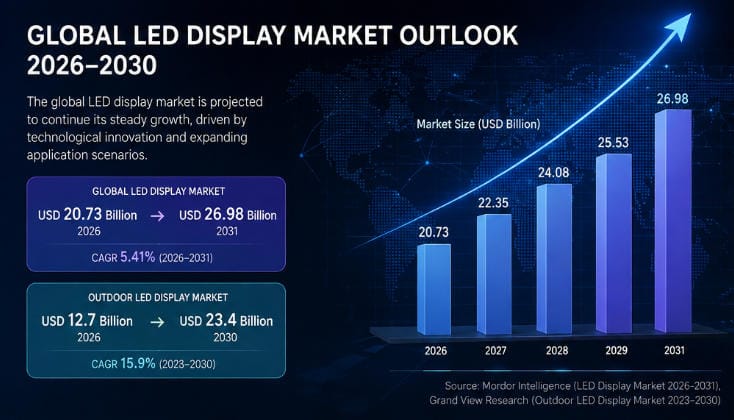
Mordor Intelligence currently estimates the global LED display market at USD 20.73 billion in 2026, with the market projected to reach USD 26.98 billion by 2031, representing a CAGR of 5.41% during 2026–2031. The research covers a broad LED display market definition and identifies Asia Pacific as the largest regional market.
A narrower market view produces different results.
For example, Grand View Research estimates the global outdoor LED display market at approximately USD 12.7 billion in 2026, with a projected value of USD 23.4 billion by 2030 and a CAGR of 15.9% over its 2023–2030 forecast period.
These figures should not be interpreted as competing forecasts for exactly the same market.
Instead, they illustrate an important characteristic of the industry: different LED display segments are developing at different speeds.
Outdoor advertising, professional video walls, fine-pitch indoor displays and emerging technologies such as COB and Micro LED each have different demand structures, price levels and adoption cycles.
For the 2026–2030 period, market development is therefore likely to be driven less by one universal trend and more by the continued expansion of multiple application segments.
2. Outdoor LED Displays Remain a Major Market Segment
Outdoor LED displays are expected to remain one of the industry’s most important application areas.
Digital advertising networks, shopping centers, sports venues, transportation facilities and public spaces increasingly rely on large-format digital displays to deliver dynamic visual content.
According to Grand View Research, the global outdoor LED display market is projected to grow from USD 12.7 billion in 2026 to USD 23.4 billion in 2030. The research identifies digital advertising and large-scale events as important factors supporting market growth.
Regional demand is also significant.
Grand View Research estimates that North America’s outdoor LED display market could reach approximately USD 7.47 billion by 2030, with a CAGR of around 17% from 2024 to 2030. The United States alone is projected to reach approximately USD 5.77 billion by 2030.
These forecasts indicate that outdoor LED demand is not limited to Asia or emerging markets. Mature markets are also continuing to invest in digital outdoor infrastructure.
For project developers, however, market growth does not necessarily mean that every outdoor LED project will use the same specification.
Brightness, pixel pitch, viewing distance, weather protection, maintenance access, structural requirements and energy consumption all need to be considered according to the installation environment.
3. Fine-Pitch LED Is Expanding Beyond Traditional Video Walls
Fine-pitch LED has become one of the most important technology directions in professional display applications.
Historically, LED video walls were primarily associated with large venues and long viewing distances. Improvements in LED packaging, driver technology and manufacturing processes have allowed pixel pitches to become increasingly smaller.
This has expanded LED applications into environments where viewers are positioned much closer to the display.
These include:
- Corporate meeting spaces
- Control rooms
- Broadcast studios
- Education facilities
- Retail environments
- Virtual production
- Premium home entertainment
- Museums and exhibition spaces
TrendForce’s LED video wall research indicates that high-resolution requirements and expanding application scenarios are supporting the development of the global LED video wall market. Its 2025 outlook estimated the global LED video wall market at approximately USD 7.991 billion in 2025, with indoor and outdoor fine-pitch displays identified as important growth areas.
The shift toward fine-pitch products also changes the competitive structure of the market.
As pixel pitch becomes smaller, product selection becomes increasingly dependent on image quality, viewing distance, processing performance, installation conditions and total cost of ownership rather than screen size alone.
This is one reason the fine-pitch LED display segment is becoming increasingly relevant in professional display planning.
4. COB Technology Is Gaining Attention in Premium Applications
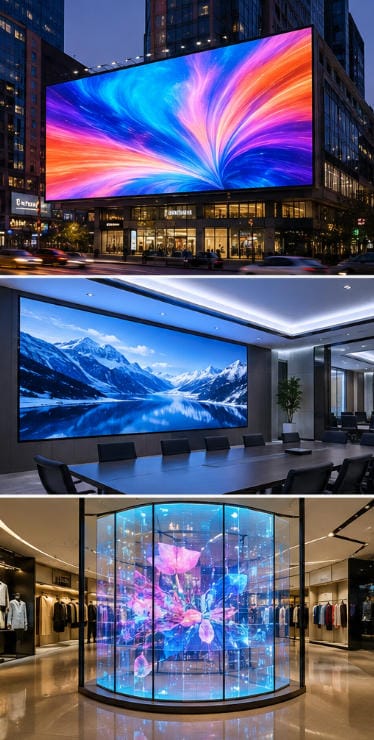
COB, or Chip on Board, is another technology receiving increasing attention within the fine-pitch LED display segment.
The basic principle is different from conventional SMD packaging. LED chips are directly packaged onto the substrate, allowing manufacturers to develop high-density display products with different structural characteristics.
COB technology is particularly relevant to applications requiring:
- Small pixel pitch
- High pixel density
- Improved surface protection
- Close viewing distances
- Premium image quality
- Long-term reliability
However, COB should not be considered an automatic replacement for SMD.
Both technologies continue to have their own advantages depending on the application, production requirements and project budget.
The more realistic outlook for 2026–2030 is therefore a coexistence of multiple LED packaging technologies, rather than a rapid transition from one technology to another.
COB is likely to gain market share where its technical advantages provide meaningful value, particularly in premium indoor and fine-pitch applications.
5. Energy Efficiency Is Becoming a More Important Market Consideration
Energy consumption has traditionally been a secondary consideration compared with brightness and image quality.
That is changing.
Large LED displays can operate for many hours per day over a service life measured in years. As electricity costs and sustainability requirements become more important, the operating cost of a display can have a meaningful impact on the total project investment.
This is particularly relevant to large outdoor advertising screens and commercial installations operating continuously.
Manufacturers are therefore paying increasing attention to:
- LED efficiency
- Driver IC performance
- Power management
- Thermal design
- Automatic brightness adjustment
- System-level energy optimization
For buyers, this means that the initial purchase price should increasingly be evaluated alongside operating expenses.
A display with a lower acquisition cost may not necessarily provide the lowest long-term cost if its power consumption, maintenance requirements or component replacement costs are significantly higher.
The concept of total cost of ownership (TCO) is therefore likely to become more important in LED display procurement through 2030.
6. Rental LED Displays Will Continue to Follow the Events Industry
Rental LED displays represent a different part of the market from permanent installations.
Their development is closely connected with concerts, festivals, sports events, exhibitions, corporate events and other temporary installations.
The requirements of rental products are therefore highly specific.
A professional rental display needs to balance image performance with:
- Lightweight construction
- Fast installation
- Easy dismantling
- Transportation efficiency
- Mechanical durability
- Cabinet protection
- Flexible configuration
- Maintenance accessibility
The continued international development of the live entertainment and event industries should provide ongoing demand for rental LED systems.
However, the market is also becoming more competitive. Buyers are increasingly evaluating rental equipment not simply by screen specification, but by how efficiently the equipment can be transported, installed and reused across multiple projects.
This makes operational efficiency an important part of the value proposition in the rental LED segment.
7. Creative LED Displays Are Creating New Application Scenarios
The LED display industry is also moving beyond traditional rectangular screens.
Creative LED solutions can take forms such as curved surfaces, transparent structures, flexible displays, spheres, irregular shapes and customized architectural installations.
The objective is often not simply to reproduce video content on a large surface.
Instead, the display itself becomes part of the architecture or visual experience.
This creates opportunities in:
- Retail
- Hospitality
- Museums
- Entertainment venues
- Architectural projects
- Brand experiences
- Urban installations
- Exhibition environments
This development is particularly important because it expands the addressable market for LED technology.
A traditional billboard competes primarily with other advertising displays.
A creative architectural display may instead compete with architectural lighting, digital art installations, projection systems or conventional building materials.
That creates a different type of market opportunity.
8. Mini LED and Micro LED: Long-Term Technology Directions
Mini LED and Micro LED will remain important technology themes during the second half of the decade, although their development paths are likely to be different.
Mini LED is already experiencing broader commercial adoption in consumer displays.
TrendForce projects global Mini LED TV shipments to reach 24.9 million units in 2026, representing an estimated 87% year-on-year increase and approximately 12.8% penetration of the global TV market in its forecast.
This figure relates specifically to Mini LED TVs and should not be interpreted as a forecast for professional LED video walls.
Nevertheless, it provides evidence of the broader commercialization of Mini LED technology.
Micro LED remains a more technically challenging and longer-term opportunity.
The technology offers potential advantages in brightness, contrast, response characteristics and display lifetime, but manufacturing complexity and cost remain significant barriers to mass adoption.
As a result, the 2026–2030 period is more likely to be characterized by gradual commercialization and application-specific adoption rather than an immediate industry-wide transition to Micro LED.
9. Regional Markets Will Develop at Different Speeds
The global LED display market should not be viewed as a single homogeneous market.
Asia Pacific remains an important center for both manufacturing and deployment.
At the same time, North America and Europe continue to represent significant opportunities for outdoor advertising, commercial displays, sports venues and professional visualization.
Grand View Research estimates that the North American outdoor LED display market could grow at approximately 17% CAGR between 2024 and 2030, while Europe is projected to grow at approximately 16.3% CAGR over the same period.
Emerging markets may also provide opportunities as digital advertising infrastructure and commercial development continue to expand.
The result is likely to be a more geographically diversified LED display market, with different regions emphasizing different applications.
For manufacturers and suppliers, this makes local regulations, installation standards, environmental conditions and purchasing behavior increasingly important when developing international market strategies.
10. What Will Matter Most Between 2026 and 2030?
The next stage of the LED display industry will probably not be defined by a single technology.
Instead, several trends are likely to develop simultaneously.
Higher resolution
Fine-pitch LED will continue to expand into environments with shorter viewing distances.
Application specialization
Products will increasingly be designed around specific environments rather than positioned as general-purpose displays.
Energy efficiency
Power consumption will become a more important component of product evaluation and project economics.
Technology coexistence
SMD, COB, Mini LED and Micro LED are likely to coexist, serving different technical and commercial requirements.
Creative integration
LED displays will increasingly become integrated into architecture, retail environments and immersive experiences.
More sophisticated procurement
Buyers will increasingly consider reliability, maintenance, energy consumption and lifetime cost alongside the initial equipment price.
11. Implications for LED Display Buyers
For buyers planning projects between 2026 and 2030, the most important change may be the increasing complexity of product selection.
The lowest pixel pitch is not always the best choice.
The highest brightness is not always necessary.
The newest technology is not automatically the most cost-effective.
Instead, display selection should begin with the application itself.
Important questions include:
- What is the actual viewing distance?
- Is the display indoor or outdoor?
- How many hours per day will it operate?
- What brightness level is genuinely required?
- What maintenance access is available?
- What environmental conditions will the display face?
- What is the expected service life?
- How important is energy consumption?
- Is the display permanent or frequently transported?
- Does the project require a standard or customized structure?
These questions can help determine whether conventional SMD, fine-pitch LED, COB, rental LED or a creative display architecture is appropriate.
The result is a more application-oriented approach to LED display procurement.
Conclusion
The global LED display market is expected to continue expanding between 2026 and 2030, but the nature of that growth is likely to be more differentiated than in previous years.
Outdoor digital advertising will remain an important market, while fine-pitch LED will continue moving into professional and commercial environments. COB technology will develop further in premium applications, rental displays will remain closely linked to the events industry, and creative LED solutions will expand the role of digital displays in architecture and retail.
At the same time, Mini LED and Micro LED will continue to influence the industry’s technology roadmap.
The key characteristic of the 2026–2030 market may therefore be diversification rather than replacement.
Different LED technologies will serve different applications, while customers will increasingly evaluate displays according to image performance, reliability, energy efficiency, maintenance requirements and total cost of ownership.
For the LED display industry, the next five years are likely to be less about simply producing larger screens and more about developing more specialized, efficient and application-specific display solutions.
Sources & References
Sources & Further Reading
- TrendForce — LED Industry Quarterly Update 1Q26
TrendForce’s 2026 LED industry analysis provides data on global LED demand, supply and technology applications.
TrendForce LED Industry Research - TrendForce — 2026 Global LED Video Wall Market Outlook
Covers global LED video wall, fine-pitch, outdoor, rental, Mini/Micro LED and related market developments.
TrendForce 2026 Global LED Video Wall Market Outlook - TrendForce — Global LED Video Wall Market Outlook and Price Cost Analysis
Provides analysis of fine-pitch LED penetration, Mini LED video walls and global market trends. - Grand View Research — Outdoor LED Display Market
Provides market estimates and forecasts for the global outdoor LED display market through 2030.
Grand View Research — Outdoor LED Display Market - Mordor Intelligence — LED Display Market
Provides a broader LED display market forecast and CAGR estimate through 2031.
Mordor Intelligence — LED Display Market - TrendForce — Micro LED Market Development
Provides forecasts for Micro LED display application chip market development through 2029.
Data note: Market-size figures cited above come from reports using different market definitions. “LED industry,” “LED display,” “LED video wall,” “fine-pitch LED,” and “outdoor LED display” should therefore be treated as separate market categories rather than aggregated into one figure.