Transparent LED displays are moving from a specialized visual technology into a broader category of commercial display solutions. Retail storefronts, shopping malls, exhibition spaces, corporate environments and architectural glass installations are increasingly looking for screens that can deliver digital content without completely blocking natural light or visibility.
At the same time, developments in transparent OLED and MicroLED are bringing more attention to transparent display technology as a whole.
According to BCC Research, the broader global transparent display market was valued at approximately USD 3.6 billion in 2024 and is projected to reach USD 8.7 billion by 2030, representing a compound annual growth rate of approximately 17.5% from 2025 to 2030. The forecast covers multiple technologies—including LED, OLED and other transparent display formats—rather than transparent LED screens alone, but it illustrates the growing commercial interest surrounding transparent visual technologies.
For transparent LED display manufacturers, system integrators, architects and commercial buyers, however, market growth is only part of the story.
The more important question is:
What will customers expect from transparent LED displays over the next several years?
Several technology and application trends are already becoming clear.
1. Transparent Displays Are Moving Beyond the “Novelty” Stage
For many years, transparent displays were mainly used as attention-grabbing installations at exhibitions, flagship stores and technology demonstrations.
That perception is changing.
Samsung introduced its Transparent MICRO LED concept at CES 2024, combining a glass-like transparent structure with modular MicroLED technology. Samsung also highlighted potential applications where information and visual content can coexist with physical products or environments behind the display.
LG has taken another approach. In December 2024, the company launched the 77-inch LG SIGNATURE OLED T transparent OLED television in the United States at a suggested retail price of USD 59,999, moving transparent display technology from demonstration toward an actual commercial product.
These developments do not mean OLED or MicroLED will replace conventional transparent LED screens.
Instead, they indicate something more important for the LED industry: transparent displays are increasingly being treated as a legitimate display category rather than an experimental visual effect.
This increased awareness is likely to benefit established transparent LED technology, particularly in applications requiring large screen areas, high brightness, modular installation and customized dimensions.
2. The Industry Will Focus More on Balancing Transparency and Image Quality
One of the fundamental engineering challenges of a transparent LED display is the trade-off between transparency and image performance.
Increasing LED density can improve resolution, but it can also reduce the open area through which viewers see the environment behind the screen. Increasing transparency, on the other hand, often requires wider spacing between LED components, which affects pixel density.
As a result, future product development is unlikely to focus on achieving the highest transparency percentage alone.
Instead, customers will increasingly evaluate several parameters together:
- transparency;
- pixel pitch;
- viewing distance;
- brightness;
- contrast;
- structural visibility;
- installation environment.
This is especially important for storefront installations.
A luxury retail window viewed from several meters away may prioritize transparency and brightness, while a close-viewing indoor installation may require a smaller pixel pitch and higher pixel density.
For example, MEITEC’s MTI-M Series Transparent LED Display currently provides multiple configurations ranging from approximately 40% to 70% transparency, with pixel-pitch options from 2.6 mm to 10.42 mm.
This type of multi-configuration approach reflects where the industry is heading: instead of one universal transparent LED screen, suppliers need product platforms that can be configured according to viewing distance, glass dimensions and transparency requirements. MEITEC lists brightness of 4500–5000 nits and a 3840 Hz refresh rate across the MTI-M configurations.
3. Retail Windows Will Remain One of the Most Important Applications
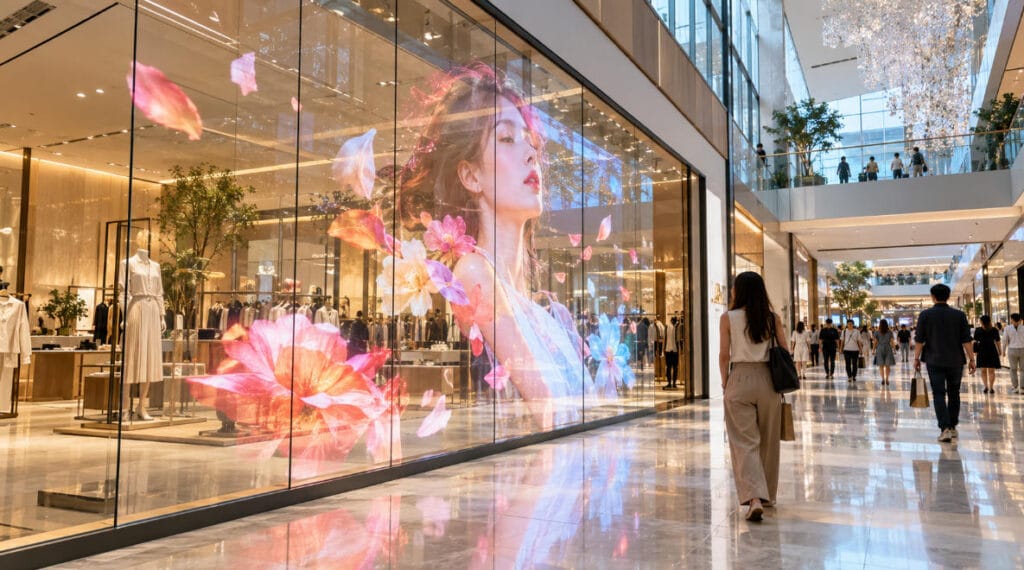
Retail is particularly well suited to transparent LED technology because conventional digital signage creates an obvious limitation: the screen itself can hide the product display or block the visual connection between the store interior and pedestrians outside.
Transparent LED screens address that problem by allowing digital advertising and physical merchandising to occupy the same visual space.
A storefront can therefore display:
- promotional campaigns;
- product launches;
- animated brand content;
- seasonal advertising;
- interactive visual effects;
while customers can still see merchandise and interior design behind the screen.
This is one reason why the future of the transparent LED industry is closely connected with the evolution of the digital storefront.
Rather than treating the LED screen as an independent piece of AV equipment, retailers are increasingly likely to consider it part of the overall architecture, visual merchandising and customer experience.
For projects involving shop windows, shopping malls and branded commercial environments, buyers can therefore evaluate transparent displays together with a broader commercial retail LED display solution rather than selecting a screen purely from its specifications.
A real installation also helps buyers understand how the technology behaves in an actual glass environment. MEITEC’s transparent LED display storefront case demonstrates this type of application and provides a more practical reference than specification sheets alone.
4. Higher Brightness Will Matter—But “More Nits” Will Not Always Mean Better
Brightness will continue to be one of the main purchasing criteria for transparent LED displays because many installations are positioned behind glass and exposed to strong ambient light.
However, the next stage of the market will likely become more sophisticated than simply competing for the highest brightness specification.
For example, a transparent screen installed inside a shopping mall does not face the same lighting conditions as a display facing a sunlit exterior window.
Excessive brightness may increase energy consumption and can produce uncomfortable visual results in darker environments. Insufficient brightness, meanwhile, can cause displayed content to lose contrast against daylight.
Therefore, project design increasingly needs to consider brightness together with:
- ambient illumination;
- viewing direction;
- glass reflection;
- content color;
- operating hours;
- power consumption.
For buyers planning different installation environments, MEITEC’s guide on how to choose LED display brightness provides a useful starting point for evaluating brightness according to real-world conditions rather than using maximum nit values as the only purchasing criterion.
This shift from specification-based selling toward application-based engineering is likely to become increasingly important in the transparent LED market.
5. Finer Pixel Pitch Will Expand Indoor Applications
Historically, many transparent LED installations were designed for long viewing distances, which made larger pixel pitches acceptable.
As transparent displays move into premium retail, museums, corporate spaces, showrooms and exhibitions, viewing distances are becoming shorter.
That creates demand for finer-pitch transparent displays.
But there is an important trade-off.
Reducing pixel pitch increases pixel density and can improve detail, but it can also affect transparency, cost and system complexity.
The future competitive advantage therefore will not simply come from offering the smallest possible pixel pitch.
Manufacturers and integrators will need to help customers determine where additional resolution creates meaningful visual improvement—and where it simply increases project cost.
For customers comparing these factors, this guide to choosing the right LED pixel pitch without overspending explains why viewing distance and application requirements should determine pixel pitch rather than specification competition alone.
6. Modular and Customized Transparent LED Structures Will Become More Important
Architecture rarely follows standard screen dimensions.
Glass walls may be extremely wide, exceptionally tall, curved or divided by structural frames. Retail spaces may also change layouts frequently.
This gives modular transparent LED systems an important advantage.
The next generation of projects will increasingly require suppliers to provide:
- multiple cabinet dimensions;
- lightweight structures;
- curved installation options;
- customized screen ratios;
- modular replacement;
- simplified mounting;
- front or accessible maintenance designs.
MEITEC’s MTI-M platform, for example, includes multiple cabinet configurations and individually replaceable modules, power supplies and IC components, while certain configurations can support curved installations.
This reflects a larger industry transition: transparent LED is gradually becoming an architectural display product rather than merely a rectangular electronic screen.
That transition will also create more opportunities for creative LED display solutions, particularly where architects and designers want digital displays to follow curved surfaces or unconventional structures.
7. Exhibition and Immersive Spaces Will Become Another Major Growth Area
Retail may be one of the most visible transparent LED applications, but exhibitions and experience centers could become equally important.
Traditional LED video walls naturally draw attention to themselves.
Transparent LED displays can behave differently.
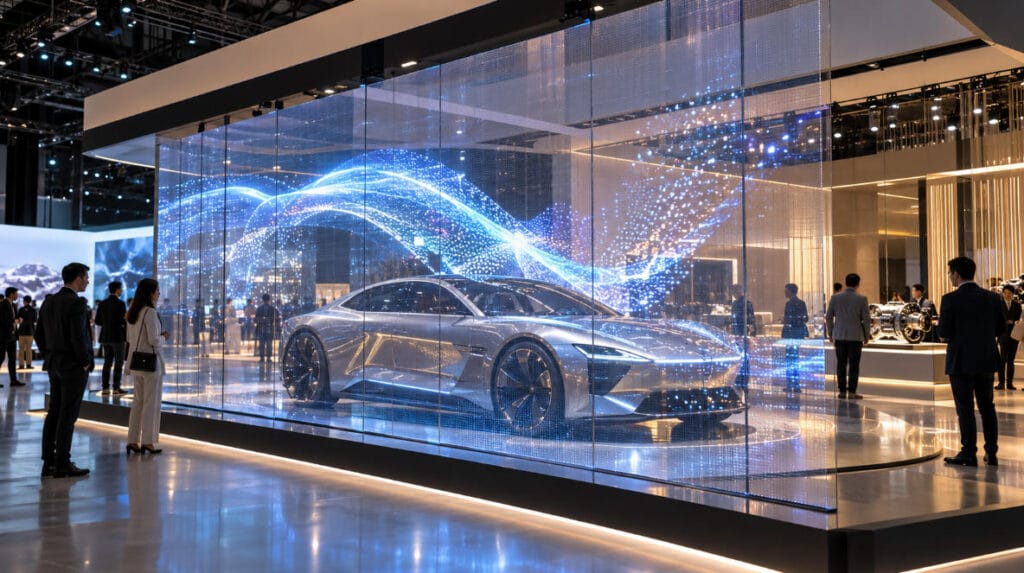
Because the physical background remains visible, designers can combine digital graphics with actual objects, models, products or stage environments.
For example, a transparent screen positioned in front of an automobile can overlay specifications, animations or product information without completely hiding the vehicle.
Museums can combine physical exhibits with digital interpretation.
Corporate showrooms can place digital information directly over machinery or products.
Exhibition booths can create layered visual effects without constructing a solid video wall.
This capability makes transparent LED technology particularly relevant to future exhibition and display solutions.
As brands increasingly compete through experiential marketing rather than static signage alone, the ability to combine real objects with digital content could become one of transparent LED’s strongest differentiators.
8. Energy Efficiency and Lifecycle Cost Will Become Stronger Purchasing Factors
The LED display market is becoming increasingly mature.
As that happens, professional buyers tend to move beyond headline specifications and evaluate total cost of ownership.
For transparent LED projects, this includes:
- average power consumption;
- heat generation;
- installation labor;
- maintenance accessibility;
- spare-part replacement;
- product lifetime;
- downtime;
- content management.
For example, MEITEC lists an average power consumption of approximately 240 W/m² for its current MTI-M transparent LED configurations, compared with a listed maximum power consumption of 800 W/m².
Actual electricity consumption will naturally depend on screen content, brightness settings and operating time, but specifications such as average power consumption will become more relevant as commercial customers calculate long-term operating expenses.
This means future competition will increasingly involve lifecycle efficiency, not only initial purchase price.
9. Transparent LED, OLED and MicroLED Will Develop in Parallel
The transparent display market should not be viewed as a competition where only one technology survives.
Different technologies have different strengths.
Transparent OLED can deliver a very clean glass-like appearance and fine image quality, making it attractive for premium indoor installations.
Transparent MicroLED has significant long-term potential because of its emissive characteristics, modularity and image performance. Samsung’s public demonstration of Transparent MICRO LED shows how seriously leading display manufacturers are investing in this area.
Conventional transparent LED, meanwhile, already offers advantages in areas such as:
- large-format scalability;
- high brightness;
- modular construction;
- customized dimensions;
- commercial installation flexibility.
Rather than eliminating transparent LED, innovation in OLED and MicroLED may expand awareness of transparent display applications and create a larger overall market.
The most important question for buyers will therefore shift from:
“Which transparent display technology is the best?”
to:
“Which technology best matches this particular application?”
10. The Industry Is Moving From Selling Screens to Delivering Complete Solutions
Perhaps the most important trend from 2026 onward will not be a single LED specification.
It will be the transition from product sales to project solutions.
A successful transparent LED installation requires much more than selecting pixel pitch.
A supplier may need to consider:
- glass dimensions and supporting structure;
- viewing distance;
- required transparency;
- ambient brightness;
- installation access;
- content resolution;
- control systems;
- electrical requirements;
- maintenance strategy;
- future module replacement.
As transparent LED technology moves further into architecture, high-end retail and experiential spaces, buyers will increasingly expect manufacturers to understand the complete project rather than simply provide LED cabinets.
This favors suppliers capable of combining product configuration, structural planning, installation guidance and long-term technical support.
Outlook: What Will Define the Next Stage of Transparent LED Displays?
From 2026 to 2030, transparent LED displays are likely to develop in several directions simultaneously.
Pixel pitches will continue to become more suitable for closer viewing. Transparency and image quality will be optimized together rather than independently. Screen structures will become lighter and more adaptable to architectural environments. Retail, exhibition and experience-based applications will continue expanding.
At the same time, improvements in OLED and MicroLED will push the broader transparent display industry forward and encourage customers to think differently about what a “screen” should look like.
For transparent LED manufacturers, the opportunity therefore goes beyond selling another category of LED display.
The larger opportunity is to transform windows, glass façades and open architectural spaces into digital communication surfaces without completely separating viewers from the physical environment behind them.
That is likely to be the defining value proposition of the transparent LED display industry during the next several years.
Data Sources & References
1. BCC Research — Global Transparent Displays Market
BCC Research reported that the global transparent display market was approximately USD 3.6 billion in 2024 and projected it to reach USD 8.7 billion by 2030, representing a 17.5% CAGR during 2025–2030.
BCC Research transparent display market report summary
2. Samsung Electronics — Transparent MICRO LED
Samsung publicly unveiled Transparent MICRO LED at First Look 2024 ahead of CES 2024. Samsung stated that development involved six years of research and development and subsequently demonstrated the technology for commercial-display applications at ISE 2024.
Samsung Global Newsroom — Transparent MICRO LED at CES 2024
3. LG Electronics — LG SIGNATURE OLED T
LG announced U.S. availability of its 77-inch transparent OLED television in December 2024 with a U.S. suggested retail price of USD 59,999.
LG Electronics — LG SIGNATURE OLED T launch announcement
4. MEITEC — MTI-M Series Transparent LED Display
MEITEC product specifications referenced in this article include 40–70% transparency, pixel pitches from 2.6 mm to 10.42 mm, 4500–5000 nits brightness, 3840 Hz refresh rate and listed average power consumption of 240 W/m².