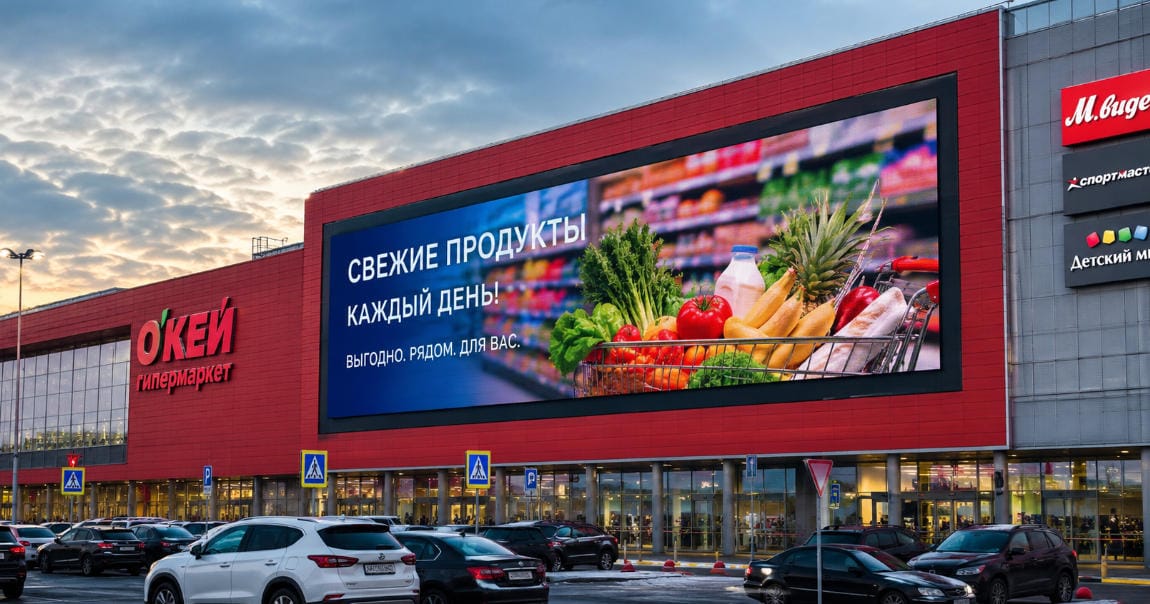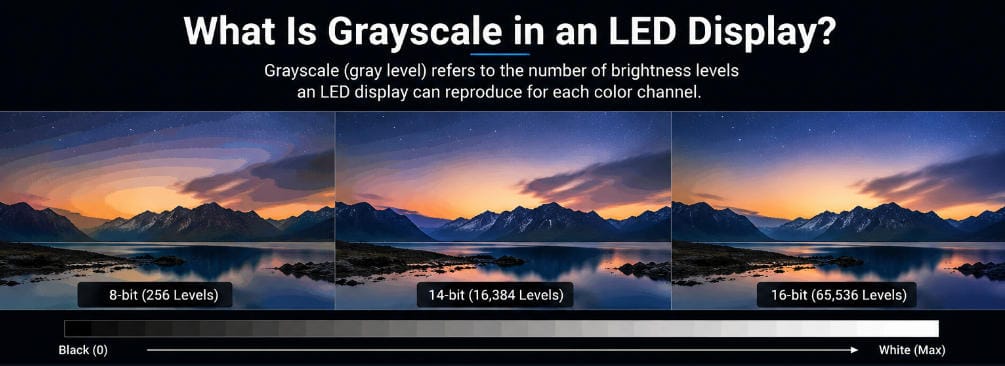
A commercial glass façade creates a valuable opportunity for brands: it provides visibility, natural light, and an open connection between the interior space and people outside.
But it also creates a challenge.
How do you introduce a large digital display without turning that transparent architectural surface into a solid wall?
That was the central requirement behind this transparent LED display project.
The customer wanted a large-format digital display capable of playing promotional videos and branded visual content in a bright commercial environment. At the same time, the installation could not significantly block the view through the glass or make the interior space feel enclosed.
A conventional LED video wall could provide the required visual impact, but its solid cabinet structure would have changed the appearance and function of the glass area.
The solution was a transparent LED display system designed to make the screen part of the architecture rather than an object covering it.
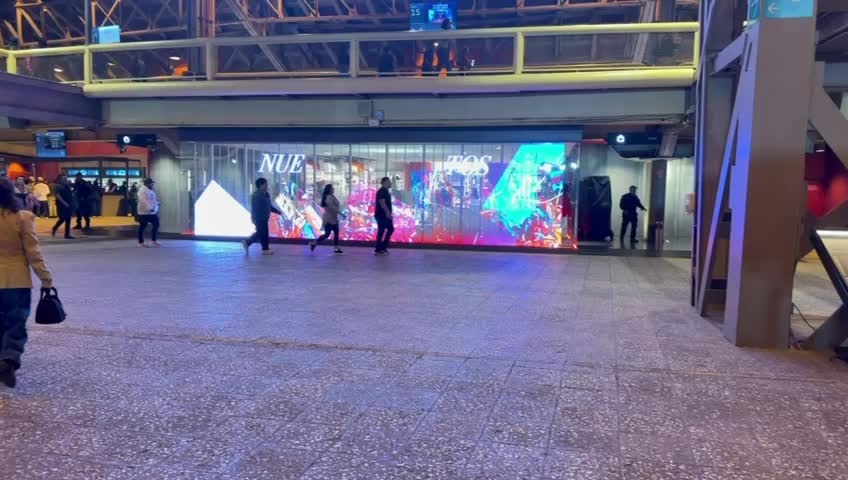
Project Note: The photographs and video shown in this case were captured from the actual completed project. The customer’s identity, exact project location, and installation date are not published because these details are no longer available in our project archive.
Project Overview
Application: Commercial glass façade / retail display
Display Type: Transparent LED display
Product Series: MEITEC MTI-M Series
Installation: Fixed transparent LED installation
Primary Goal: Digital advertising while maintaining transparency and natural light
Project Location: Not disclosed
Project Status: Completed installation
The installed solution is based on MEITEC’s MTI-M Series transparent LED display, a system developed for commercial spaces where brightness, transparency, architectural appearance, and maintainability all need to be considered together.
The Challenge: A Digital Screen Without Losing the Glass
The customer’s requirement was not simply to install a large LED screen.
The glass surface was already an important architectural feature of the space. Covering it with a conventional opaque display would have created several problems.
First, the interior would lose part of its natural light.
Second, visibility through the glass would be reduced.
Third, a traditional LED cabinet installed directly behind the glazing could make the storefront appear visually heavy, particularly when the screen was switched off.
At the same time, relying only on printed graphics, posters, or static signage would limit how frequently the customer could change campaigns and would not provide the same visual impact as moving digital content.
The project therefore required a display that could achieve two apparently conflicting goals:
create a strong digital advertising surface while keeping the architectural transparency of the glass.
That requirement is exactly where transparent LED technology becomes valuable.
Why a Transparent LED Display Made More Sense
Instead of creating a solid visual barrier, the transparent LED structure allows a substantial portion of the glass area to remain visually open.
The MTI-M Series offers transparency levels ranging from approximately 40% to 70%, depending on the selected pixel configuration.
This allows video content, branding, promotional campaigns, and motion graphics to appear across a large area while people can still perceive the space behind the display.
For the end customer, that changes the role of the glass façade.
It is no longer only a window.
It becomes a digital communication surface.
During content playback, the screen attracts attention with large-format moving visuals. When darker content is displayed, or when the display is switched off, the lightweight structure has substantially less visual presence than a conventional solid LED wall.
For commercial environments, this balance between digital impact and architectural openness can be more valuable than simply maximizing resolution.
Solving the Bright Ambient Light Problem
Transparency alone would not have been enough.
A transparent screen installed in a commercial glass environment must also compete with a significant amount of ambient light.
Sunlight, indoor lighting, reflections from glass, and surrounding illuminated signage can all reduce the perceived contrast of digital content.
For this reason, brightness was another important consideration.
The MTI-M Series provides a specified brightness range of 4500–5000 nits, helping promotional content remain visible in high-ambient-light commercial applications.
Instead of using a conventional indoor screen designed for controlled lighting conditions, the transparent LED system provides the additional luminance required for glass-facing installations.
This helps the customer’s content remain visually effective throughout different lighting conditions during normal commercial operation.
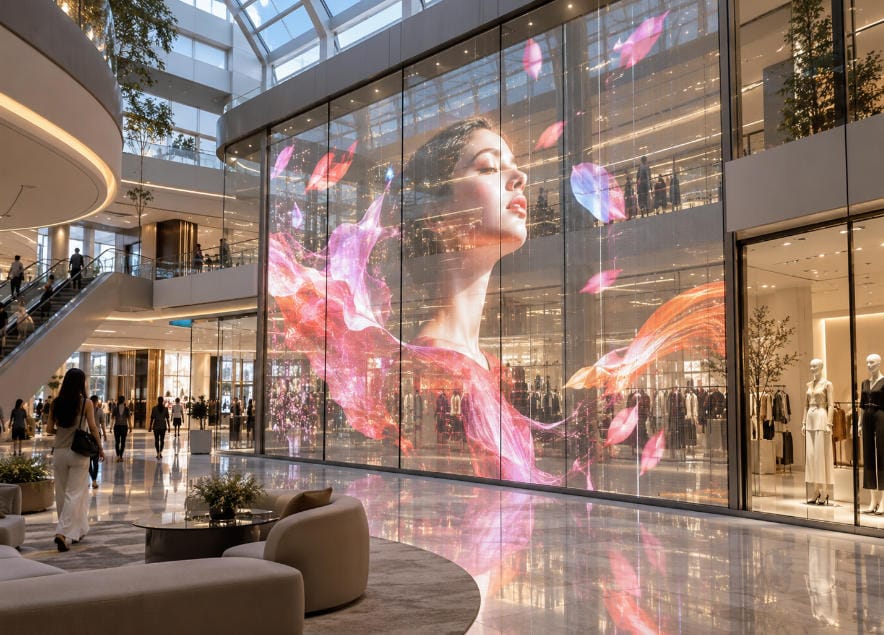
Keeping the Space Open Instead of Building a Digital Wall
One of the most noticeable benefits after installation is not only what the screen displays.
It is what the screen does not completely hide.
Customers and visitors can still perceive the architecture behind the display.
Natural light can continue to enter the space.
The glass still functions visually as glass.
This is particularly important in retail stores, shopping malls, brand showrooms, commercial atriums, automobile showrooms, and other premium environments where interior design is part of the customer experience.
A traditional display can sometimes appear as equipment added to a building.
A transparent LED display has the potential to feel much more integrated with the building itself.
This project demonstrates why transparent screens are increasingly considered as part of broader commercial retail LED display solutions rather than simply as another advertising screen.
A Better Experience for the End Customer
From the customer’s perspective, the completed installation delivered several practical benefits.
More Flexible Advertising
Digital content can be changed without replacing printed graphics or physical signage.
Promotional campaigns, product launches, seasonal messages, brand videos, animations, and event content can all use the same display surface.
This gives the customer significantly greater flexibility in managing the visual communication of the space.
Stronger Visual Impact
Motion naturally attracts attention.
A large transparent LED surface allows the storefront or glass façade to become part of the advertising experience rather than simply acting as a background.
This can help brands communicate with visitors before they enter the space.
Preserved Interior Visibility
Because the screen is transparent, the customer does not have to choose completely between digital media and an open glass design.
Visitors can still see elements of the interior environment behind the content.
Better Use of Existing Architecture
No additional solid advertising wall is required simply to create a digital media surface.
The existing glass area itself becomes the location for communication.
For projects where usable advertising space is limited, this can be particularly valuable.
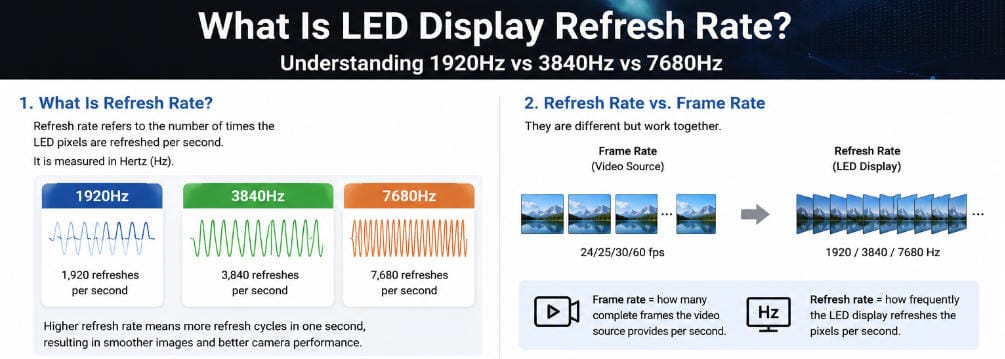
High Refresh Rate for Smooth Content and Camera Use
Modern commercial displays are increasingly recorded on smartphones and cameras.
Customers may film the installation for social media, promotional videos, product launches, events, or corporate content.
Low-refresh-rate LED screens can create visible scan lines or flickering when recorded by cameras.
The MTI-M Series uses a 3840 Hz refresh rate, helping deliver smooth video playback and improving performance in camera-based environments.
This is especially relevant to this project because the completed installation was also captured on video.
The screen therefore needed to look convincing not only to people standing in front of it, but also through a camera.
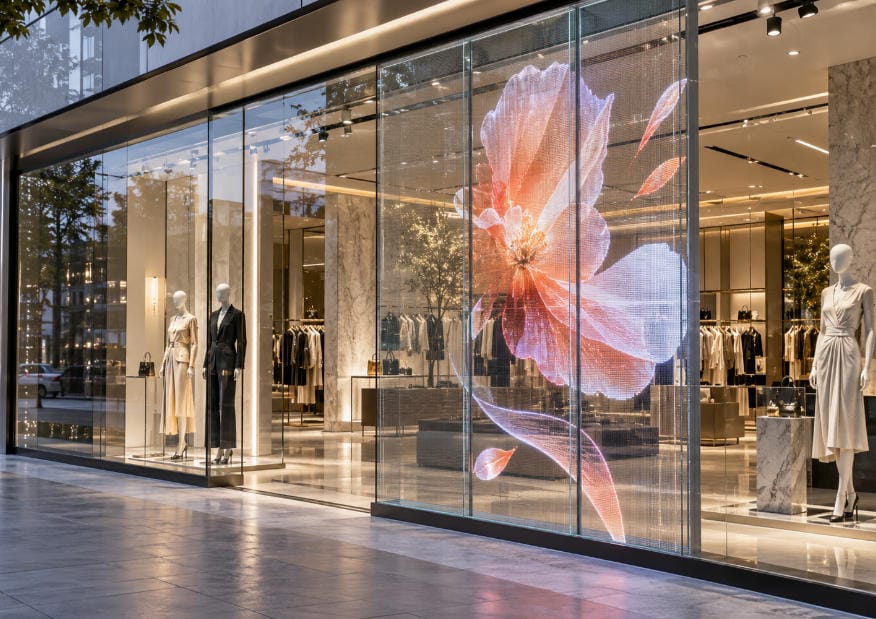
Lightweight Structure Reduced the Visual Burden
A transparent LED project is not only about LED specifications.
The mechanical structure matters just as much.
Large, bulky cabinets would undermine many of the visual advantages of a transparent screen.
The MTI-M Series uses a slim aluminum structure together with a narrow power-box design. This helps reduce the visual mass behind the glass and creates a cleaner finished appearance.
The modular cabinet system also provides different panel dimensions, allowing the display layout to be adapted to the proportions of different architectural surfaces.
For the customer, this meant the LED installation could follow the existing glass area rather than forcing the building to adapt to a single standardized screen format.
Maintenance Was Considered Before Installation
One of the most important questions for a permanent LED installation is often overlooked during the purchasing stage:
What happens when a component eventually needs service?
An LED screen is not a single sealed product. It contains modules, power supplies, control components, cables, and other electronic parts that may require inspection or replacement during its operating life.
The MTI-M Series is designed so that key components including LED modules, power supplies, and IC-related components can be serviced or replaced individually.
This helps avoid treating the entire display as a single non-serviceable structure.
For commercial customers, easier component-level maintenance can reduce unnecessary disruption and simplify long-term operation.
MEITEC also applies inspection, calibration, aging, and functional testing as part of its LED display quality control process before product shipment.
Choosing the Right Balance Between Resolution and Transparency
Transparent LED displays involve an important design trade-off.
A smaller pixel pitch provides greater pixel density and finer visual detail.
A larger or asymmetric pixel configuration can provide greater transparency.
There is therefore no single specification that is automatically correct for every transparent LED project.
The MTI-M Series includes multiple configurations ranging from fine-pitch options to models providing up to approximately 70% transparency.
The correct choice depends on factors such as:
- viewing distance;
- screen dimensions;
- required image detail;
- glass dimensions;
- expected ambient brightness;
- required transparency;
- audience position;
- structural conditions;
- content type.
For example, a screen primarily viewed from a greater distance may prioritize transparency and overall visual impact, while a storefront with closer viewers may require greater pixel density.
This is why MEITEC approaches transparent LED projects as system-design projects rather than recommending one specification for every application.
Customers who want to understand parameters such as cabinets, modules, pixel pitch, calibration, and maintenance can also refer to our LED display knowledge base.
The Final Result: Digital Content Became Part of the Architecture
The completed installation demonstrates the main advantage of transparent LED technology particularly well.
The customer gained a large digital communication surface without completely sacrificing the architectural character of the glass façade.
Instead of installing a conventional display that visually separates the interior from the exterior, the transparent screen allows digital content and physical space to exist together.
The result is a display that can attract attention when content is running while remaining visually lighter within the environment.
For the end customer, the value is therefore not limited to image quality.
The project provides:
- a reusable digital advertising platform;
- dynamic content instead of static signage;
- strong visibility in bright commercial environments;
- preserved transparency through the glass;
- continued access to natural light;
- smooth video playback;
- a lightweight architectural appearance;
- and a serviceable modular structure for long-term use.
That combination is what made a transparent LED solution suitable for this project.
What This Project Shows About Transparent LED Displays
A transparent LED screen should not be selected simply because transparency looks visually impressive.
It becomes valuable when transparency solves a real architectural or commercial problem.
For this project, the customer needed digital media but did not want a conventional LED wall to close off an important glass surface.
That made transparency a functional requirement rather than a decorative feature.
The lesson from the project is straightforward:
when the glass itself is part of the customer experience, the LED display should work with the architecture rather than hide it.
That is where a properly selected transparent LED system can create a meaningful difference.
Planning a Similar Transparent LED Display Project?
Every glass installation is different.
Screen dimensions, viewing distance, structural support, pixel pitch, transparency, ambient lighting, installation access, power distribution, and maintenance space should all be evaluated before the final configuration is selected.
MEITEC provides project-based LED display support from product selection and technical configuration through production, installation guidance, and after-sales service.
If you are planning a transparent LED display for a retail window, showroom, shopping mall, commercial glass façade, atrium, or customized architectural installation, contact the MEITEC LED display team with your screen dimensions, photos, viewing distance, and installation environment.
We can help evaluate the appropriate configuration for your project.