Buying an LED display for the first time can be more complicated than it appears.
At the beginning of a project, buyers often receive several quotations that seem easy to compare. Each supplier provides a pixel pitch, screen size, brightness level, cabinet type, refresh rate, and final price. It may therefore seem logical to select the solution with the best specifications or the lowest quotation.
In reality, successful LED screen procurement involves much more than comparing specification sheets.
An LED display is a complete visual system involving LED modules, cabinets, power supplies, receiving cards, control equipment, mounting structures, power distribution, installation, calibration, content management, spare parts, and long-term technical support.
A mistake in any one of these areas can increase project costs or affect the display’s performance after installation.
For first-time buyers, understanding the most common LED display buying mistakes is therefore one of the best ways to reduce procurement risk.
Based on practical project considerations, this guide explains what buyers should evaluate before placing an LED display order and how a structured procurement process can lead to better long-term results.
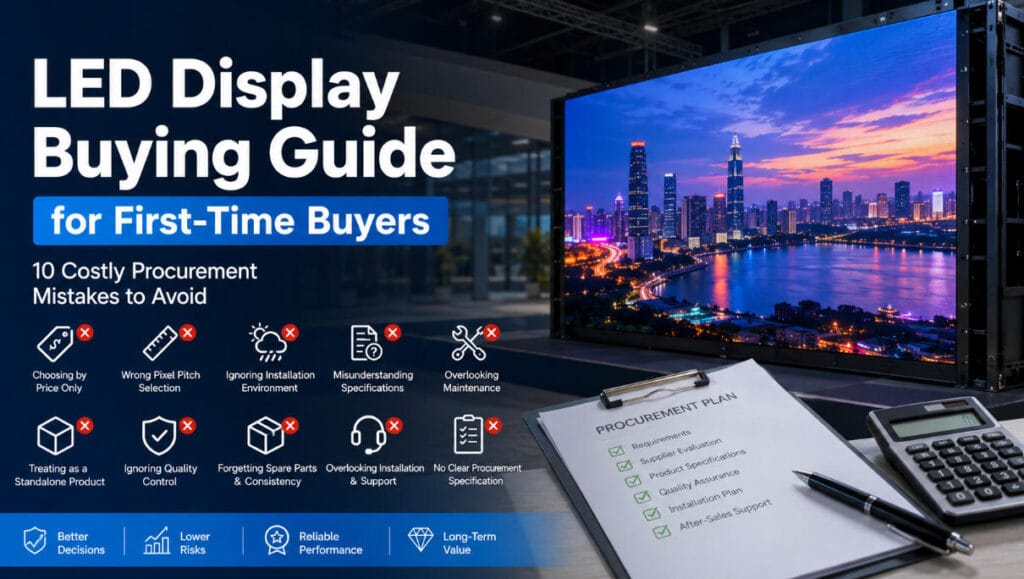
Mistake 1: Choosing an LED Display Based Only on Price
One of the most common LED display buying mistakes is selecting the lowest quotation without understanding what is included.
Two LED displays with the same pixel pitch and screen dimensions may have very different internal configurations.
Differences can include:
- LED chip quality
- Driver IC configuration
- Power supply quality
- PCB design
- Cabinet material
- Refresh rate
- Brightness consistency
- Color calibration
- Control system
- Spare module quantity
- Packaging
- Warranty terms
- Technical support
A lower purchase price may therefore result in higher maintenance expenses, more frequent component replacement, or shorter practical service life.
Instead of asking only:
“How much does the LED screen cost?”
buyers should ask:
“What is the total value of this LED display over its operating life?”
This approach shifts procurement decisions from initial price toward total cost of ownership, including energy consumption, maintenance accessibility, replacement parts, technical support, and expected operating conditions.
Mistake 2: Selecting Pixel Pitch Without Considering Viewing Distance
Pixel pitch is one of the first specifications buyers encounter during LED screen procurement.
It describes the center-to-center distance between adjacent pixels, typically measured in millimeters.
A smaller pixel pitch provides higher pixel density and allows viewers to see detailed images from shorter distances. However, smaller pixel pitch usually increases system cost.
Choosing the smallest available pixel pitch is therefore not automatically the best decision.
For example, a large outdoor advertising screen viewed from tens of meters away does not usually require the same pixel density as an indoor corporate display viewed from several meters.
The correct pixel pitch depends on several factors:
- Minimum viewing distance
- Screen dimensions
- Content resolution
- Application environment
- Audience position
- Budget
- Required visual detail
First-time buyers sometimes overspend on resolution that viewers cannot realistically appreciate.
Conversely, choosing a pitch that is too large for close viewing can make individual pixels visible and reduce image quality.
A professional supplier should evaluate the project environment before recommending pixel pitch rather than simply offering the highest-resolution product.
Mistake 3: Ignoring the Real Installation Environment
Another major procurement error is choosing a display before clearly defining where and how it will operate.
Indoor and outdoor LED displays face very different conditions.
Outdoor installations may need to handle:
- Rain and moisture
- Direct sunlight
- Temperature changes
- Dust
- Wind loads
- High ambient brightness
- Structural requirements
Indoor installations may place greater importance on:
- Fine pixel pitch
- Low-noise operation
- Viewing comfort
- Accurate colors
- Front maintenance
- Architectural integration
The installation location also determines whether front or rear service access is more practical.
For permanent commercial projects, buyers can explore Meitec’s indoor and outdoor Standard LED Displays, which are designed for fixed-install applications such as advertising, commercial spaces, information displays, and public visual communication.
The important principle is simple: choose the display around the environment rather than adapting the environment to an unsuitable display later.
Mistake 4: Comparing Specifications Without Understanding Their Meaning
Specification sheets often contain impressive numbers, but higher figures do not always mean better real-world performance.
Common specifications include:
- Brightness
- Refresh rate
- Grayscale
- Contrast ratio
- Viewing angle
- Power consumption
- IP protection
- Color temperature
First-time buyers may focus on whichever supplier presents the largest values.
However, specifications should always be evaluated in context.
For instance, brightness requirements depend heavily on ambient light conditions. An outdoor screen facing direct sunlight needs significantly different brightness performance from an indoor conference room display.
Refresh rate is also important for applications involving cameras, broadcasting, live events, or professional video production. But purchasing specifications far beyond the actual application requirement can unnecessarily increase costs.
During LED screen procurement, specifications should therefore be linked directly to project requirements.
A good quotation should explain why a specification is required, not merely list numbers.
Mistake 5: Forgetting About Maintenance Access
A display may look perfect immediately after installation, but every professional LED system must eventually be serviced.
Modules, receiving cards, cables, and power supplies are replaceable components.
Buyers should therefore determine how technicians will reach these components before approving the final installation design.
There are generally two common maintenance approaches.
Front-service displays allow key components to be accessed from the viewing side. They are useful when the LED screen is installed directly against a wall or when rear access is limited.
Rear-service displays provide maintenance access behind the screen and may be suitable where sufficient service space is available.
Failing to consider maintenance access during system design can create major problems later.
A technician may discover that replacing a simple module requires removing surrounding structures or dismantling part of the installation.
Maintenance strategy should therefore be discussed during procurement, not after installation.
Mistake 6: Treating the LED Screen as a Standalone Product
An LED display is not simply a collection of cabinets.
It is an integrated system.
A complete project may involve:
- LED cabinets
- Sending and receiving equipment
- Video processor
- Power distribution
- Signal cables
- Mounting structure
- Control computer
- Content source
- Backup components
- Installation accessories
Depending on the project, additional equipment such as fiber transmission systems, redundant signal paths, monitoring systems, or customized structures may also be required.
This is why an effective LED screen procurement process should begin with the complete project rather than the screen alone.
Meitec’s LED display solutions are organized around different commercial applications and project environments, helping buyers consider display configuration together with system design, installation requirements, and application goals.
For first-time buyers, this system-level approach can prevent unexpected costs appearing after the LED panels have already been ordered.
Mistake 7: Failing to Evaluate the Supplier’s Quality-Control Process
A sample cabinet can look excellent while long-term production consistency tells a different story.
For commercial projects, buyers should investigate how the supplier controls quality during production.
Important questions include:
- How are incoming components inspected?
- How are LED modules tested?
- Is aging testing performed before shipment?
- How is brightness and color consistency checked?
- How are finished cabinets inspected?
- How are problems recorded and corrected?
- Are replacement modules prepared from the same production batch?
Consistency is particularly important for larger displays because small differences between modules can become visible across a large video wall.
Supplier evaluation should therefore go beyond photographs, brochures, and quotation sheets.
For significant projects, buyers should request technical documentation, production information, test procedures, project references, and—when practical—factory inspection or video verification.
Mistake 8: Ignoring Spare Parts and Batch Consistency
LED displays are designed for long-term operation, but individual electronic components may eventually require replacement.
First-time buyers often purchase exactly the number of modules required for the screen without planning for future maintenance.
This can create problems years later.
LED components from different manufacturing batches can have slightly different optical characteristics. If a buyer purchases replacement modules much later, obtaining a perfect visual match may be more difficult.
A procurement plan should therefore include an appropriate quantity of spare components from the original production batch.
Depending on the project, spare parts may include:
- LED modules
- Power supplies
- Receiving cards
- Cables
- Hub boards
- Specialized accessories
The appropriate spare ratio varies according to screen size, project importance, operating environment, and maintenance strategy.
Your supplier should help determine a reasonable spare-parts package instead of using a universal percentage for every project.
Mistake 9: Overlooking Installation and Technical Support
Even high-quality LED hardware can perform poorly if installation or configuration is incorrect.
Mechanical alignment, power distribution, signal configuration, grounding, ventilation, calibration, and software setup can all influence final performance.
Before purchasing, buyers should clarify what technical support is included.
Questions worth asking include:
- Are installation drawings provided?
- Is cabinet layout assistance available?
- Will the supplier help configure the control system?
- Is remote technical support available?
- Can engineers support complicated installations?
- What is the troubleshooting process?
- How quickly are technical questions handled?
Meitec’s LED display technical support covers product selection, specification confirmation, installation guidance, control-system considerations, troubleshooting, maintenance planning, and spare-parts coordination.
For international projects especially, clear technical communication can be just as important as the hardware itself.
Mistake 10: Ordering Without a Clear Procurement Specification
Perhaps the most preventable LED display buying mistake is requesting a quotation with insufficient project information.
A message such as:
“Please quote a P2.5 LED screen.”
does not give the supplier enough information to recommend an optimized solution.
Before requesting a final quotation, buyers should prepare a basic procurement brief containing at least:
- Application
- Indoor or outdoor environment
- Screen width and height
- Installation location
- Approximate viewing distance
- Fixed or rental application
- Installation method
- Maintenance access
- Expected operating hours
- Content type
- Required brightness
- Control requirements
- Project deadline
- Destination country
- Installation responsibility
The more accurate the initial project information, the easier it becomes for suppliers to provide technically comparable quotations.
Without a standardized brief, one supplier may quote a basic screen while another includes processors, spare parts, cables, structural accessories, and engineering services.
Their prices will appear dramatically different even though the quotations are not actually equivalent.
A Better LED Screen Procurement Process
For first-time buyers, a structured procurement process reduces uncertainty and makes supplier comparison significantly easier.
A practical sequence is:
1. Define the application.
Determine exactly where the LED display will operate and what it must accomplish.
2. Confirm physical conditions.
Measure installation dimensions, viewing distance, available maintenance space, and environmental conditions.
3. Establish performance requirements.
Define suitable pixel pitch, brightness, refresh rate, protection level, control requirements, and expected operating schedule.
4. Request comparable quotations.
Send the same project brief to shortlisted suppliers.
5. Compare complete configurations.
Review components, accessories, control system, spare parts, warranty, technical service, and packaging—not just screen price.
6. Verify the supplier.
Evaluate manufacturing capabilities, quality-control procedures, technical knowledge, communication, and relevant project experience.
7. Confirm drawings and technical details.
Review cabinet arrangement, power requirements, signal design, structure, maintenance method, and installation plan before production.
8. Define acceptance criteria.
Agree on important technical and visual requirements before shipment.
9. Plan installation and commissioning.
Confirm who is responsible for physical installation, electrical work, configuration, calibration, and final testing.
10. Prepare for long-term operation.
Document spare parts, maintenance procedures, warranty contacts, configuration files, and technical support channels.
Following this process transforms LED purchasing from a simple product transaction into controlled project procurement.
What First-Time Buyers Should Ask an LED Display Supplier
Before placing an order, buyers should be comfortable asking detailed questions.
A professional supplier should be able to explain its recommendations clearly rather than simply sending a price list.
Useful questions include:
Why do you recommend this pixel pitch?
What brightness level is appropriate for my environment?
Which components are included in the quotation?
What control system is included?
How will the screen be maintained?
What spare parts do you recommend?
What testing is completed before shipment?
What technical documentation will I receive?
What happens if a component fails after installation?
Can you provide relevant project references?
The quality of the answers can reveal a great deal about the supplier’s technical capability.
A supplier focused only on closing the sale may avoid detailed project questions.
A solution-oriented partner will usually ask many questions before recommending a configuration.
How Meitec Supports LED Display Procurement
For professional LED projects, the purchasing decision should balance image performance, installation conditions, reliability, maintainability, and long-term cost.
Meitec provides LED display solutions for indoor and outdoor fixed installations, rental projects, fine-pitch applications, COB displays, and customized creative projects.
Rather than treating every inquiry as the same screen purchase, the project process can involve product selection, specification confirmation, solution design, installation guidance, and after-sales technical support.
This approach is particularly valuable for first-time buyers who may understand their application requirements but are unfamiliar with LED display engineering details.
By discussing viewing distance, operating environment, screen dimensions, installation method, content requirements, maintenance strategy, and budget early in the project, buyers and suppliers can identify potential risks before manufacturing begins.
Final Thoughts
Most expensive LED display buying mistakes do not happen because buyers choose the “wrong technology.”
They happen because important project requirements were never defined.
Choosing a screen based only on price, selecting pixel pitch without considering viewing distance, ignoring maintenance requirements, comparing incomplete quotations, overlooking spare parts, or failing to plan technical support can turn an attractive purchase price into a costly long-term project.
Successful LED screen procurement therefore begins with a simple principle:
Buy the solution your application requires—not merely the LED panels listed on a quotation.
For first-time buyers, taking more time during the planning and supplier-evaluation stages can significantly reduce installation problems, unexpected costs, and maintenance difficulties later.
If you are planning an indoor, outdoor, commercial, rental, fine-pitch, or customized LED display project, Meitec can help evaluate your application requirements and develop a suitable system configuration from initial selection through project delivery and technical support.