Autor: Equipo Técnico de Meitec
Revisado por: Especialista en Productos de Pantallas LED
Categoría: Aspectos básicos del producto / Calidad y fiabilidad
Última actualización: Septiembre de 2026
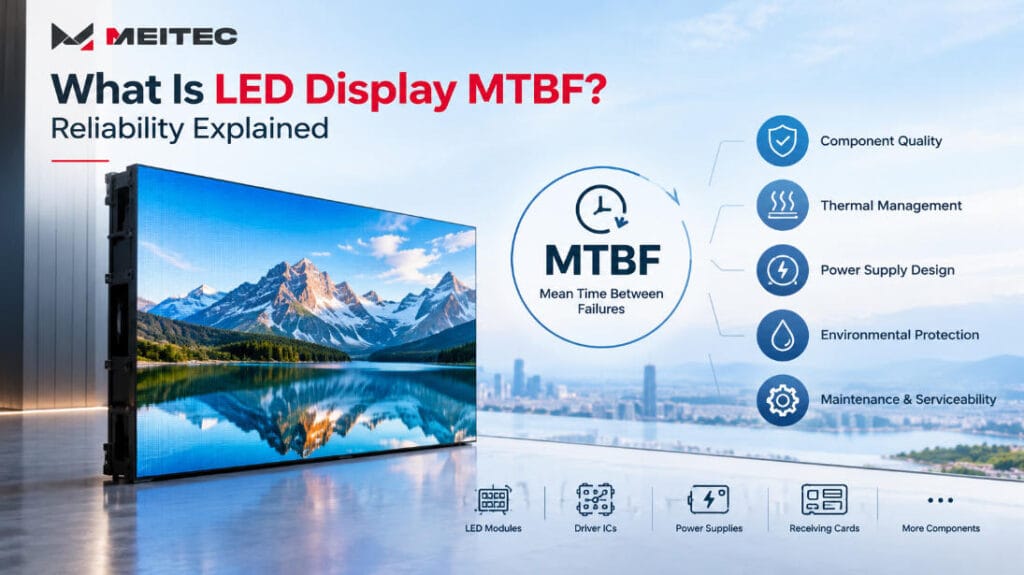
Mean Time Between Failures (MTBF) is a reliability metric used to describe the average operating time between failures of a repairable system. NIST defines MTBF as the average time between one system failure and the next, excluding repair and waiting time. In LED display applications, MTBF helps engineers and buyers evaluate expected failure frequency and maintenance requirements. It is not a guarantee that a display will operate without failure for the stated number of hours.
What Does MTBF Mean for an LED Display?
An LED display is a system rather than a single component. A typical display includes LED modules, driver ICs, power supplies, receiving cards, control electronics, cables, connectors, and mechanical structures. A failure in one of these parts can affect part of the screen or, depending on the component, the operation of the entire display.
For this reason, an LED display MTBF value should always be understood together with its scope. A supplier may provide an MTBF for a component, module, cabinet, or complete display system. These values are not automatically interchangeable.
A simple observed-data formula is:
MTBF = Total operating time ÷ Number of failures
For example, if a defined population of repairable displays accumulates 100,000 operating hours and experiences 10 qualifying failures, the observed MTBF is 10,000 hours. This is an average across the defined population and period, not a promise that every screen will last 10,000 hours without failure. MTBF is also dependent on the statistical model and conditions used to estimate it.
A meaningful MTBF figure therefore needs a defined failure criterion, operating condition, calculation method, and data set.
MTBF vs. LED Display Lifespan
MTBF and lifespan are often confused, but they answer different questions.
MTBF asks: How frequently are failures expected to occur in a repairable system?
Lifespan asks: How long can the display or its components remain usable under specified operating conditions?
These metrics should not be substituted for one another.
Meitec currently publishes a ≥100,000-hour long-lifespan figure on its website for its LED display offering. That figure should not be rewritten as a 100,000-hour MTBF because the two metrics describe different reliability concepts.
LED components can also degrade gradually without causing an immediate system failure. Brightness reduction, color shift, or aging may occur before a complete display failure. Reliability evaluation should therefore consider both failure frequency and long-term performance retention.
MTBF vs. MTTF and MTTR
Three reliability terms are commonly used together:
- MTBF — Mean Time Between Failures: generally used for repairable systems that can be restored and returned to service.
- MTTF — Mean Time To Failure: generally used for non-repairable items, where failure ends the item’s useful operation.
- MTTR — Mean Time To Repair: the average time required to restore a failed system or component.
For an LED display, MTBF and MTTR are useful together. A system may experience an occasional component failure but still maintain high availability if the failed module, power supply, or receiving card can be identified and replaced quickly. MTTF is more commonly associated with non-repairable components.
This is why maintainability matters alongside reliability. Modular construction, fault monitoring, spare parts, and accessible service points can reduce the operational impact of failures.
How Is LED Display MTBF Determined?
1. Field Failure Data
The most direct approach is to collect operating data from a defined population of installed systems:
- Define what counts as a failure.
- Record actual operating hours.
- Track qualifying failures.
- Calculate the average time between failures.
- Continue collecting data to improve confidence in the estimate.
Field data reflects real operating environments, but it can take significant time to accumulate enough failures and operating hours.
2. Reliability Prediction or Testing
Manufacturers may also estimate reliability using component data, stress models, environmental assumptions, or reliability testing. Predictive MTBF values can be useful during product development and procurement, but they depend on assumptions such as component quality, temperature, duty cycle, and environmental conditions.
This means MTBF numbers from different suppliers should not be compared without checking whether the calculation methods and operating conditions are comparable. Reliability prediction is an estimate rather than a precise forecast of when an individual display will fail.
A useful MTBF specification should identify, where applicable:
- Product or system covered
- Operating temperature and environment
- Duty cycle
- Definition of failure
- Test or prediction methodology
- Data population or component assumptions
- Statistical basis or confidence level
What Factors Affect LED Display MTBF?
Component Quality
LED chips, driver ICs, power supplies, receiving cards, PCBs, connectors, and other electronic components all contribute to system reliability. A weak component can become a recurring failure point even when the rest of the display is well designed.
Temperature and Heat Dissipation
Excessive heat can accelerate component aging and increase stress on LEDs, driver ICs, power supplies, and other electronics. Appropriate thermal design and operating conditions therefore support long-term reliability.
Power Supply Design
Power supplies are critical because they provide the operating voltage required by display electronics. Voltage instability, overheating, poor-quality components, or inadequate power margins can contribute to failures. For large or critical installations, redundancy may also be used to reduce the effect of a single power-supply failure.
Environmental Conditions
Indoor and outdoor displays operate under different conditions. Outdoor systems may face rain, humidity, dust, temperature variation, and sunlight. Protection levels, enclosure design, sealing, and thermal management are therefore part of reliability engineering.
Meitec’s MTO Pro Series, for example, uses fully enclosed modules, dust- and waterproof design, temperature and voltage monitoring, and front/rear maintenance access for outdoor applications.
Operating Schedule
A display running several hours per day does not experience the same duty cycle as a display operating continuously. Brightness settings, ambient temperature, power cycling, and operating hours can all affect component stress.
Maintenance and Serviceability
Reliability does not mean failures never occur. A well-designed system should make failures easier to detect, isolate, and repair. Modular construction can allow technicians to replace a failed module, power supply, or receiving card without replacing the entire display.
How Does MTBF Relate to LED Display Design?
A useful reliability evaluation should look beyond the LED package itself. Relevant design and manufacturing factors can include:
- Stable LED and driver components
- Controlled power distribution
- Gestión térmica
- Protección ambiental
- Modular cabinet architecture
- Monitoring functions
- Redundant critical components where required
- Accessible maintenance points
- Factory calibration and aging tests
- Defined quality-control procedures
Meitec states that its quality-control process includes incoming material inspection, standardized manufacturing, calibration, aging tests, functional verification, and final inspection. Its quality documentation also describes tests covering brightness and color uniformity, power consumption, temperature and humidity, IP protection, vibration, and ESD protection.
These processes do not establish a specific MTBF value by themselves, but they are relevant to the broader reliability chain because MTBF depends on the quality and operating behavior of the system being measured.
For a closer look at the manufacturing and testing process, see Meitec’s Control de calidad de pantallas LED de Meitec página.
MTBF in COB, Fine-Pitch, and Outdoor LED Displays
MTBF applies across LED display technologies.
Para COB, reliability considerations include LED packaging, thermal behavior, driver electronics, module construction, and serviceability. Meitec’s COB range includes fine-pitch products for professional indoor applications. Its NOC Pro control-room case also describes 24/7 operation with dual power backup, dual receiving-card redundancy, and front maintenance.
For a closer look at this product family, see Meitec’s Pantallas LED COB.
Para fine-pitch LED displays, high pixel density makes component consistency and serviceability particularly important because small visual defects can be easier to notice at close viewing distances.
Para outdoor LED displays, environmental protection and thermal management become more significant. Buyers should review protection ratings, enclosure design, temperature range, power architecture, and maintenance access alongside any MTBF specification.
La serie de Meitec Pantallas LED para exteriores category provides examples of display systems designed for outdoor operating conditions.
What Should Buyers Ask About an LED Display MTBF?
An MTBF number by itself is incomplete. Before using it in procurement, ask:
- What does the MTBF cover? Is it for the LED package, module, cabinet, power supply, or complete display?
- How was it obtained? Was it calculated from field data, reliability prediction, laboratory testing, or a combination?
- What conditions were assumed? Ask about temperature, humidity, duty cycle, brightness, and operating hours.
- What counts as a failure? A dead pixel, failed module, power-supply fault, and complete screen outage can have very different operational effects.
- Is the value based on actual production or field data?
- What maintenance strategy is assumed? Ask about MTTR, spare parts, service access, and technical support.
For related technical topics, Meitec’s LED Display Knowledge Base covers display components, parameters, installation, maintenance, and troubleshooting.
Can a High MTBF Guarantee an LED Display Will Not Fail?
No. MTBF is an average reliability measure, not a failure-free guarantee. A particular display can fail earlier or later than the stated MTBF because component variation, operating conditions, environmental stress, maintenance, and random failures affect field performance.
This distinction is important when comparing very large MTBF figures. The calculation method and assumptions may be more informative than the number itself.
For control rooms, transportation systems, broadcast environments, or continuously operating commercial displays, reliability should be evaluated as a system-level requirement that also considers redundancy, monitoring, maintenance access, spare parts, and recovery time.
MTBF and Availability: Why Both Matter
Availability describes how much of the required time a system is actually operational. MTBF contributes to availability, but it is only one part of the picture.
A simplified relationship is:
Availability ≈ MTBF ÷ (MTBF + MTTR)
This shows why reducing repair time can be important even when MTBF does not change. If a component fails, rapid fault detection and accessible maintenance can allow the affected module or component to be replaced quickly. The failure still occurred, but the resulting downtime can be limited.
For long-term LED display projects, reliability and maintainability should therefore be considered together.
Conclusión
LED display MTBF, or Mean Time Between Failures, is a reliability metric that describes the average operating time between failures in a repairable system. It is useful for evaluating expected failure frequency and maintenance planning, but it is not the same as lifespan and should not be treated as a guaranteed number of operating hours.
A meaningful MTBF value depends on the product scope, failure definition, operating conditions, calculation method, and quality of the underlying data. Buyers should ask how the number was established before comparing MTBF specifications between suppliers.
For an LED display, reliability is influenced by component quality, power supply design, thermal management, environmental protection, system architecture, monitoring, maintenance access, quality control, and operating conditions.
The most complete evaluation considers MTBF together with MTTR, availability, lifespan, protection level, serviceability, and the supplier’s documented quality-control process.