North America, Europe, Asia Pacific, Middle East and Latin America Compared
The global LED display industry is entering a more differentiated phase in 2026. Rather than expanding uniformly across all markets, demand is increasingly shaped by regional investment cycles, application requirements, technology adoption, infrastructure development and procurement conditions.
The latest market data from Omdia illustrates this divergence clearly. In the first quarter of 2026, global LED video display shipments increased only 0.6% year over year, while market revenue declined 2.3%. The decline was particularly visible in the 1.00–1.99mm pixel-pitch segment, while demand continued to grow in selected applications such as sports venues, cultural events, smart cities, hospitality, higher education and enterprise visualization.
Regional performance was significantly different. Asia & Oceania recorded the strongest shipment growth at 16.9% year over year, while North America maintained stable growth. Western Europe experienced a slight decline, and Middle East & Africa recorded modest declines amid geopolitical and logistics uncertainty.
This suggests that the global LED display market in 2026 should not be viewed as a single growth story. It is better understood as a collection of regional markets moving at different speeds and prioritizing different types of LED solutions.
Global LED Display Market in 2026: From Broad Expansion to Regional Differentiation
The LED display industry has matured considerably over the past decade. Large-format outdoor advertising remains an important application, but the technology is increasingly being adopted in professional indoor environments, corporate visualization, broadcast studios, control rooms, retail, transportation, sports venues and immersive experiences.
One of the most important changes in 2026 is the increasing importance of fine-pitch and ultra-fine-pitch LED.
Omdia reported that fine-pitch LED displays accounted for 55.4% of global LED video display revenue in Q1 2025, with fine-pitch revenue growing 8.1% year over year. The 1.50–1.99mm category also recorded 11.1% year-over-year growth, supported by applications including corporate meeting rooms, all-in-one displays, retail and transportation.
At the same time, the market is becoming more selective. Traditional applications in developed markets are facing slower replacement cycles, while new investment is moving toward applications where LED provides a clear advantage over LCD or conventional display technologies.
This is creating a two-speed global market:
- Mature markets are increasingly focused on replacement, premium upgrades and higher-value applications.
- Emerging markets are seeing stronger greenfield investment in infrastructure, retail, advertising and public-space displays.
- Technology-driven applications such as fine-pitch LED, COB, immersive displays and large-format sports screens are gaining importance across both groups.
For manufacturers, integrators and buyers, regional market analysis is therefore becoming more important than simply looking at global shipment growth.
1. Asia Pacific: The Fastest-Growing Regional Market
Asia Pacific is currently the strongest growth region outside China and one of the most important sources of new LED display demand globally.
According to Omdia, Asia & Oceania recorded 16.9% year-over-year shipment growth in Q1 2026, the strongest performance among the major regions tracked in its latest report. India, Indonesia and Vietnam were specifically identified as important growth drivers, with increasing adoption of fine-pitch LED displays.
The region’s growth is supported by several structural factors.
Infrastructure and Smart-City Investment
Governments and major infrastructure developers across Asia are continuing to invest in transportation systems, public spaces, digital infrastructure and urban development.
LED displays are increasingly being incorporated into:
- Transportation hubs
- Airports and railway stations
- Control rooms
- Public information systems
- Smart-city projects
- Government facilities
- Large commercial developments
Omdia previously identified government-led smart-city and infrastructure programs in India, Indonesia and Singapore as important drivers for fine-pitch LED demand.
Retail and Commercial Digitalization
Asia’s rapidly developing retail sector is another major source of demand.
Shopping malls, flagship stores and commercial complexes increasingly use LED displays for advertising, branding, interactive experiences and architectural integration. This has expanded the market beyond conventional rectangular LED video walls.
Creative formats such as curved displays, transparent LED, shelf displays, flexible LED and immersive screens are becoming more relevant in premium commercial environments.
For buyers evaluating these applications, Meitec’s Creative Display solutions provide an example of how LED technology is moving beyond conventional flat-screen installations.
Fine-Pitch Adoption
Fine-pitch LED is particularly important in Asia Pacific.
In Q1 2025, Asia & Oceania represented 20.2% of global shipments in the 1.50–1.99mm category, according to Omdia, exceeding North America’s share in that segment.
The trend suggests that the region’s growth is not simply volume-driven. Demand is also moving toward higher-resolution products for professional indoor and close-viewing applications.
2026 Outlook
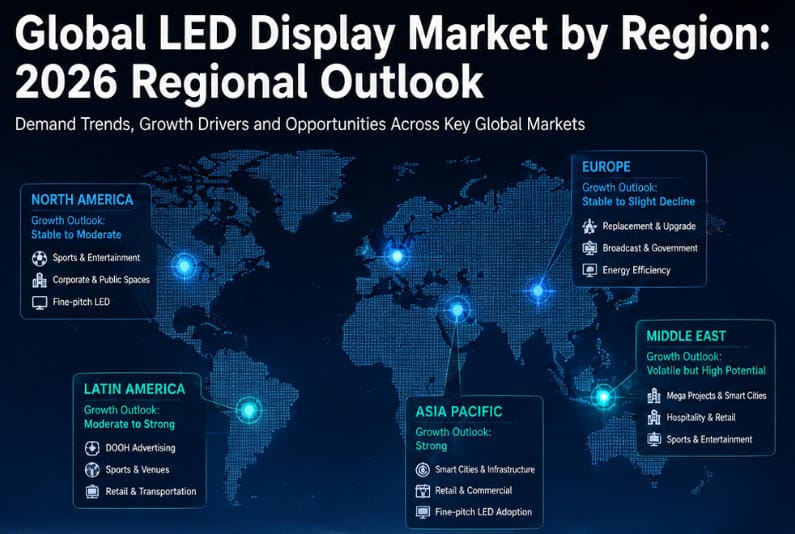
Growth outlook: Strong
Asia Pacific is likely to remain one of the most attractive regions for LED display suppliers through 2026 and beyond, particularly in India, Southeast Asia and selected infrastructure-heavy markets.
The key opportunity is increasingly shifting from conventional outdoor advertising toward a broader combination of fine-pitch, smart infrastructure, retail, transportation and professional visualization.
2. North America: Mature Demand, Higher-Value Applications
North America remains one of the world’s most valuable LED display markets, but its growth pattern is fundamentally different from Asia Pacific.
Omdia reported that North America maintained stable growth in both shipments and revenue in Q1 2026, with average selling prices remaining above the global average. Growth was supported by sports arena upgrades ahead of the 2026 FIFA World Cup and large-format LED deployments in public spaces.
The North American market is therefore characterized less by rapid unit growth and more by high-value projects and premium specifications.
Sports and Entertainment
Sports remains one of the strongest applications.
Stadiums, arenas and entertainment venues increasingly require:
- Large-format perimeter displays
- Scoreboards
- Ribbon displays
- High-refresh-rate screens
- Fan engagement displays
- Premium indoor video walls
The 2026 FIFA World Cup has also contributed to infrastructure and venue-related investment across North America. Omdia specifically identified pre-World Cup sports arena upgrades as a driver of regional LED demand in Q1 2026.
Corporate and Professional Visualization
Another important trend is the increasing adoption of fine-pitch LED for corporate and professional environments.
LED is competing directly with traditional LCD video walls in applications where seamless viewing, large image sizes, high brightness and long operating life are important.
This includes:
- Corporate headquarters
- Boardrooms
- Command centers
- Broadcast studios
- Higher education
- Enterprise visualization
- Control rooms
Omdia has noted continued demand for fine-pitch and sub-1mm technologies in professional applications, particularly as COB and MIP technologies improve image quality and cost performance.
Meitec’s Fine Pitch Display portfolio is positioned within this broader transition toward high-resolution professional LED applications.
Procurement and Supply-Chain Considerations
North American buyers are also paying greater attention to supply-chain resilience, localization and tariff exposure.
Omdia reported in 2025 that North American vendors and manufacturers were adapting their supply chains, including expanding manufacturing capacity outside China, with the United States and Mexico becoming increasingly relevant to production strategies.
This does not eliminate China’s role in LED manufacturing, but it does mean that international suppliers increasingly need to consider:
- Tariff exposure
- Logistics
- Local service
- Spare parts
- Compliance
- Installation support
- Long-term maintenance
2026 Outlook
Growth outlook: Stable to moderate
North America is likely to remain a high-value market rather than the fastest-growing market by shipment volume.
The strongest opportunities are expected in sports, entertainment, professional visualization, corporate applications, fine-pitch LED and large-format public displays.
3. Europe: Replacement and Efficiency Are Becoming More Important
Europe presents a different market environment.
Omdia reported a slight decline in Western European LED video display shipments in Q1 2026. However, LED continues to gain ground in high-end broadcast and government applications, particularly as professional users gradually replace traditional LCD video walls.
The European market is therefore less dependent on rapid new-build volume and more influenced by replacement cycles, energy efficiency, product longevity and compliance requirements.
Professional and Government Applications
LED is increasingly being considered for:
- Government facilities
- Control rooms
- Broadcast environments
- Corporate offices
- Transportation
- Public institutions
- Premium retail
The transition from LCD to LED is particularly relevant when customers require very large seamless display surfaces.
Energy Efficiency and Sustainability
Energy consumption is becoming a more important purchasing consideration in Europe.
For large installations operating for many hours per day, buyers increasingly evaluate total operating cost rather than simply initial equipment price.
This creates demand for LED products that combine:
- Lower power consumption
- High brightness efficiency
- Long operating life
- Thermal stability
- Reduced maintenance
- Reliable components
The importance of environmentally responsible procurement is also increasing, particularly in public-sector and institutional projects.
Market Challenge
The major challenge is that Europe’s mature commercial environment can produce longer investment cycles.
Compared with emerging markets, customers are more likely to evaluate projects based on lifecycle cost, technical documentation, compliance and long-term reliability.
Consequently, suppliers competing in Europe need to provide more than competitive hardware pricing.
2026 Outlook
Growth outlook: Stable to slightly negative in traditional segments, with selective growth in premium applications
The European LED market should not be considered a high-volume growth market in 2026. Instead, opportunities are concentrated in premium indoor LED, broadcast, government, transportation, corporate visualization and energy-efficient replacement projects.
4. Middle East: High Project Potential but Greater Market Volatility
The Middle East remains one of the most strategically important emerging LED display markets.
Saudi Arabia, the United Arab Emirates and Qatar continue to invest in large-scale infrastructure, hospitality, entertainment, retail and smart-city developments.
Omdia previously identified Saudi Arabia’s Vision 2030 and the UAE’s smart-city initiatives as important drivers for LED display adoption, particularly in public spaces and premium commercial environments.
Large-Scale Urban Development
The Middle East is particularly suitable for large-format LED because many projects are developed at a large architectural scale.
Applications include:
- Shopping malls
- Airports
- Hospitality
- Stadiums
- Entertainment districts
- Digital-out-of-home advertising
- Building facades
- Public spaces
- Smart-city infrastructure
High-end retail and hospitality projects in Dubai and Doha have also contributed to demand for fine-pitch LED.
Sports and Mega Events
The region’s investment in international sporting and entertainment events has helped establish LED displays as an important part of venue infrastructure.
Large-format displays are increasingly integrated into stadiums, fan zones, entertainment complexes and commercial developments.
Current Market Risks
However, the 2026 market outlook is more complicated than the underlying project pipeline suggests.
Omdia reported modest declines in both shipments and revenue for Middle East & Africa in Q1 2026. The company attributed part of the uncertainty to conflict-related disruptions beginning in March 2026, alongside higher freight costs and longer lead times.
This means that project potential and short-term market performance are not necessarily moving in the same direction.
2026 Outlook
Growth outlook: High long-term potential, but short-term volatility
The Middle East remains one of the most interesting markets for large-format outdoor LED, hospitality, retail, sports and smart-city applications, but suppliers need to account for logistics, project timing and geopolitical risks.
5. Latin America: A Smaller Base with Significant Growth Potential
Latin America is smaller than Asia Pacific, North America and Europe in absolute LED display demand, but its growth potential is increasingly attracting attention.
Omdia reported positive momentum in Latin America & the Caribbean during 2025, with growth supported by digital-out-of-home advertising, sports venue upgrades, retail and banking applications. The company also highlighted the potential impact of major sporting events on future LED demand.
Digital Out-of-Home Advertising
DOOH is one of the most important growth opportunities.
Large outdoor LED displays are increasingly used for advertising in:
- Shopping districts
- Transportation hubs
- High-traffic roads
- Commercial centers
- Urban public spaces
As advertisers move from static billboards toward dynamic digital content, LED provides a flexible platform for multiple advertisers and real-time campaigns.
Sports and Public Infrastructure
Sports venues are another important demand driver.
Stadium modernization creates demand for:
- Perimeter LED
- Scoreboards
- Large-format video walls
- Fan-zone displays
- Outdoor advertising screens
The broader modernization of retail, banking and transportation infrastructure also creates opportunities for indoor LED and digital signage.
Mexico as a Strategic Market
Mexico is particularly relevant because of its position within North American supply chains and its growing importance in manufacturing and logistics.
For international LED suppliers, Mexico can also function as a bridge between Latin American demand and North American supply-chain strategies.
2026 Outlook
Growth outlook: Moderate to strong from a smaller base
Latin America is unlikely to match Asia Pacific in absolute market size, but its relatively lower penetration creates room for expansion.
The most promising applications are DOOH advertising, sports, retail, transportation and commercial digitalization.
Regional Comparison: Five Markets, Five Different Growth Models
The 2026 LED display market can be summarized as follows:
| Region | 2026 Market Direction | Main Demand Drivers | Key Characteristics |
|---|---|---|---|
| Asia Pacific | Strong growth | Smart cities, infrastructure, retail, transportation, fine-pitch LED | Fastest shipment growth |
| North America | Stable growth | Sports, entertainment, corporate, public spaces, fine-pitch LED | High-value projects and higher ASP |
| Europe | Slight decline / selective growth | Broadcast, government, corporate, transportation, replacement | Mature market with stronger efficiency focus |
| Middle East | Volatile but high potential | Smart cities, hospitality, retail, sports, mega projects | Large projects but geopolitical/logistics risks |
| Latin America | Moderate to strong potential | DOOH, sports, retail, transportation, banking | Smaller installed base with room for expansion |
The most important conclusion is that regional growth does not necessarily mean the same thing.
Asia Pacific is primarily a story of new infrastructure and expanding adoption.
North America is increasingly a story of premium projects and technology upgrades.
Europe is more closely associated with replacement, efficiency and professional applications.
The Middle East is driven by large-scale development but remains sensitive to geopolitical and logistics conditions.
Latin America is a developing market where DOOH, sports and commercial digitalization can support future expansion.
What These Regional Differences Mean for LED Display Technology
The regional divergence is also influencing product specifications.
Fine-Pitch LED Will Continue to Expand
Fine-pitch LED is becoming increasingly important in corporate, broadcast, education, control-room and premium retail applications.
Omdia’s Q1 2026 data showed that the 0.60–0.99mm segment increased shipments by 11.6% year over year, while the 5.00–9.99mm segment increased 16.1%. At the same time, several traditional pixel-pitch categories declined.
This indicates that the market is not simply moving toward smaller pixel pitch everywhere. Instead, buyers are becoming more application-specific.
COB and MIP Are Becoming More Relevant
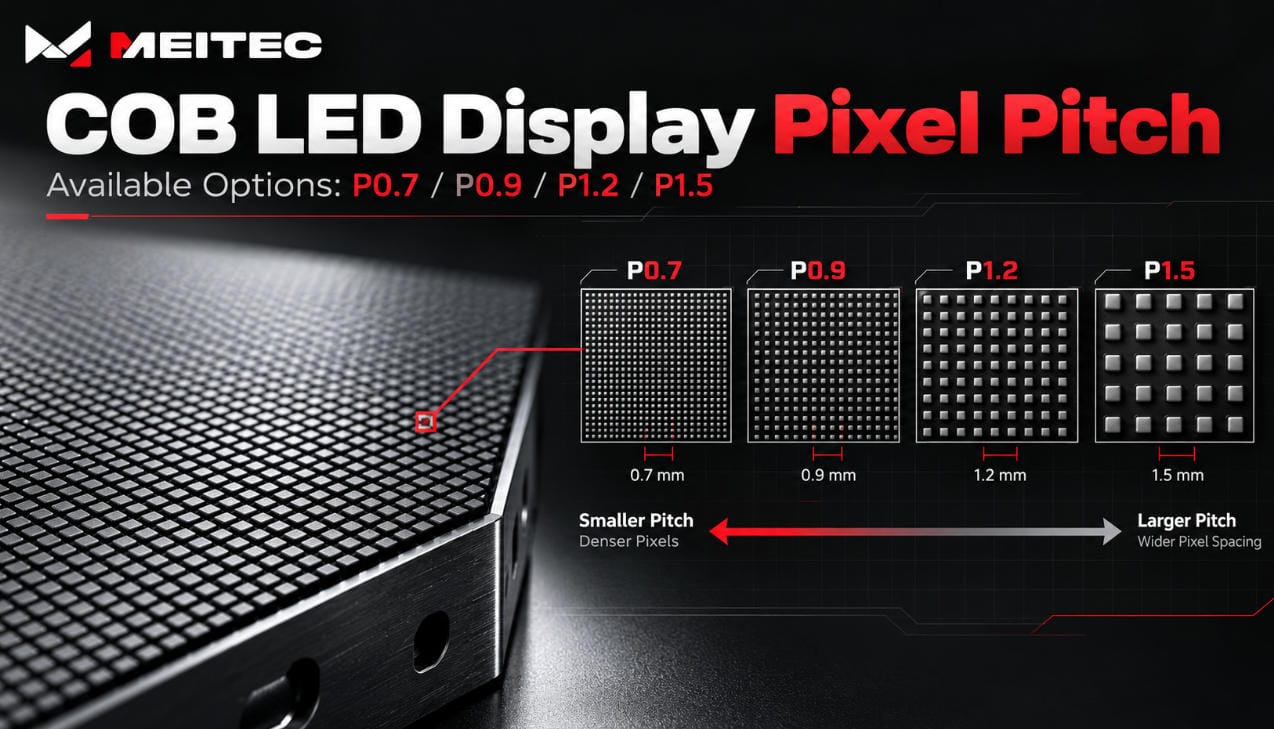
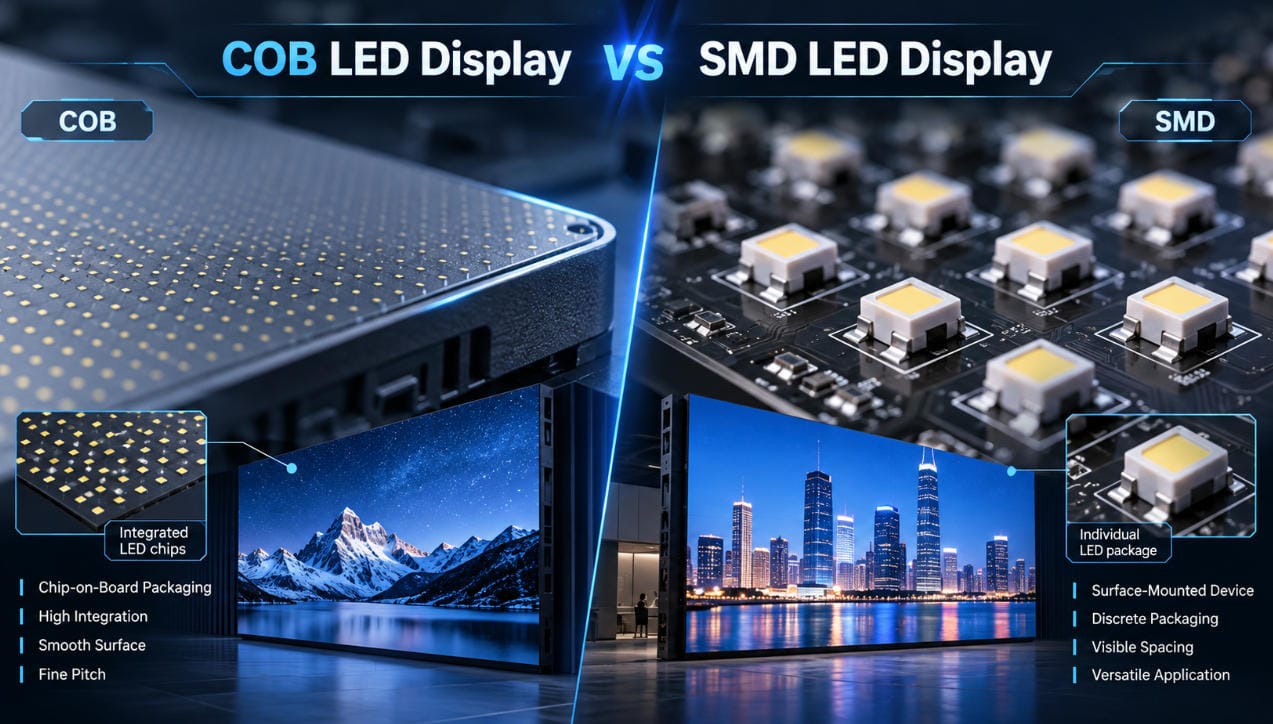
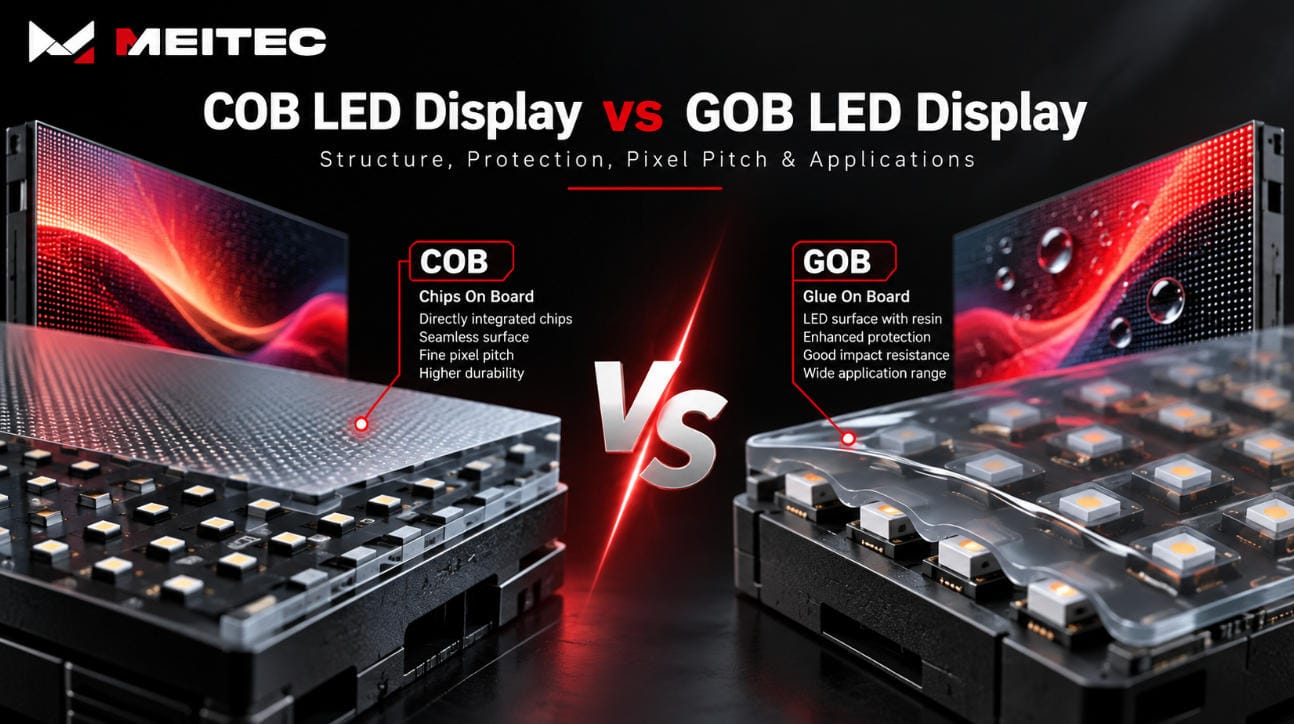
COB and MIP technologies are helping manufacturers develop smaller pixel pitches while improving durability, image quality and cost performance.
Omdia highlighted COB-based solutions in the sub-1mm category as an emerging opportunity in healthcare, hospitality, higher education and enterprise visualization.
Outdoor Displays Remain Important
Despite the rapid growth of fine-pitch indoor LED, outdoor displays remain essential in emerging markets and large public-space projects.
Outdoor applications continue to require:
- High brightness
- Weather resistance
- Stable thermal performance
- High refresh rates
- Long operating life
- Efficient power consumption
- Easy maintenance
This is particularly relevant in the Middle East, Latin America and parts of Asia where outdoor advertising and infrastructure projects remain important sources of demand.
For outdoor projects, suppliers with a broader Outdoor LED Display portfolio can address different brightness, installation and environmental requirements.
2026–2030: What Should the Global LED Display Industry Expect?
The next phase of the LED display market is unlikely to be defined simply by higher shipment volumes.
Instead, the industry is moving toward application-driven growth.
Three major developments are likely to shape the market through 2030.
1. Regional Market Diversification
China remains an important manufacturing and consumption center, but the international market is becoming increasingly diversified.
India, Southeast Asia, the Middle East, Latin America and selected North American markets are becoming increasingly important for global suppliers.
This creates opportunities for manufacturers that can provide flexible supply chains and region-specific solutions.
2. Premiumization of LED Displays
The market is gradually moving toward higher-value products.
Fine-pitch LED, COB, MIP, high-refresh-rate displays, high-brightness outdoor products and creative LED solutions are likely to account for an increasing share of project value.
The focus is shifting from simply selling a display to delivering a solution optimized for viewing distance, brightness, environment, content and lifecycle cost.
3. Application-Specific Product Development
The future market will increasingly be divided by application rather than simply by indoor versus outdoor.
For example:
- Sports venues require large-format, high-refresh LED.
- Corporate environments favor fine-pitch and all-in-one solutions.
- Retail favors creative and flexible formats.
- Transportation requires high reliability and long operating hours.
- Outdoor advertising emphasizes brightness, durability and maintenance.
- Broadcast and control rooms increasingly require fine-pitch and seamless visualization.
- Smart-city projects require networked, reliable and scalable display systems.
This trend will favor suppliers capable of adapting product specifications to project requirements rather than offering a single standardized solution.
Conclusion
The global LED display market in 2026 is entering a more mature but more differentiated stage.
The latest Omdia data shows that global shipment growth is relatively modest, while regional performance varies considerably. Asia & Oceania is currently the strongest growth market, North America remains a high-value market with stable demand, Western Europe is more focused on replacement and premium applications, the Middle East combines significant project potential with short-term uncertainty, and Latin America continues to develop from a smaller installed base.
For LED display manufacturers, distributors and project integrators, the implication is clear: there is no single global LED display strategy that fits every region.
Success increasingly depends on understanding the local demand structure, selecting the appropriate pixel pitch and product architecture, managing logistics and compliance requirements, and matching technology to the specific application.
From 2026 onward, the strongest opportunities are likely to come not simply from selling more LED screens, but from providing more application-specific, efficient, reliable and technically differentiated LED display solutions.
Sources & Market References
- Omdia, Global LED Video Display Market Grows Steadily in 1Q26, June 2026.
- Omdia, Global LED Video Display Shipments Grow 8.3% YoY in 3Q25, Driven by Regional Diversification, December 2025.
- Omdia, LED Video Display Market Grows Steadily in 1Q25, Driven by Micro-LED Adoption and Fine Pixel Pitch Demand, June 2025.
- Omdia, LED Video Displays Country-Level Report, covering Western Europe, North America and Asia & Oceania.
Note: Regional growth figures in this article refer specifically to Omdia’s LED video display market tracking where stated. Where Omdia’s public release does not provide a precise regional percentage for 2026, the article intentionally uses qualitative descriptions rather than presenting unsupported estimates.