The global commercial display industry is entering a new stage of growth. LED displays are no longer used only for stadium scoreboards, roadside advertising, and large entertainment events. They are increasingly becoming part of corporate headquarters, shopping malls, airports, control rooms, exhibition centers, hotels, retail stores, and smart-city infrastructure.
For project owners, distributors, architects, and AV integrators, this shift creates both opportunities and new technical challenges. Buyers are paying greater attention to image quality, installation flexibility, energy consumption, maintenance, content management, and total cost of ownership rather than simply comparing the purchase price of LED modules.
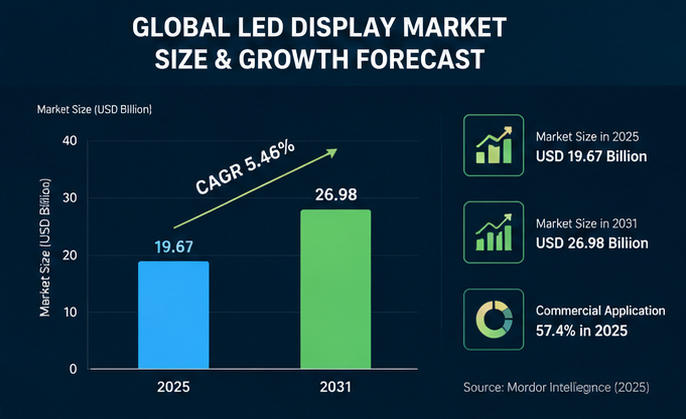
Market research reflects this broader adoption. Mordor Intelligence valued the global LED display market at approximately USD 19.67 billion in 2025 and estimates that it could reach USD 26.98 billion by 2031. Commercial applications represented 57.4% of market revenue in 2025, while Asia-Pacific accounted for 47.6% of global sales.
Meanwhile, Grand View Research estimated the wider video wall market at USD 10.23 billion in 2024 and projects an 11.7% compound annual growth rate from 2025 to 2030. LED technology already represented more than 59% of video wall revenue in 2024.
These figures indicate that LED display demand is being driven not by one single application, but by a global transition toward larger, brighter, more flexible, and more immersive visual communication systems.
1. Fine-Pitch LED Is Expanding Beyond Premium Projects
One of the most important LED display market trends is the rapid adoption of fine-pixel-pitch technology.
Pixel pitch refers to the distance between the centers of adjacent LED pixels. A smaller pixel pitch provides higher pixel density, allowing viewers to stand closer to the display without seeing individual pixels. For this reason, fine-pitch LED displays are particularly suitable for boardrooms, control centers, broadcast studios, luxury retail stores, command centers, showrooms, museums, and corporate lobbies.
Displays with a pixel pitch of 1.5 mm or below are forecast to grow faster than many conventional LED categories. Mordor Intelligence projects an 8.21% CAGR for this segment through 2031.
This trend is also changing the competition between LED and traditional LCD video walls. LCD systems may still be practical for some smaller projects, but visible bezels can interrupt content, especially when dashboards, maps, live video feeds, or branded graphics are displayed across multiple panels.
Direct-view LED provides a seamless canvas with flexible dimensions and aspect ratios. As manufacturing costs continue to decrease, fine-pitch LED is becoming accessible to a broader range of commercial projects.
For applications where close viewing distance, high contrast, durability, and seamless presentation are essential, buyers can explore Meitec’s COB LED display solutions. COB packaging can provide improved surface protection and is increasingly considered for high-end indoor LED video walls.
2. COB and Package-Less Technologies Are Reshaping the Market
Traditional SMD technology remains widely used and accounted for a large majority of LED display revenue in 2025. However, COB, Micro-LED, Mini-LED, MiP, and other package-less or advanced packaging technologies are gaining attention.
Futuresource Consulting reported that average selling prices declined by double digits in 2024, partly because of increasing MiP and COB availability. Although market value growth was limited, total LED display volume measured in square meters increased. Futuresource also expects the package-less LED transition to expand the total addressable market and support double-digit market growth through 2029.
For commercial users, these packaging developments are relevant because they can improve several practical characteristics:
- Pixel protection against impact and dust
- Black-level performance and contrast
- Viewing comfort at short distances
- Product consistency and image uniformity
- Resistance to moisture and environmental contamination
- Long-term reliability in high-traffic spaces
The best technology still depends on the application. SMD remains an effective and economical choice for many rental, outdoor, and standard commercial installations. COB is more attractive for premium indoor projects where the screen may be viewed from a short distance or touched during daily operation.
Rather than selecting a display based only on a technology name, project teams should compare viewing distance, brightness, resolution, installation environment, maintenance method, budget, and operating hours.
3. Commercial LED Displays Are Becoming More Application-Specific
The market is moving away from one-size-fits-all LED screens. Different commercial environments now require highly specialized display configurations.
In retail, LED displays are used for product launches, seasonal campaigns, digital storefronts, immersive brand storytelling, and in-store navigation. In transportation, they support passenger information, advertising, emergency communication, and traffic management. In corporate spaces, they function as presentation walls, digital art installations, visitor information systems, and real-time data dashboards.
Grand View Research identified retail as the largest video wall end-use segment in 2024, while outdoor applications represented the largest application share. The research also highlights increasing use in corporate workplaces, transportation, hospitality, and control rooms.
Fortune Business Insights estimates that the broader commercial display market was valued at USD 57.78 billion in 2025 and may grow to USD 107.79 billion by 2034. The company attributes this growth to digital transformation, digital-out-of-home advertising, interactive experiences, and expanding deployment across retail, education, transportation, healthcare, and hospitality.
As the number of applications increases, suppliers must be able to recommend products based on project conditions rather than simply selling a standard cabinet. Meitec’s LED display solutions cover commercial, outdoor, event, exhibition, retail, and customized visual applications.
4. Creative and Architectural LED Installations Are Growing
Commercial LED projects are increasingly influenced by architecture.
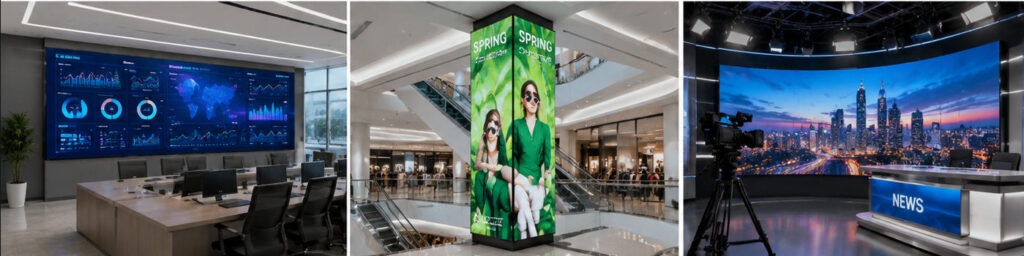
Instead of installing only flat rectangular screens, designers are integrating LED displays into columns, ceilings, shop windows, curved walls, building façades, exhibition booths, and artistic structures. Transparent LED, flexible LED, corner displays, cube displays, and customized geometric screens allow digital content to become part of the physical environment.
This trend is especially visible in flagship retail stores, shopping malls, museums, hospitality projects, brand experience centers, and international exhibitions. In these locations, the LED display is not simply an advertising device. It becomes a visual landmark that helps define the identity of the space.
Creative LED projects require close cooperation among the LED supplier, structural engineer, architect, content producer, and installation team. Cabinet dimensions, curve radius, module shape, ventilation, steel structure, power distribution, content resolution, and service access must be considered during the early design stage.
Project teams planning non-standard installations can review Meitec’s creative LED display solutions and completed LED display project cases for application ideas.
5. Energy Efficiency and Total Cost of Ownership Matter More
Energy consumption is becoming an important purchasing criterion for global commercial projects.
Large LED displays may operate for 12, 18, or even 24 hours per day. For airports, malls, control rooms, transportation hubs, and outdoor advertising networks, electricity costs can become a major part of the total operating budget.
Buyers are therefore evaluating maximum power consumption, average power consumption, heat generation, power-supply efficiency, automatic brightness adjustment, common-cathode technology, standby modes, and intelligent power management.
Lower power consumption provides several benefits beyond electricity savings. It can reduce heat output, decrease air-conditioning demand, improve component stability, and extend the operating life of power supplies and LED modules.
However, energy efficiency should not be evaluated from a single specification. Actual consumption depends on brightness settings, content type, ambient light, pixel pitch, screen size, operating schedule, and power architecture. A realistic calculation should be based on average operating conditions rather than maximum laboratory values.
Commercial buyers should request estimated annual energy consumption and compare it with expected service life, maintenance cost, spare-parts availability, and warranty terms. This creates a more accurate total cost of ownership model.
6. Front Maintenance and Modular Design Are Becoming Standard Requirements
Installation and maintenance costs can significantly influence the long-term value of an LED display system.
In many commercial spaces, there is limited access behind the screen. Retail walls, control rooms, meeting rooms, elevator areas, and building interiors may not have enough depth for technicians to enter from the rear.
Front-service LED displays allow modules, receiving cards, power supplies, and cables to be accessed from the front. This reduces wall depth and makes maintenance easier in space-restricted environments.
Modular cabinet design is equally important. Standardized modules and cabinets simplify replacement, transportation, expansion, and future upgrades. For rental projects, lightweight cabinets, fast locks, corner protection, climbing structures, and integrated cabling can reduce installation time and labor requirements.
Meitec’s rental LED displays are intended for stages, exhibitions, corporate events, and temporary installations where rapid assembly and repeated handling are priorities. For permanent commercial advertising and public-information projects, standard indoor and outdoor LED displays provide fixed-installation options.
7. Outdoor LED Projects Require Greater Environmental Reliability
Outdoor LED display demand remains strong, particularly in advertising, transportation, sports, public infrastructure, and commercial districts. Outdoor systems represented 55.3% of LED display revenue in 2025, according to Mordor Intelligence.
However, outdoor installations face more demanding conditions than indoor displays. They may be exposed to rain, humidity, dust, salt, ultraviolet radiation, extreme temperatures, wind loads, voltage fluctuations, and direct sunlight.
A successful outdoor project requires more than high brightness. Engineers should consider:
- IP protection rating
- Cabinet corrosion resistance
- Heat dissipation
- Waterproof module and cable design
- Wind-load calculations
- Lightning and surge protection
- Automatic brightness control
- Redundant power and data systems
- Safe access for maintenance
- Local structural and electrical regulations
Brightness must also be selected carefully. A display needs sufficient luminance for daytime visibility, but excessive brightness at night can cause visual discomfort and may violate local signage regulations.
For outdoor commercial projects, reliability engineering and site-specific design are often more important than achieving the lowest purchase price.
8. Global Buyers Are Focusing on Supply-Chain Stability
International LED display projects often involve long production schedules, sea freight, customs clearance, local construction, commissioning, and after-sales support. This makes supply-chain reliability a central purchasing concern.
The commercial display supply chain remains highly concentrated in Asia-Pacific, particularly China, South Korea, Japan, and Taiwan. Trade policies, tariffs, logistics costs, semiconductor availability, exchange-rate fluctuations, and regional conflicts can affect lead times and landed costs.
Global buyers are therefore evaluating suppliers based on:
- Component consistency
- Production capacity
- Quality-control procedures
- Aging and calibration processes
- Spare-parts planning
- Technical documentation
- Export experience
- Remote troubleshooting capability
- Warranty response
- Local or multilingual support
For projects that may be expanded in phases, component continuity is especially important. Using different LED batches, driver ICs, power supplies, or calibration standards can create visible color and brightness differences.
A reliable supplier should document the bill of materials, reserve compatible spare modules, and maintain calibration data for future service requirements.
9. Project Success Depends on Specification, Not Only Product Price
As competition increases, LED display prices will continue to become more accessible. However, the cheapest quotation is not necessarily the lowest-cost solution over the life of the project.
Commercial buyers should begin by defining the operational requirements:
- What is the minimum viewing distance?
- Will the screen be installed indoors or outdoors?
- What resolution and aspect ratio are required?
- How many hours will the display operate each day?
- Is front or rear maintenance available?
- What brightness is appropriate for the ambient environment?
- Does the project require live video, data dashboards, advertising, or interactive content?
- Are redundant power supplies or signal systems necessary?
- What installation, structural, and local compliance requirements apply?
- How quickly must spare parts and technical support be available?
These questions help determine the correct pixel pitch, LED packaging type, cabinet structure, brightness, refresh rate, controller, protection level, and service method.
For additional technical information, project buyers can visit the Meitec LED display knowledge base, which covers product selection, installation, maintenance, troubleshooting, and buying guidance.
Conclusion
The global LED display market is evolving from a hardware-focused industry into a complete visual-technology ecosystem.
Fine-pitch LED, COB packaging, energy-efficient design, architectural integration, modular maintenance, and intelligent content systems are creating new opportunities across retail, corporate, transportation, hospitality, entertainment, exhibition, and public-infrastructure projects.
At the same time, buyers are becoming more professional. They are comparing total cost of ownership, supply-chain consistency, installation efficiency, service capability, and application-specific performance.
For manufacturers and integrators, future success will depend on the ability to combine reliable products with technical consultation, customized design, quality control, and long-term project support.
Organizations planning a new indoor, outdoor, rental, fine-pitch, or creative LED installation can contact Meitec to discuss pixel pitch, screen dimensions, installation conditions, budget, and project requirements.
Frequently Asked Questions
What is the main growth driver of the LED display market?
Growth is being driven by digital advertising, retail digitalization, smart-city infrastructure, corporate visualization, transportation systems, entertainment venues, and increasing demand for seamless large-format displays.
Which LED display segment is growing quickly?
Fine-pitch indoor LED displays, particularly products with pixel pitches of 1.5 mm or below, are growing rapidly because they support close-distance viewing in control rooms, boardrooms, broadcast studios, and premium retail environments.
Is COB better than SMD for every project?
No. COB is attractive for fine-pitch indoor applications that require high protection, contrast, and close viewing. SMD remains a proven and cost-effective option for many standard indoor, outdoor, and rental projects.
What should buyers consider before purchasing an LED display?
Important factors include viewing distance, pixel pitch, brightness, refresh rate, installation environment, maintenance access, energy consumption, protection rating, content resolution, component quality, warranty, and technical support.
External Sources
Fortune Business Insights, Commercial Display Market Size and Forecast
https://www.fortunebusinessinsights.com/commercial-display-market-113683
Mordor Intelligence, LED Display Market Size and Share
https://www.mordorintelligence.com/industry-reports/led-display-market
Grand View Research, Video Wall Market Size, Share & Trends
https://www.grandviewresearch.com/industry-analysis/video-wall-market-report-v1
Futuresource Consulting, Global LED Display Market Trends, Growth and Forecast
https://www.futuresource-consulting.com/market-reports/futuresource-led-market-report/