Author: Meitec Technical Team
Reviewed by: LED Display Product Specialist
Category: Product Basics
Last Updated: October 2026
COB (Chip-on-Board) and SMD (Surface-Mount Device) are two packaging technologies used for direct-view LED displays. Both generate images through red, green, and blue LED arrays, but they differ in the packaging, mounting, and protection methods of their LED chips.
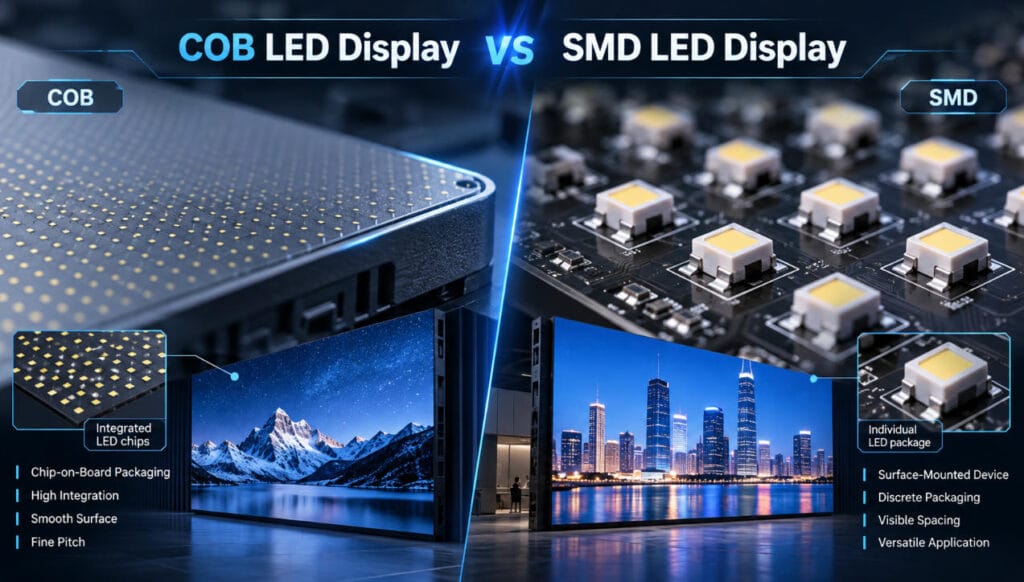
The main difference between COB and SMD LED displays lies in their packaging structure. COB integrates LED chips directly onto the substrate and arranges them in an array form row encapsulation; In contrast, traditional SMD displays use individually packaged LED components that are soldered onto a printed circuit board (PCB).
This structural difference affects pixel density, surface durability, optical performance, manufacturing processes, and maintenance methods. COB (Chip-on-Board) is increasingly widely used in fine-pitch indoor LED video walls, especially in scenarios with close viewing distances and requiring surface protection. SMD remains widely used in indoor and outdoor displays due to its mature manufacturing ecosystem, extensive product supply, and established maintenance processes.
Understanding these differences helps engineers, system integrators, and display buyers evaluate the technologies according to actual project requirements rather than packaging terminology alone.
What Is a COB LED Display?
A COB LED display uses Chip on Board packaging, in which bare LED chips are mounted directly onto a PCB or another suitable substrate and then covered by a protective encapsulation layer.
Unlike conventional SMD construction, the LED chips do not need to be enclosed in separate LED packages before being assembled into the display module.
The COB manufacturing process generally involves:
- Preparing the display substrate and electrical connections.
- Mounting RGB LED chips onto the substrate.
- Establishing electrical connections through wire bonding or flip-chip bonding.
- Applying protective encapsulation over the LED array.
- Testing, calibrating, and assembling the completed display modules.
The resulting display surface is relatively continuous, with the LED chips protected beneath the encapsulation material.
COB technology is particularly relevant to fine-pitch LED displays because it eliminates the need to mount large numbers of separately packaged SMD devices.
However, COB itself does not define the pixel pitch, brightness, refresh rate, or overall image quality. These specifications depend on the particular display design.
Meitec offers COB LED display solutions designed for applications such as control rooms, corporate meeting environments, and professional visualization systems.
What Is an SMD LED Display?
An SMD LED display uses individually packaged surface-mount LED components installed on a PCB.
In conventional full-color SMD displays, the red, green, and blue LED chips are typically integrated into one LED package. The packaged components are then mounted and soldered onto the display module through automated surface-mount assembly.
A simplified manufacturing sequence includes:
- Packaging LED chips into individual SMD devices.
- Applying solder paste to the PCB.
- Positioning packaged LEDs using pick-and-place equipment.
- Soldering the components through a reflow process.
- Testing and calibrating the completed module.
Because the LED packages remain physically distinct, conventional SMD displays have visible spaces between their components when examined at close range.
SMD technology supports many pixel pitches, brightness configurations, and cabinet designs.
It is commonly used for indoor commercial displays, outdoor advertising screens, rental LED walls, and large-format video installations.
For example, Meitec’s MTO Pro Series Outdoor Fixed LED Display includes SMD configurations designed for outdoor advertising and commercial applications.
COB vs SMD LED Display: Technical Comparison
The following table summarizes their main differences.
| Comparison Factor | COB LED Display | SMD LED Display |
|---|---|---|
| Packaging method | Bare LED chips mounted and encapsulated on a substrate | Individually packaged LED devices mounted on PCB |
| Display surface | Continuous protective encapsulation | Separate LED packages with exposed gaps |
| Pixel pitch | Well suited to very fine pitches | Supports fine to large pixel pitches |
| Surface protection | Generally stronger against direct contact | Individual packages are more exposed |
| Contrast | Can benefit from dark encapsulation and low-reflection treatment | Depends on package design, mask, and surface treatment |
| Brightness | Depends on chips, thermal design, and driving conditions | Wide range, including high-brightness outdoor configurations |
| Heat management | Potentially efficient chip-to-substrate thermal path | Depends on LED package and PCB construction |
| Pixel-level repair | Often requires specialized equipment or module replacement | Individual LED replacement is generally more accessible |
| Manufacturing | Requires precise chip bonding and encapsulation | Mature SMT manufacturing processes |
| Initial cost | Often higher in fine-pitch configurations | Often more economical at comparable mainstream pitches |
| Typical applications | Premium indoor video walls and close-view displays | Indoor, outdoor, rental, and commercial displays |
These are general technology characteristics, not guaranteed performance rankings. Actual results must be evaluated using the specifications and test conditions of individual display products.
1. Packaging Structure and Pixel Density
Packaging is the fundamental difference between COB and SMD technology.
COB Packaging
COB mounts unpackaged LED chips directly onto the display substrate.
This reduces the space required for individual LED packages and allows manufacturers to create high-density pixel arrangements.
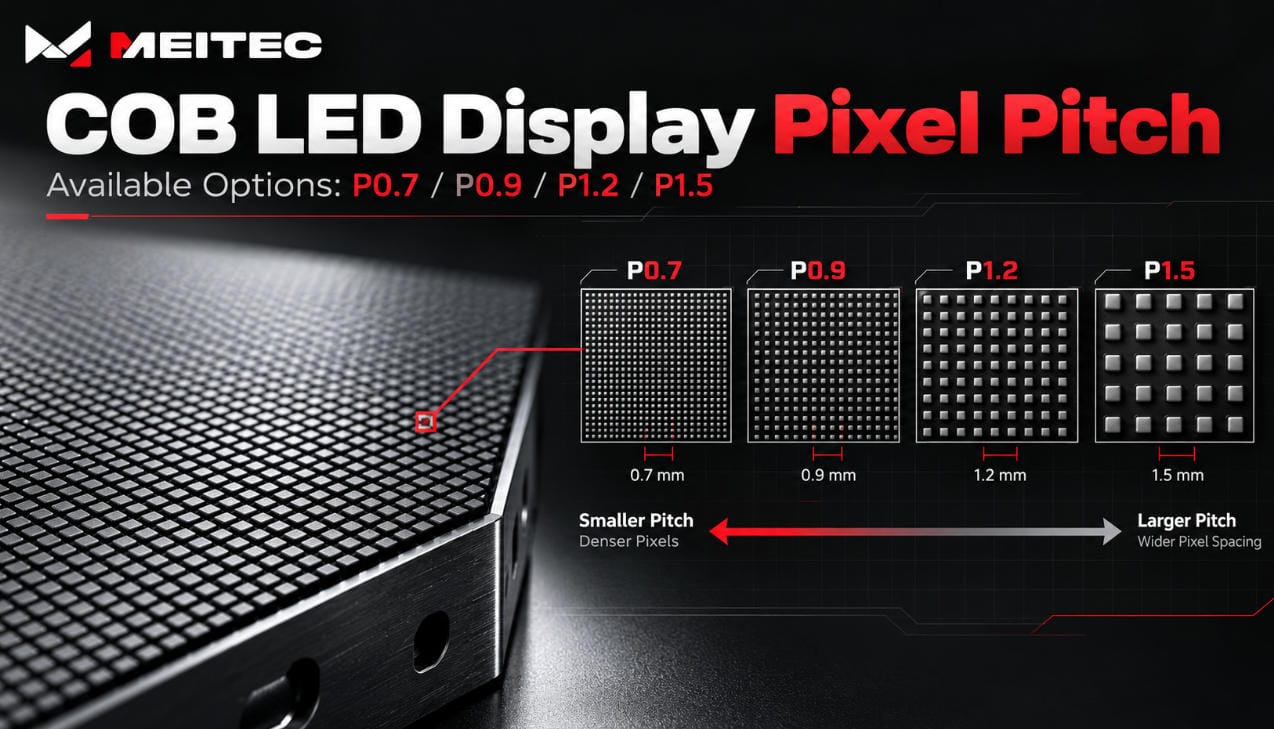
The technology is especially useful when pixel pitch approaches or falls below 1 mm, where component dimensions and mounting accuracy become increasingly important.
However, the minimum achievable pixel pitch also depends on electrical routing, chip dimensions, bonding processes, and manufacturing yield.
SMD Packaging
SMD uses prefabricated LED packages that are attached to the PCB.
The dimensions and mounting requirements of these packages influence how closely pixels can be positioned.
Advances in miniaturized SMD components have enabled increasingly fine pixel pitches, although densely packed SMD assemblies can become more difficult to manufacture and maintain.
Key distinction: COB offers structural advantages for high-density chip integration, but SMD is not inherently unsuitable for fine-pitch displays.
2. Image Quality and Contrast Performance
Neither COB nor SMD automatically produces superior image quality.
The final image depends on several factors, including pixel pitch, LED consistency, calibration, driver ICs, grayscale processing, contrast, and optical surface treatment.
Contrast and Black-Level Performance
COB displays can achieve strong contrast when they use dark encapsulation materials and low-reflection surface treatments.
A darker display surface can reduce the amount of ambient light reflected toward the viewer, improving perceived contrast in illuminated rooms.
SMD displays can also provide high contrast through black LED packages, dark PCB surfaces, and carefully designed optical masks.
Therefore, a COB screen should not automatically be considered higher contrast than every SMD screen.
Contrast ratios should be compared under equivalent measurement conditions.
Color Uniformity
Both technologies require accurate brightness and color calibration.
Variations in LED chips, drive current, temperature, and manufacturing tolerances can produce visible color differences across a display.
COB’s integrated structure does not eliminate these variations.
Similarly, SMD’s individually packaged components do not necessarily cause poor color uniformity.
For a detailed explanation of the correction process, see Meitec’s technical guide to LED display calibration.
Viewing Angle and Surface Reflection
COB displays can provide wide viewing angles, but the actual optical performance depends on the encapsulation material and surface geometry.
SMD viewing angles are influenced by the LED package structure, lens design, and module configuration.
When comparing displays, viewing-angle specifications should be supported by brightness and color measurements taken at different observation positions.
3. Durability and Surface Protection
Surface durability is one of the more significant practical differences between the two technologies.
In a conventional SMD display, the LED packages are mounted individually on the PCB. Although the packages provide some protection for their internal chips, they remain vulnerable to direct mechanical contact.
Accidental impact, scratching, or improper handling may damage individual LEDs or their solder connections.
COB displays protect the chip array beneath an encapsulation layer.
This generally improves resistance to:
- Accidental surface contact
- Minor mechanical impacts
- Dust reaching the chip surfaces
- Damage during routine cleaning
These properties can be valuable in meeting rooms, public-access interiors, and environments where people regularly work close to the screen.
However, COB encapsulation does not automatically make a display waterproof.
Moisture resistance and environmental protection must be assessed using the complete module and cabinet design, including the specified IP rating.
A conventional outdoor SMD display with a suitable waterproof cabinet may be more appropriate for outdoor use than an indoor COB display without equivalent environmental protection.
4. Heat Dissipation and Power Consumption
LED displays convert part of their electrical input into light and the remainder into heat. Excessive operating temperature can affect brightness stability, color consistency, and component reliability.
COB packaging can provide an efficient thermal path because LED chips are bonded directly to a substrate. This reduces some of the thermal interfaces associated with individually packaged LED devices.
However, actual heat dissipation also depends on:
- Substrate thermal conductivity
- Chip bonding materials
- Encapsulation properties
- PCB structure and cabinet design
- LED driving current
- Ambient temperature and ventilation
The absence of separate LED packages does not guarantee lower operating temperatures.
Is COB More Energy Efficient Than SMD?
Not necessarily.
Power consumption depends on LED luminous efficiency, power supply efficiency, driver IC architecture, brightness settings, and display content.
A well-engineered SMD display can consume less power than a poorly optimized COB display at the same measured brightness.
For accurate comparison, manufacturers should provide average and maximum power consumption under clearly defined conditions.
Values expressed in watts per square meter (W/m²) are useful, but only when the compared displays operate at equivalent brightness levels and similar content conditions.
5. Reliability and Dead Pixel Performance
Long-term reliability is especially important for displays operating continuously in control rooms, transportation facilities, and commercial environments.
COB and SMD have different potential failure mechanisms.
COB Reliability
The encapsulated surface reduces exposure of the LED chips to external mechanical damage.
However, COB displays can still experience failures associated with chip bonding, internal electrical connections, driver circuits, substrate defects, or encapsulation degradation.
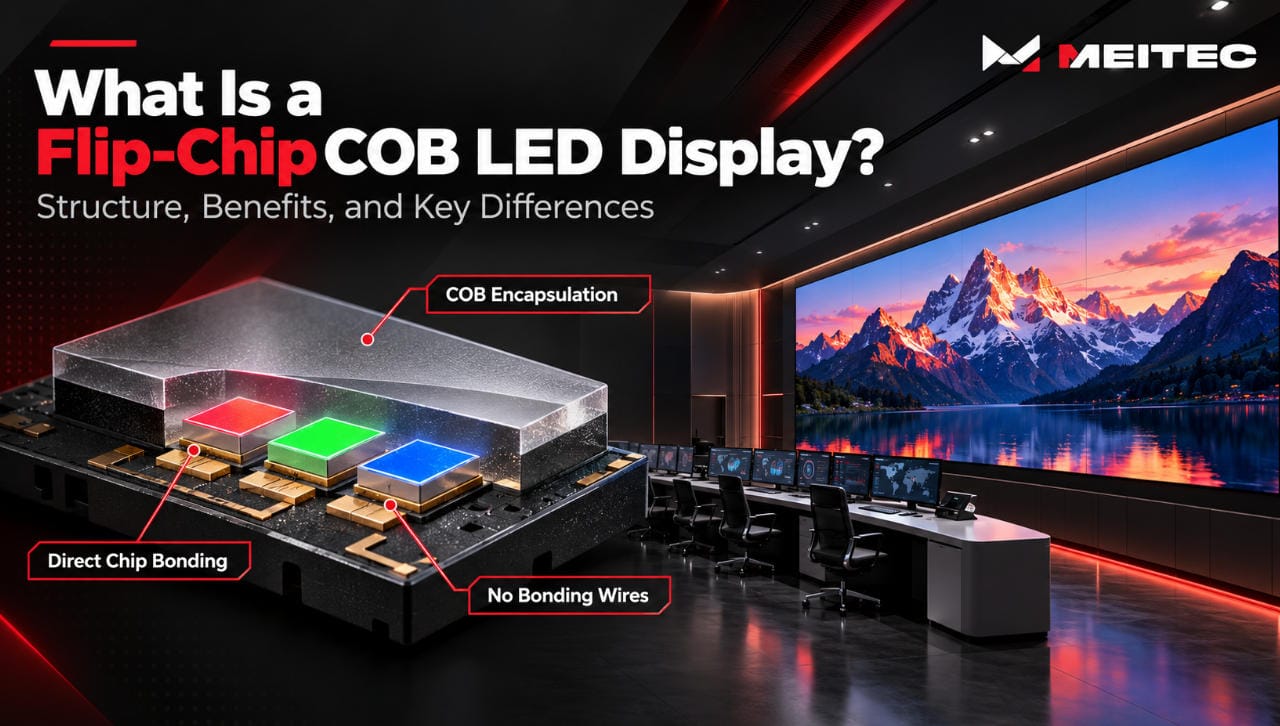
In flip-chip COB designs, electrical connections can be formed without conventional wire bonds. This changes the interconnection structure but does not eliminate all possible failure mechanisms.
SMD Reliability
SMD technology has a long manufacturing history and well-established quality control processes.
Potential failures include damaged LED packages, solder-joint defects, moisture-related problems, and mechanical damage during handling.
For both technologies, reliability depends heavily on manufacturing quality and operating conditions.
A meaningful comparison should consider dead pixel rates, temperature cycling, humidity testing, repair history, and manufacturing yield rather than relying on generalized claims about service life.
6. Maintenance and Repair Differences
COB and SMD displays require different repair strategies.
SMD Maintenance
Individual SMD LED packages can often be removed and replaced using appropriate rework equipment.
This makes component-level repair relatively accessible for trained technicians.
However, replacing LEDs on very fine-pitch SMD modules requires specialized tools and precise handling. Subsequent calibration may also be necessary.
COB Maintenance
Because LED chips are encapsulated together, individual chip repair is more complex.
Depending on the product design, a damaged COB module may require specialist factory-level repair or replacement.
Module replacement is often the practical on-site solution.
For both technologies, front-service cabinet designs can simplify maintenance access.
The important distinction is between module-level serviceability and chip-level repairability.
A COB display may support convenient front module replacement while still requiring more specialized procedures for repairing individual pixels.
7. Cost and Total Cost of Ownership
SMD displays often have a lower initial purchase cost because conventional surface-mount manufacturing is highly developed and widely available.
COB production requires precise chip placement, bonding, and encapsulation processes. Manufacturing yield and process control can significantly influence production costs.
The price difference varies with pixel pitch, product design, production volume, and market conditions.
For long-term projects, acquisition cost is only one part of the calculation.
Total cost of ownership should include:
| Cost Factor | What to Evaluate |
|---|---|
| Initial investment | Display modules, cabinets, control equipment |
| Installation | Mounting structure, labor, electrical infrastructure |
| Electricity | Measured operating power and daily usage |
| Maintenance | Labor, spare modules, specialist repair |
| Downtime | Operational impact of display failures |
| Replacement | Availability of compatible spare parts |
COB’s additional surface protection may reduce damage-related maintenance in some environments. SMD’s established component-repair methods may reduce service costs in others.
Neither technology guarantees a lower lifetime cost without project-specific data.
8. Which Applications Are Better Suited to COB or SMD?
The choice should begin with viewing distance, pixel pitch, environmental conditions, operating hours, and maintenance expectations.
When COB Is a Suitable Choice
COB is particularly relevant to:
Control Rooms: Fine pixel pitch, protected surfaces, and detailed image reproduction can support continuous monitoring applications.
Corporate Meeting Rooms: Close viewing distances and low-reflection surfaces can improve the usability of detailed presentations.
Broadcast and Professional Visualization: Fine-pitch COB solutions can support high-resolution imagery, subject to suitable refresh, processing, and camera compatibility.
Premium Indoor Installations: COB can be useful where surface protection and visual consistency are important design requirements.
As an example, Meitec’s NOC Pro Series COB Micro LED Display offers fine-pitch configurations for professional indoor visualization environments.
When SMD Is a Suitable Choice
SMD is commonly used for:
Outdoor Advertising: High-brightness configurations, weather-resistant cabinet designs, and established production processes support outdoor installations.
Rental and Event Displays: Mature packaging technology and established service procedures are useful for frequently assembled and transported systems.
Commercial Digital Signage: SMD offers a broad selection of pixel pitches for shopping centers, retail displays, and public information systems.
Large-Format Displays: For applications viewed from longer distances, SMD can provide practical resolution and cost advantages.
These are typical application patterns, not exclusive limitations. Both technologies can serve professional installations when the product specifications meet the requirements.
9. How to Choose Between COB and SMD LED Displays
A practical selection process should answer several questions before comparing manufacturers.
First, determine the required pixel pitch.
Pixel pitch should be based on viewing distance, display dimensions, target resolution, and content requirements.
A smaller pitch provides higher pixel density, but it does not automatically produce a meaningful improvement for viewers positioned far from the screen.
Second, evaluate the operating environment.
Consider ambient light, humidity, dust, exposure to physical contact, and required protection ratings.
Third, compare measured optical performance.
Request specifications for brightness, contrast, color uniformity, grayscale, and viewing angles.
Where possible, compare physical samples under equivalent settings.
Fourth, assess maintenance requirements.
Determine whether modules can be replaced from the front, what spare parts are available, and whether pixel-level repair requires factory service.
Finally, consider long-term operation.
Operating hours, expected power consumption, component redundancy, and supplier support may be more important than the packaging technology alone.
Meitec’s documented COB control room application illustrates how fine pixel pitch, image performance, redundancy, and maintenance access can influence the selection of a professional LED video wall.
Conclusion
COB and SMD are two mature technologies for LED display encapsulation, each with distinct structural characteristics and practical advantages. COB integrates LED chips directly onto the display panel and protects them through encapsulation. This makes it particularly important in fine-pitch indoor displays, as surface protection, close viewing distances, and high pixel density are crucial in these applications.
SMD uses individually packaged LED components and benefits from mature manufacturing processes, flexible product configurations, and established repair procedures. It remains widely used for indoor, outdoor, commercial, and rental LED displays.
The most reliable approach is to evaluate the entire display system, rather than assessing packaging technology in isolation. For engineers and system integrators, factors such as pixel pitch, optical performance, ecological protection, maintainability, and long-term operational requirements should determine whether COB or SMD technology is more suitable.