COB and GOB are two technologies commonly used to improve the reliability and visual performance of modern LED displays, particularly indoor fine-pitch screens.
Because both technologies can create a protected display surface, they are sometimes described as if they were competing versions of the same packaging method. This is not technically accurate.
The main difference is more fundamental:
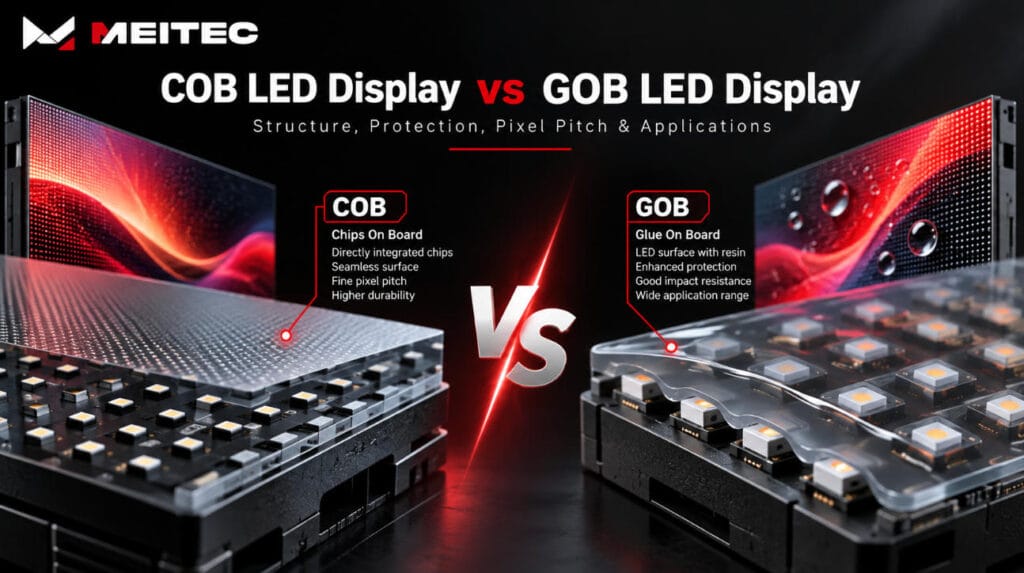
COB changes how the LED chips are packaged and mounted onto the display substrate, while GOB normally adds a protective encapsulation layer over an already assembled LED module.
This structural difference affects pixel density, surface protection, manufacturing complexity, repair methods, optical performance and project cost.
Neither technology is automatically the right choice for every application. COB is particularly strong in ultra-fine-pitch and premium professional displays, while GOB can be a practical way to improve the durability of conventional SMD-based LED modules.
This guide explains the differences between COB and GOB LED displays from a product-engineering perspective.
What Is a COB LED Display?
COB stands for Chip on Board.
In a COB LED display, the LED chips are mounted directly onto the PCB or substrate rather than first being packaged as individual conventional SMD LED components.
After the chips are bonded and electrically connected, the display surface is encapsulated with protective material.
The result is a highly integrated LED module in which the light-emitting chips, substrate and protective layer form a relatively compact structure.
This packaging architecture is especially useful for fine-pitch LED displays because it can support very high pixel densities while reducing dependence on individual packaged LED lamps.
Modern COB products may use different chip structures, including wire-bonded designs and flip-chip designs.
For example, Meitec’s NOC Pro Series COB Micro LED Display uses Full Flip-Chip COB technology and is available in P0.7, P0.9 and P1.2 configurations for professional indoor applications. Meitec specifies the series for control rooms, data visualization, broadcasting studios and corporate meeting rooms.
What Is a GOB LED Display?
GOB usually stands for Glue on Board.
Unlike COB, GOB is generally not a completely different LED chip-packaging architecture.
A typical GOB display begins with a conventional LED module, often using SMD LED packages soldered onto a PCB. A transparent or semi-transparent protective resin is then applied over the LED surface.
The resin fills the spaces around the LEDs and forms a protective layer across the front of the module.
The objective is primarily to improve physical and environmental protection.
A standard SMD LED module may have exposed LED packages that can be damaged by impact, handling, static electricity, moisture or repeated installation. GOB encapsulation helps reduce these risks.
For this reason, GOB is often used in applications where conventional SMD technology provides acceptable image quality but additional surface protection is desirable.
COB vs GOB: The Fundamental Structural Difference
The easiest way to understand COB and GOB is to look at where the protection process occurs.
With GOB:
Packaged LED → SMT assembly → PCB → protective resin
With COB:
Bare LED chip → direct chip bonding → PCB/substrate → encapsulation
This means GOB normally protects an existing packaged LED structure, while COB integrates the LED chips directly at board level.
That distinction affects almost every other difference between the two technologies.
| Comparison | COB LED Display | GOB LED Display |
|---|---|---|
| Basic structure | LED chips mounted directly on PCB/substrate | Usually packaged SMD LEDs mounted on PCB |
| Encapsulation | Part of the COB packaging process | Protective resin added after module assembly |
| Pixel density | Particularly suitable for very fine pitches | Usually limited by underlying SMD package size |
| Surface protection | High | High |
| Impact resistance | Generally strong | Significantly improved over standard SMD |
| Moisture/dust resistance | Good module-surface protection | Good module-surface protection |
| Surface appearance | Smooth and highly integrated | Smoother than normal SMD |
| Fine-pitch capability | Strong advantage | Depends on SMD package and manufacturing process |
| Manufacturing complexity | Higher | Lower than full COB production |
| Repair method | Often module/factory-level | May require removing resin or replacing module |
| Typical positioning | Premium fine-pitch displays | Protected SMD-based displays |
These are general technology characteristics rather than universal specifications. Actual performance depends on the LED chips, encapsulation material, PCB design, driver system, manufacturing quality and calibration.
1. Pixel Pitch and Pixel Density
Pixel pitch is one of the most important differences between COB and GOB.
Traditional SMD technology requires each packaged LED component to occupy physical space on the PCB. As the pixel pitch becomes smaller, placing and soldering these components becomes increasingly demanding.
GOB does not fundamentally remove this limitation because the underlying LED packages are normally still SMD components.
The resin protects the LEDs, but it does not substantially change the physical dimensions of those packages.
COB removes the conventional packaged LED body from the module structure. Individual LED chips can therefore be arranged more densely.
This is one reason COB has become increasingly important in sub-1.5 mm and sub-1.0 mm displays.
However, a smaller pixel pitch should not automatically be considered better.
The correct pitch depends on viewing distance, screen size and target resolution. As discussed in Meitec’s guide to choosing LED display pixel pitch, purchasing more pixel density than viewers can actually perceive may increase project cost without providing meaningful visual benefit.
2. Surface Protection
Both technologies can provide much better surface protection than an unprotected conventional SMD module.
This is one reason COB and GOB are sometimes confused.
On a normal SMD LED module, the individual LED packages protrude from the PCB. These components can be vulnerable to:
- Accidental impact
- Repeated touching
- Transport damage
- Static electricity
- Dust
- Moisture
- Cleaning or maintenance damage
GOB covers these LEDs with a resin layer, making the surface more resistant to physical contact.
COB also uses encapsulation, but the chips are already integrated directly onto the substrate before the encapsulating layer is applied.
For environments where the display may be touched frequently, installed at low height or exposed to repeated handling, both approaches can significantly improve durability.
The quality of the encapsulation material is important. Poor resin formulation or improper curing can affect transparency, color consistency, aging behavior or surface flatness.
Therefore, “GOB” or “COB” alone does not define the protection quality of a finished display.
3. Image Contrast and Black-Level Performance
COB displays are often associated with higher contrast, particularly in fine-pitch professional applications.
One reason is the reduced amount of reflective material visible between individual pixels.
A properly designed dark encapsulation surface can absorb more ambient light and make the inactive screen appear darker.
This improves the difference between bright pixels and the surrounding black area.
However, contrast is not determined by COB technology alone.
It also depends on:
- Encapsulation color
- Surface reflectivity
- LED chip characteristics
- Mask or coating design
- Module calibration
- Ambient light
- Display brightness
GOB can also improve the visual uniformity of a conventional SMD surface, but transparent encapsulating resin may introduce additional reflections if the optical design is not well controlled.
For this reason, actual contrast-ratio measurements are more useful than simply assuming that one packaging label guarantees better blacks.
Meitec’s COB LED Display product family is designed around fine-pitch indoor applications where high contrast, low surface reflection and close-distance viewing are important design requirements.
4. Viewing Angle
Both COB and GOB can provide wide viewing angles, but COB generally has fewer physical package structures protruding above the PCB.
Because the LED chips are integrated directly into the module and encapsulated as a continuous surface, light distribution can be more uniform across different viewing directions.
GOB retains the optical structure of the SMD LED package underneath the protective layer.
Therefore, its final viewing performance still depends significantly on the original LED package.
In practice, high-quality SMD/GOB screens can still provide excellent viewing angles.
The correct way to compare products is to test brightness and color consistency from different positions rather than relying only on the technology name.
5. Heat Management
COB is often promoted as having superior heat dissipation.
There is some technical basis for this because the LED chips can have a shorter thermal path to the substrate compared with some conventional packaged LED structures.
However, thermal performance should not be evaluated from packaging type alone.
The complete thermal system includes:
- LED chip efficiency
- PCB material
- Copper thickness
- Chip bonding method
- Driver IC design
- Power architecture
- Cabinet construction
- Ventilation
- Operating brightness
A well-engineered GOB or SMD display can therefore have better thermal behavior than a poorly designed COB product.
For buyers, actual power consumption, temperature rise and long-term operating tests are more meaningful than a general claim that “COB dissipates heat better.”
6. Resistance to Impact and Handling
Both COB and GOB are suitable where impact resistance is more important than with a standard exposed SMD surface.
GOB was developed largely to address this issue.
The resin helps prevent individual SMD LEDs from being knocked off during transport, assembly or use.
This makes GOB particularly useful for products that may be handled frequently, including certain rental displays, floor displays or interactive installations.
COB also provides strong protection because the LED chips are embedded beneath the encapsulating surface.
There are no conventional SMD LED packages protruding above the module surface.
This characteristic can be particularly valuable for fine-pitch displays, where extremely small LED components would otherwise be more susceptible to physical damage.
7. Repair and Maintenance
Maintenance is an area where the difference between COB and GOB deserves careful consideration.
Traditional SMD modules can often be repaired by removing and replacing an individual LED package.
Once a GOB module is covered with resin, individual-component repair becomes more difficult because the encapsulating material must first be removed or locally processed.
In many projects, damaged GOB modules are therefore replaced as complete modules and repaired later under controlled factory conditions.
COB follows a similar trend.
Because the chips are highly integrated and encapsulated, field-level LED replacement may be less practical than with conventional SMD modules.
Professional COB systems therefore rely heavily on:
- High manufacturing yield
- Low initial defect rate
- Good module consistency
- Spare-module planning
- Front-service module replacement
- Factory repair capability
This does not necessarily mean COB has higher maintenance costs.
If the encapsulated surface significantly reduces pixel damage in the first place, the total number of maintenance interventions may decrease.
The correct comparison is therefore lifecycle maintenance rather than only the difficulty of replacing a single pixel.
8. Manufacturing Complexity
COB manufacturing requires precise semiconductor-level processes.
Production may include:
- Die bonding
- Flip-chip bonding or wire bonding
- Electrical testing
- Encapsulation
- Surface treatment
- Optical correction
- Module calibration
As pixel pitch becomes extremely fine, manufacturing accuracy becomes increasingly important.
GOB production normally starts with a conventional SMT module.
The additional process focuses mainly on resin application, filling, curing and surface control.
As a result, GOB can often be introduced into an existing SMD production architecture more easily than a complete COB manufacturing line.
This is one reason GOB can provide an attractive balance between durability and cost.
9. Color Uniformity and Calibration
Neither COB nor GOB automatically guarantees perfect color uniformity.
Color consistency depends on LED wavelength, brightness binning, driver IC behavior, power stability and calibration.
COB may create a more visually continuous surface, but manufacturing differences among chips can still produce variations.
GOB modules can also experience optical differences caused by the encapsulation process if resin thickness or transparency varies.
For fine-pitch professional displays, pixel-level calibration is therefore important regardless of packaging method.
Calibration compensates for differences in brightness and RGB output so that adjacent pixels and modules appear more consistent.
10. Cost
COB generally has higher manufacturing complexity, particularly at very fine pixel pitches.
Its cost is influenced by:
- LED chip selection
- Bonding process
- Semiconductor manufacturing equipment
- Yield rate
- Encapsulation process
- Testing
- Calibration
GOB usually retains more of the conventional SMD manufacturing chain and adds a protective treatment afterward.
This can make it more economical when the project requires better durability but does not require extremely fine pixel pitch.
However, initial purchase price should not be the only comparison.
A complete cost analysis should also consider:
- Spare modules
- Pixel failure rate
- Maintenance labor
- Energy consumption
- Screen lifetime
- Downtime
- Repair logistics
A product with a higher initial cost may still provide a lower lifecycle cost if it experiences fewer failures or requires less intervention.
Where Is COB More Suitable?
COB is generally better suited to applications where very fine pitch, close viewing distance and long-term image consistency are major priorities.
Typical applications include:
- Command and control rooms
- Security operation centers
- Corporate meeting rooms
- Broadcast studios
- Data visualization centers
- High-end retail
- Premium showrooms
- Fine-pitch indoor video walls
Meitec has used Full Flip-Chip COB for professional visualization projects requiring close viewing, dark-interface performance and 24/7 reliability. A practical example can be found in the Meitec COB control-room project case.
Where Is GOB More Suitable?
GOB can be a practical option when a project already fits conventional SMD technology but requires stronger surface protection.
Possible applications include:
- Rental LED displays
- Exhibition displays
- Interactive LED walls
- LED floor applications
- Commercial displays installed within reach
- Transportable displays
- Fine-pitch SMD screens requiring additional protection
The value of GOB is therefore not necessarily that it competes directly with COB.
In many cases, it extends the usable range of conventional SMD technology.
COB vs GOB: Which One Should You Choose?
The answer should be based on the project rather than the technology label.
Choose COB when the project places a high priority on:
- Very small pixel pitch
- High pixel density
- Close viewing distance
- Premium black-level performance
- Smooth display surface
- Strong surface protection
- Professional 24/7 operation
Choose GOB when the project requires:
- Better protection than standard SMD
- Proven SMD architecture
- Moderate fine-pitch requirements
- Frequent handling
- Improved impact resistance
- A lower-cost alternative to full COB in suitable applications
If neither additional encapsulation nor extremely fine pitch is required, a conventional SMD display may still be the more economical solution.
This is why COB, GOB and SMD should not be treated as a simple quality ranking.
They solve different engineering problems.
Common Misunderstandings About COB and GOB
Is GOB the same as COB with an extra glue layer?
No.
GOB generally encapsulates already packaged LEDs, while COB mounts LED chips directly onto the substrate before encapsulation.
Is COB always more reliable than GOB?
Not automatically.
Reliability depends on design, materials, manufacturing quality, thermal management and production control.
COB has structural advantages for highly integrated fine-pitch displays, but a poor COB product can still perform worse than a well-engineered GOB product.
Can GOB achieve very small pixel pitches?
It can support fine-pitch products, but the practical limit is still affected by the physical dimensions and placement accuracy of the underlying SMD packages.
COB generally offers greater potential as pixel pitch moves toward sub-1 mm levels.
Is GOB waterproof?
GOB can significantly improve moisture resistance at the LED module surface, but this does not automatically make the entire LED display waterproof.
Connectors, PCB edges, power supplies, cabinet joints and other components also determine the final protection level.
Always evaluate the certified or specified IP rating of the complete system.
Does COB eliminate dead pixels?
No.
COB can reduce certain mechanical failure risks, but LED chips, driver circuits, solder joints, PCB traces and other components can still fail.
Packaging technology reduces some failure modes; it does not eliminate all of them.
Final Comparison
The essential difference between COB and GOB is not simply the protective material on the surface.
COB is a chip-level packaging architecture. GOB is primarily a protective encapsulation process applied to an assembled LED module.
COB is therefore particularly valuable when manufacturers need extremely high pixel density, a highly integrated module structure and strong protection for fine-pitch professional displays.
GOB is valuable when conventional SMD technology already satisfies the optical requirements but additional protection against impact, handling, dust or moisture is required.
For LED display buyers, the better question is not: “Is COB better than GOB?”
It is: “Which structure provides the required pixel pitch, image quality, protection, maintenance strategy and lifecycle cost for this project?”
That approach produces a much more reliable product decision.