Author: Meitec Technical Team
Reviewed by: LED Display Product Specialist
Category: Product Basics
Last Updated: October 2026
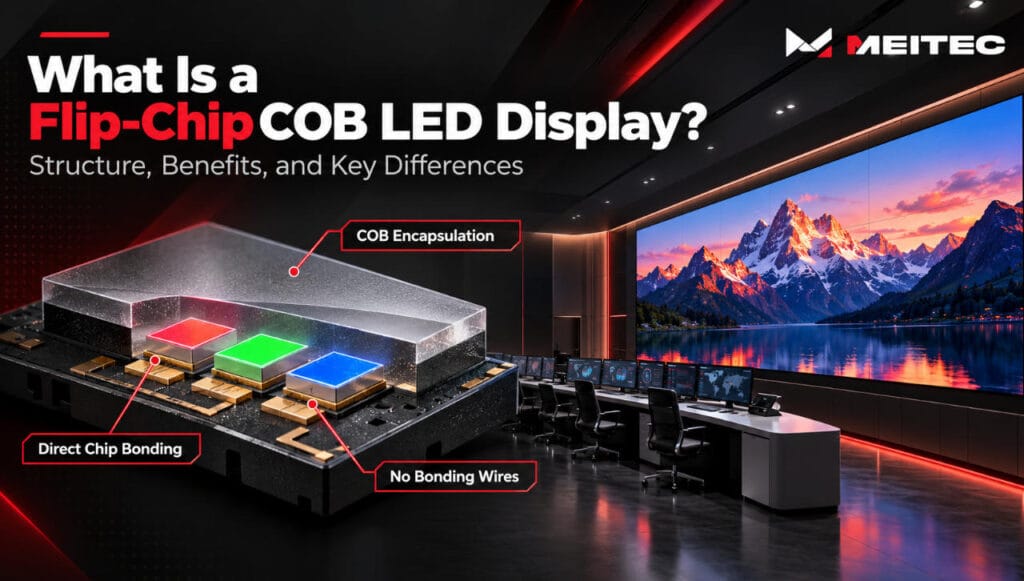
A Flip-Chip COB LED display is a direct-view LED display that combines two packaging technologies: Chip-on-Board (COB) and flip-chip LED architecture.
In a COB display, bare red, green, and blue LED chips are mounted directly onto the PCB rather than being packaged individually into conventional SMD LED components.
With flip-chip technology, the LED chip is turned so that its electrical contacts connect directly to the substrate. This removes the fine bonding wires used in conventional face-up or wire-bond LED packaging.
After the LED chips are mounted and electrically connected, the module is encapsulated with a protective material to form a relatively flat and durable display surface.
This architecture is especially suitable for fine-pitch and Micro LED displays, where pixel density, thermal management, surface protection, reliability, and close-distance image quality become increasingly important.
Meitec uses Full Flip-Chip COB technology in professional COB products such as the NOC Pro Series COB Micro LED Display, which is available in fine pixel pitches including P0.7, P0.9, and P1.2.
What Does “Flip-Chip COB” Mean?
The term can be separated into two parts.
COB: Chip on Board
COB refers to how LED chips are packaged.
Instead of manufacturing an individual LED package first and then soldering that packaged LED onto a PCB, COB technology mounts the LED chips directly onto the circuit board.
The chips are then encapsulated together as part of the LED module.
This reduces the number of individual packaged components on the display surface and makes it possible to create very dense pixel structures.
You can explore Meitec’s broader range of COB LED displays for professional fine-pitch applications.
Flip-Chip
Flip-chip describes how the semiconductor chip is electrically connected.
In a traditional face-up LED structure, the chip normally has electrodes on the upper side. Very thin bonding wires connect these electrodes to the circuit board.
In a flip-chip structure, the LED chip is inverted and its electrical contacts are connected directly to corresponding pads on the substrate.
The conventional bonding wires are therefore eliminated.
A simplified structure looks like this:
Traditional wire-bond LED
LED chip → bonding wires → PCB
Flip-chip LED
LED chip → direct electrical connection → PCB
Removing the bonding wires changes both the electrical and mechanical structure of the LED package.
How Is a Flip-Chip COB LED Display Made?
Although actual manufacturing processes vary among manufacturers, the basic process generally includes several stages.
1. LED Chip Preparation
Individual red, green, and blue semiconductor chips are prepared and sorted according to their electrical and optical characteristics.
Consistency at this stage is important because an LED display may contain millions of individual chips.
Differences in brightness or wavelength can later appear as color or brightness inconsistencies across the screen.
2. Chip Placement
The LED chips are precisely positioned directly onto the PCB or substrate.
Fine-pitch displays require extremely accurate positioning because the distance between neighboring pixels may be less than one millimeter.
As pixel pitch decreases, placement accuracy becomes increasingly important.
3. Direct Electrical Bonding
The flip-chip electrodes are bonded directly to the corresponding PCB pads.
This eliminates the fine gold or copper bonding wires required in conventional face-up LED packaging.
4. Electrical and Optical Testing
The module is tested to identify abnormal LEDs, electrical connection problems, brightness variation, or other defects before final encapsulation.
5. COB Encapsulation
The LED array is covered with a protective encapsulation material.
Instead of individual LED packages protruding from the PCB surface, the COB module forms a much more integrated display surface.
The encapsulation layer helps protect the LED chips against external mechanical and environmental influences.
6. Calibration
After production, brightness and color differences can be measured and corrected electronically.
Calibration becomes particularly important in fine-pitch displays because users normally view them at shorter distances.
For more detail, see Meitec’s guide to LED display calibration.
Flip-Chip COB vs. Wire-Bond COB
Not every COB LED display uses flip-chip technology.
One important distinction is between wire-bond COB and flip-chip COB.
| Feature | Wire-Bond COB | Flip-Chip COB |
|---|---|---|
| LED chips mounted directly on PCB | Yes | Yes |
| Uses individual SMD LED packages | No | No |
| Bonding wires required | Yes | No conventional bonding wires |
| Electrical connection | Wire connection | Direct chip-to-substrate connection |
| Thermal path | Longer | Shorter and more direct |
| Suitability for ultra-fine pitch | Good | Generally better |
| Mechanical complexity | Higher due to bonding wires | Simplified chip interconnection |
| COB surface encapsulation | Yes | Yes |
Both structures belong to the COB family.
The main difference is therefore not whether the chips are mounted directly onto the PCB—they are in both cases—but how the semiconductor chip is electrically connected to the substrate.
This distinction is why buyers should not assume that every product labeled “COB” uses the same internal architecture.
Flip-Chip COB vs. SMD LED Display
The difference from a conventional SMD display is more fundamental.
With SMD technology, the RGB LED chips are first packaged inside individual LED components. These packaged LED devices are then soldered onto the module PCB.
A COB display skips this individual package stage.
Simplified Comparison
| Feature | SMD LED | Flip-Chip COB |
|---|---|---|
| LED packaging | Individual packaged LEDs | Bare chips mounted directly |
| Chip-to-board architecture | SMD component soldered to PCB | Chips integrated directly onto PCB |
| Surface | Individual LED packages visible | Integrated encapsulated surface |
| Fine-pitch capability | Very good | Particularly suited to very fine pitch |
| Surface protection | Individual components exposed | Encapsulated surface |
| Mechanical impact resistance | Depends on package | Generally stronger surface protection |
| Module repair | Individual LEDs may be serviceable | Often handled at module level |
| Typical applications | Broad indoor/outdoor applications | Premium indoor fine-pitch applications |
Neither technology should automatically be considered better for every project.
SMD remains highly practical for many commercial, rental, indoor, and outdoor LED displays.
Flip-Chip COB becomes particularly valuable where extremely fine pixel pitch, close viewing, surface durability, and continuous professional operation are priorities.
What Are the Main Advantages of Flip-Chip COB?
The benefits of Flip-Chip COB come from the combination of direct chip mounting, wire-free interconnection, and integrated encapsulation.
1. Suitable for Smaller Pixel Pitches
Removing conventional LED packages and bonding-wire constraints allows LEDs to be arranged at very high density.
This makes Flip-Chip COB well suited to pixel pitches below approximately P1.5 and particularly attractive around P1.0 and below.
For example, Meitec’s NOC Pro series includes P0.78125, P0.9375, and P1.25 configurations.
A smaller pitch increases pixel density, which can improve detail reproduction when the screen is viewed from short distances.
Pixel pitch should still be chosen according to screen size, viewing distance, required resolution, and budget rather than simply selecting the smallest available option.
2. Shorter Thermal Path
Heat management is important because LED efficiency and long-term stability are affected by operating temperature.
In a flip-chip structure, the semiconductor chip has a relatively direct thermal connection to the substrate.
Removing the traditional bonding-wire architecture can shorten the heat-transfer path.
This does not mean that every Flip-Chip COB screen automatically operates cooler than every SMD screen.
Final thermal performance also depends on:
- PCB design
- driver IC efficiency
- operating current
- brightness
- power architecture
- cabinet structure
- ambient temperature
- ventilation
Flip-chip architecture simply provides a favorable foundation for thermal design.
3. Fewer Bonding-Wire Failure Points
Traditional wire-bond structures rely on extremely small metallic wires.
Although mature wire-bond manufacturing is highly reliable, those wires remain additional physical connections inside the LED package.
Flip-chip removes this conventional connection method.
A properly manufactured direct-bond structure therefore eliminates potential failure mechanisms related specifically to bond-wire breakage or wire connection degradation.
This becomes increasingly relevant as pixel density rises and millions of LED chips must operate reliably within one display.
4. Stronger Display-Surface Protection
One of the most visible differences between COB and traditional SMD displays is the module surface.
The LED chips in a COB module are protected by an integrated encapsulation layer.
This can improve resistance to:
- accidental contact
- minor impact
- dust
- moisture
- static electricity
- surface contamination
The smooth surface can also be easier to clean than a conventional SMD module containing large numbers of individually protruding LED packages.
The exact protection level should still be confirmed from the individual product specification rather than assumed from the term COB alone.
5. Better Suitability for Close Viewing
Fine-pitch Flip-Chip COB displays are commonly used where users sit relatively close to the LED wall.
Typical applications include:
- command and control centers
- Network Operations Centers
- corporate meeting rooms
- broadcast studios
- data visualization rooms
- high-end retail environments
- exhibition spaces
- premium indoor video walls
At short viewing distances, viewers become more sensitive to pixel structure, module boundaries, reflections, inconsistent blacks, and color variation.
The integrated COB surface and fine pixel structure can therefore provide practical advantages in these environments.
Meitec has used Full Flip-Chip COB technology in a real control-room LED video wall project where close viewing, continuous operation, contrast, information density, and system reliability were important requirements.
Does Flip-Chip COB Automatically Mean Better Image Quality?
No.
Packaging technology is only one part of an LED display system.
A Flip-Chip COB screen can provide an excellent technical foundation, but final image quality also depends on:
LED chip consistency
If the chips have large optical differences, uniformity can still be poor.
Calibration
Fine-pitch screens require accurate brightness and color correction.
Driver IC performance
The driver architecture affects grayscale reproduction, refresh rate, low-brightness performance, and image stability.
PCB design
Electrical layout affects current distribution, signal integrity, heat transfer, and long-term stability.
Encapsulation quality
Uneven encapsulation or inconsistent surface treatment can affect black uniformity and optical performance.
Processing system
The sending system, receiving cards, video processor, HDR processing, and color management also influence the final image.
Mechanical accuracy
Poor cabinet alignment can make seams visible even when the LED modules themselves perform well.
For this reason, buyers should evaluate the complete LED display rather than treating “Flip-Chip COB” as a complete image-quality specification.
What Does “Full Flip-Chip COB” Mean?
The term Full Flip-Chip COB generally indicates that the RGB chips used in the pixel structure adopt flip-chip architecture rather than combining flip-chip and conventional wire-bond devices.
This distinction is relevant because earlier or hybrid COB architectures may use different packaging methods for different LED colors.
In a full flip-chip implementation, the objective is to apply the direct-bond structure consistently across the RGB pixel.
For example, both Meitec’s NOC Pro and NOC Plus series specify Full Flip-Chip COB LED architecture.
The NOC Pro combines Full Flip-Chip COB with common-cathode driving, 3840Hz refresh rate, fine pixel pitches, front maintenance, and professional calibration for applications such as control rooms and broadcasting environments.
However, “full flip-chip” still should not be used as the only purchasing criterion. The complete module and display architecture must be evaluated.
Is Flip-Chip COB the Same as Micro LED?
Not exactly.
The terms describe different things.
Flip-chip describes the orientation and electrical connection structure of the semiconductor chip.
COB describes how the LED chips are mounted and packaged on the display module.
Micro LED generally refers to the use of extremely small LED semiconductor devices and high-density direct-view display architectures.
These technologies often appear together, but they are not interchangeable definitions.
A product marketed as a COB Micro LED display may use Flip-Chip COB as its packaging method.
When comparing products, it is therefore better to ask for specific information about:
- LED type
- chip dimensions
- pixel pitch
- packaging method
- driver architecture
- brightness
- contrast
- calibration
- power consumption
- maintenance method
rather than relying only on the words “Micro LED.”
What About Common Cathode Technology?
Common cathode and Flip-Chip COB are also separate technologies.
Flip-Chip COB concerns LED packaging.
Common cathode concerns how the RGB LEDs are electrically driven.
A display can therefore combine both technologies.
Common-cathode architectures can allow the different RGB channels to use more appropriate voltage levels, reducing unnecessary electrical losses in a properly designed system.
The actual power saving depends on the complete module architecture, driver ICs, brightness target, scanning method, and power-supply design.
Meitec’s NOC Pro is one example where Full Flip-Chip COB and common-cathode driving are integrated into the same display platform.
Are There Any Disadvantages?
Flip-Chip COB also creates engineering and service challenges.
Manufacturing Requirements
Very small chips require highly precise placement, bonding, encapsulation, testing, and calibration equipment.
Manufacturing quality therefore has a strong effect on final performance.
Module-Level Repair
Repair procedures differ from conventional SMD modules.
Individual SMD LEDs are relatively accessible to technicians experienced in component-level repair.
COB modules have an encapsulated surface, so field maintenance often focuses more on module replacement or specialized factory repair.
Calibration Requirements
Very high pixel density makes small differences in brightness or color easier to notice at close range.
High-quality calibration therefore remains necessary.
Cost
Depending on pixel pitch, production scale, chip configuration, and manufacturing process, Flip-Chip COB products may cost more than conventional LED alternatives.
The relevant question is therefore not:
“Is COB more expensive?”
It is:
“Does COB provide useful advantages for this particular application?”
For a long-distance advertising screen, ultra-fine COB may provide little practical benefit.
For a mission-critical control room viewed from one or two meters away, the calculation may be completely different.
When Should You Consider a Flip-Chip COB LED Display?
Flip-Chip COB is especially worth evaluating when a project requires several of the following characteristics simultaneously:
- pixel pitch near or below P1.5
- short viewing distance
- high information density
- 4K or similarly high display resolution
- continuous operation
- strong surface protection
- low-reflection display surface
- detailed dark imagery
- high contrast
- accurate calibration
- front maintenance
- premium indoor installation
Applications such as control rooms, command centers, corporate boardrooms, studios, visualization centers, and high-end commercial installations frequently match this profile.
For general advertising, outdoor displays, touring screens, and applications viewed from longer distances, other LED packaging technologies may provide a more economical solution.
What Should You Check Before Buying?
Do not compare COB displays only by pixel pitch.
For professional projects, verify the following:
Packaging architecture:
Is it wire-bond COB, hybrid COB, or Full Flip-Chip COB?
Pixel pitch and resolution:
What resolution will the finished screen provide at the required physical dimensions?
Brightness:
Is it appropriate for the actual ambient-light environment?
Contrast ratio:
How is contrast measured, and how does the display perform with dark content?
Refresh rate:
For camera-facing applications, confirm the available refresh rate and test actual camera performance where possible.
For more information, see What Is LED Display Refresh Rate?.
Low-brightness grayscale:
A display may look excellent at maximum brightness but perform differently when dimmed for meeting rooms or studios.
Calibration:
Ask how brightness and color calibration are performed and whether calibration data can be restored after module replacement.
Power consumption:
Compare measured average consumption at realistic brightness rather than relying only on maximum power ratings.
Maintenance:
Determine whether modules, power supplies, receiving cards, and other components can be serviced from the required direction.
Redundancy:
For mission-critical applications, evaluate power and signal redundancy rather than focusing only on the LED packaging.
Flip-Chip COB Is a Packaging Architecture, Not a Complete Specification
The most important point is that Flip-Chip COB should not be treated as a marketing label or a single measure of display quality.
It is an LED packaging architecture that can provide important engineering advantages, especially for fine-pitch professional displays.
Direct chip bonding can shorten electrical and thermal paths.
Removing conventional bonding wires can simplify chip interconnection.
COB encapsulation can improve surface protection.
High-density chip placement can support very small pixel pitches.
But the final display still depends on chip quality, PCB engineering, driver electronics, calibration, encapsulation, cabinet construction, processing, maintenance design, and manufacturing consistency.
A well-designed Flip-Chip COB LED display is therefore not simply a screen with smaller LEDs.
It is a complete display system engineered around extremely high pixel density and close-range professional viewing.
Quick FAQ
What is a Flip-Chip COB LED display?
It is an LED display in which bare LED chips are mounted directly on a PCB using COB packaging, while the chips use flip-chip architecture to connect their electrodes directly toward the substrate instead of relying on conventional bonding wires.
What is the main difference between COB and Flip-Chip COB?
COB describes direct chip-on-board packaging. Flip-chip describes how the LED chip itself is electrically connected. A COB display can use either conventional wire-bond chips or flip-chip architecture.
Is Flip-Chip COB better than SMD?
It can provide advantages for very fine pixel pitch, surface protection, thermal design, and close viewing. SMD remains highly suitable for many other applications, especially where larger pixel pitches, field repairability, or lower system cost are priorities.
Is Flip-Chip COB suitable for control rooms?
Yes. Fine pixel pitch, high pixel density, protected surfaces, close viewing, and long operating hours make Flip-Chip COB particularly relevant to control rooms and command centers.
Does Flip-Chip COB reduce power consumption?
The packaging architecture can improve thermal and electrical efficiency, but total display power consumption depends on the complete system, including driver ICs, common-anode or common-cathode architecture, brightness, scan mode, PCB design, and power supplies.
Is all COB LED Full Flip-Chip?
No. COB products may use wire-bond, hybrid, or full flip-chip architectures. Buyers should confirm the actual LED packaging structure with the manufacturer.
What pixel pitches are available with Flip-Chip COB?
Available pitches depend on the manufacturer and product platform. Meitec’s current professional COB range includes sub-1 mm and approximately 1 mm-class products, including P0.78125 and P0.9375 configurations.
Conclusion
A Flip-Chip COB LED display combines direct chip-on-board packaging with flip-chip semiconductor architecture.
Instead of packaging each LED separately or connecting the chip through conventional bonding wires, the LED chips are directly integrated with the module substrate and protected beneath a common encapsulated surface.
The architecture is particularly useful for fine-pitch LED displays because it supports high pixel density while providing strong surface protection and favorable electrical and thermal characteristics.
However, Flip-Chip COB should not be evaluated in isolation.
Pixel pitch, brightness, contrast, grayscale, refresh rate, calibration, driver IC performance, power consumption, maintenance design, manufacturing quality, and application requirements all determine whether a display is suitable for a project.
For professional applications requiring very fine pixel pitch and close-distance viewing, Meitec’s COB LED display solutions include Full Flip-Chip COB platforms designed for control rooms, visualization centers, corporate spaces, broadcasting studios, and other premium indoor applications.