Author: Meitec Technical Team
Reviewed by: LED Display Product Specialist
Category: Product Basics
Last Updated: September 2026
The LED display cabinet is a structural unit used to mount LED modules, power supplies, receiver cards, cables, and other components, collectively forming part of a complete LED screen. If the LED module is the fundamental image generation unit of an LED display, then the enclosure can be regarded as a larger mechanical and electrical component that organizes these modules into a stable, installable screen section. Multiple cabinets are connected horizontally and vertically to create an LED video wall of the desired size.
Although the cabinet itself does not determine image quality like LED chips or driver ICs, its design directly affects installation precision, heat dissipation, maintenance, transportation, screen flatness, environmental friendliness, and long-term reliability.
Therefore, when specifying fixed installation or rental LED screens, it is crucial to understand the importance of LED display cabinets.
What Is Inside an LED Display Cabinet?
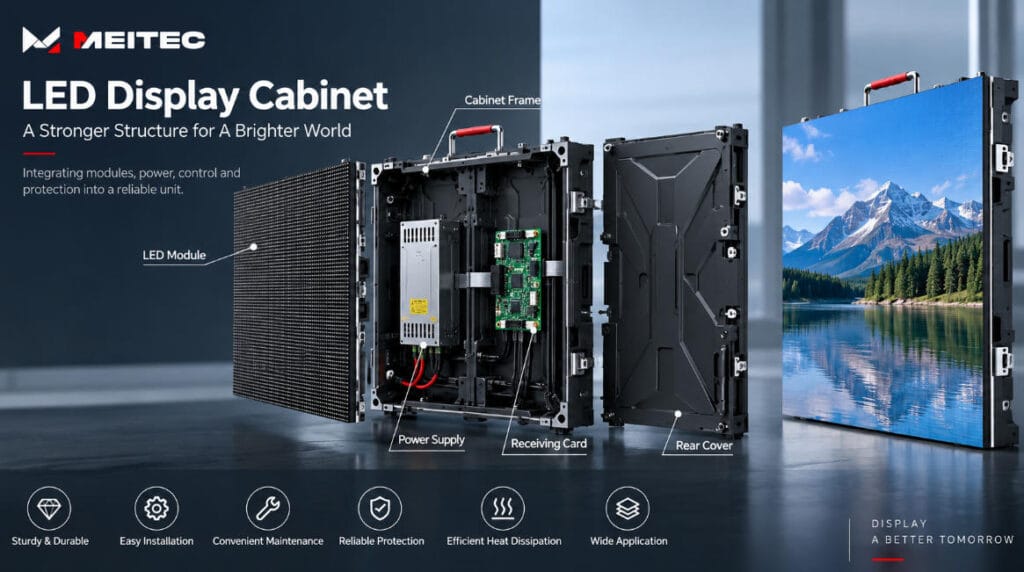
A typical LED display cabinet combines several components into one manageable unit.
Depending on the product design, a cabinet may contain:
- LED display modules
- Power supplies
- Receiving card
- HUB board or adapter board
- Power and signal cables
- Cooling or ventilation components
- Cabinet frame or enclosure
- Input/output connectors
- Positioning pins and cabinet locks
- Maintenance hardware
The LED modules form the visible display surface. Behind them, the power supply converts incoming electrical power into the voltage required by the LED system, while the receiving card receives image data from the control system and distributes it to the modules.
The cabinet provides the mechanical structure that keeps these components correctly positioned and protected.
This modular architecture is one reason large LED screens can be manufactured, transported, installed, and maintained efficiently. Instead of constructing the entire display as one unit, installers assemble standardized cabinets into a larger screen.
LED Module vs. LED Cabinet: What Is the Difference?
LED modules and LED cabinets are related but should not be treated as the same component.
An LED module is a smaller display unit containing LEDs, PCB, driver ICs, connectors, and associated electronics. It produces part of the visible image.
An LED cabinet is a larger assembly containing multiple LED modules together with the supporting power, control, wiring, and structural components.
A simplified LED display hierarchy can be understood as:
LED pixels → LED module → LED cabinet → complete LED screen
For example, several modules may be mounted onto a 500 × 500 mm or 500 × 1000 mm cabinet. Multiple cabinets can then be connected to build a stage backdrop, advertising billboard, video wall, or other large-format display.
Cabinet dimensions vary significantly between product families, so there is no universal cabinet size for all LED displays.
What Does an LED Display Cabinet Do?
The cabinet performs several functions at the same time.
1. Provides Structural Support
The cabinet keeps LED modules and internal components in their specified positions.
This is especially important for large displays. Small mechanical deviations between cabinets can create visible seams, uneven surfaces, or alignment problems across the finished screen.
A well-designed cabinet should maintain sufficient dimensional accuracy after manufacturing, transportation, repeated assembly, and normal operation.
2. Simplifies Installation
Instead of installing individual modules and electrical components separately at the project site, technicians can assemble preconfigured cabinets.
Cabinets normally include mounting points, positioning systems, signal connections, and power connections that make large-screen assembly more systematic.
Rental cabinets often take this further by using quick locks, handles, positioning pins, and integrated connectors to reduce setup and dismantling time.
For this reason, cabinet design is particularly important in Rental LED Displays, where equipment may be transported and assembled repeatedly.
3. Protects Internal Components
The cabinet provides mechanical protection for power supplies, control electronics, cables, and other internal components.
Outdoor cabinets also contribute to the overall environmental protection of the display.
However, the IP rating of an outdoor LED screen should not be judged from cabinet material alone. Module sealing, connectors, cable entries, rear covers, gaskets, drainage design, and assembly quality all contribute to the final protection level.
4. Supports Heat Management
LED modules, driver ICs, and power supplies generate heat during operation.
The cabinet structure influences how this heat is transferred or dissipated. Depending on the design, thermal management may rely on the cabinet material, natural convection, ventilation, fans, or a combination of methods.
Effective thermal design becomes particularly important for high-brightness outdoor displays and screens operating for long periods.
5. Enables Maintenance
Cabinet design determines how technicians access modules, power supplies, receiving cards, and cables when servicing the display.
Some cabinets are designed for rear maintenance, while others allow major components to be removed from the front.
The appropriate design depends on the installation environment.
Common Types of LED Display Cabinets
LED cabinets can be classified according to their application and mechanical design.
Fixed-Installation LED Cabinets
Fixed cabinets are designed for screens that remain installed in one location for long periods.
They are commonly used for:
- Outdoor advertising screens
- Building façades
- Shopping malls
- Retail displays
- Transportation facilities
- Corporate displays
- Public information screens
Because these cabinets are not frequently moved, priorities may include structural strength, environmental protection, maintenance accessibility, thermal performance, and long-term stability.
For example, outdoor fixed installations typically require greater consideration of weather exposure and maintenance conditions. Meitec’s Outdoor LED Displays represent this type of application, where cabinet configuration needs to be considered together with brightness, protection, installation structure, and service access.
Rental LED Cabinets
Rental cabinets are designed for repeated installation, dismantling, transportation, and reuse.
Typical applications include concerts, exhibitions, conferences, festivals, touring productions, and corporate events.
Compared with conventional fixed cabinets, rental cabinet design usually emphasizes:
- Lower weight
- Fast locking systems
- Convenient handles
- Accurate positioning
- Rapid power and signal connection
- Corner protection
- Easy module replacement
- High mechanical durability
Common rental cabinet formats include 500 × 500 mm and 500 × 1000 mm, although actual dimensions depend on the product.
Compatibility between cabinet sizes can also be useful because it allows installers to create different screen dimensions using the same product family.
Front-Service LED Cabinets
Front-service cabinets allow technicians to remove modules and, depending on the design, power supplies and control components from the viewing side.
They are useful when the screen is mounted directly against a wall or when there is little or no maintenance space behind the display.
Front maintenance can reduce the required installation depth, but the complete screen structure must be designed for this service method from the beginning.
Rear-Service LED Cabinets
Rear-service cabinets provide access to components from behind the LED screen.
This approach is common when the installation structure provides sufficient maintenance space.
Rear access can make servicing straightforward, but the required service corridor increases the overall installation depth. The project therefore needs to account for maintenance space during structural planning.
What Materials Are LED Cabinets Made From?
The cabinet material affects weight, strength, precision, heat management, corrosion resistance, manufacturing cost, and transportation.
Several materials are commonly used.
Die-Cast Aluminum
Die-cast aluminum is widely used in rental LED displays and many precision indoor displays.
Its main advantages include relatively low weight, good dimensional accuracy, efficient heat transfer, and the ability to produce thin cabinet structures.
High manufacturing precision is especially useful when many cabinets need to form a flat, visually continuous screen.
The main limitation is cost. Die-cast tooling and manufacturing can be more expensive than basic sheet-metal cabinet construction.
Sheet Metal or Steel
Steel cabinets are traditionally used in many fixed-installation LED displays.
They provide good structural strength and can be cost-effective for large permanent installations.
However, steel is generally heavier than aluminum, which increases the load on supporting structures and can raise transportation and installation requirements.
Corrosion protection also needs to be considered, particularly for outdoor installations.
Aluminum Profile or Fabricated Aluminum
Some LED cabinets use aluminum profiles or fabricated aluminum structures rather than one-piece die-cast frames.
These designs can provide a balance between weight, structural strength, thermal performance, customization, and manufacturing cost.
The appropriate material should therefore be selected according to the application rather than assuming that one cabinet material is always superior.
Why Cabinet Precision Matters
Cabinet accuracy becomes increasingly important as pixel pitch decreases.
When cabinets are connected, their edges must align closely. Poor dimensional control can produce:
- Visible cabinet seams
- Uneven module gaps
- Surface height differences
- Irregular pixel spacing at cabinet boundaries
- Mechanical stress during assembly
These problems become more noticeable on fine-pitch LED displays viewed from short distances.
Positioning pins, precision locks, cabinet machining, module tolerances, and installation structure all contribute to final screen alignment.
This means that screen flatness is not determined by one component alone. It is the result of mechanical accuracy throughout the complete assembly.
Cabinet Size and Screen Configuration
Cabinet dimensions influence how an LED screen can be configured.
A project should not select cabinet size only because a particular format is common in the market.
Important considerations include:
- Final screen width and height
- LED module dimensions
- Pixel pitch
- Required resolution
- Supporting structure
- Transportation limitations
- Installation labor
- Maintenance access
- Weight per cabinet
- Installation environment
For example, a smaller cabinet may provide greater flexibility for unusual screen dimensions but require more cabinet connections. A larger cabinet may reduce the number of units needed but can be heavier and less convenient to handle.
The optimal configuration depends on the complete project.
What Is a Cabinet-Free LED Display?
Not every modern LED installation uses a conventional enclosed cabinet.
Some products use lightweight frames, integrated module structures, or cabinet-free designs to reduce overall thickness and weight.
In these systems, modules and supporting components may be mounted directly onto a structural frame rather than enclosed inside traditional metal cabinets.
This approach can be useful for certain indoor fine-pitch or space-limited applications, but it does not eliminate the need for mechanical support, power distribution, signal management, heat control, and maintenance access.
“Cabinet-free” therefore describes a different structural approach rather than an LED screen with no supporting structure.
How Does Cabinet Design Affect Maintenance?
Maintenance is one of the most practical reasons to evaluate cabinet design carefully.
During the service life of an LED display, technicians may need to replace an LED module, power supply, receiving card, cable, or connector.
A service-friendly cabinet should allow technicians to identify and access these components without unnecessarily dismantling surrounding sections of the screen.
Before selecting a cabinet, project planners should determine:
Where will technicians stand during maintenance?
Can components be removed from the front or rear?
Is enough working space available?
Can one cabinet or module be serviced without disturbing adjacent units?
How quickly can common components be replaced?
These questions are more useful than simply asking whether a product is described as “easy maintenance.”
How to Evaluate an LED Display Cabinet
Cabinet evaluation should be based on the actual installation rather than one specification.
Important points include cabinet dimensions and weight, material, mechanical accuracy, locking system, module mounting method, front or rear service access, power and signal connections, heat dissipation, environmental protection, structural compatibility, and ease of component replacement.
For rental applications, repeated assembly durability and handling efficiency become especially important.
For permanent outdoor installations, weather protection, corrosion resistance, thermal performance, structural strength, and long-term service access deserve greater attention.
For fine-pitch indoor installations, cabinet precision, flatness, installation depth, and maintenance accessibility may have higher priority.
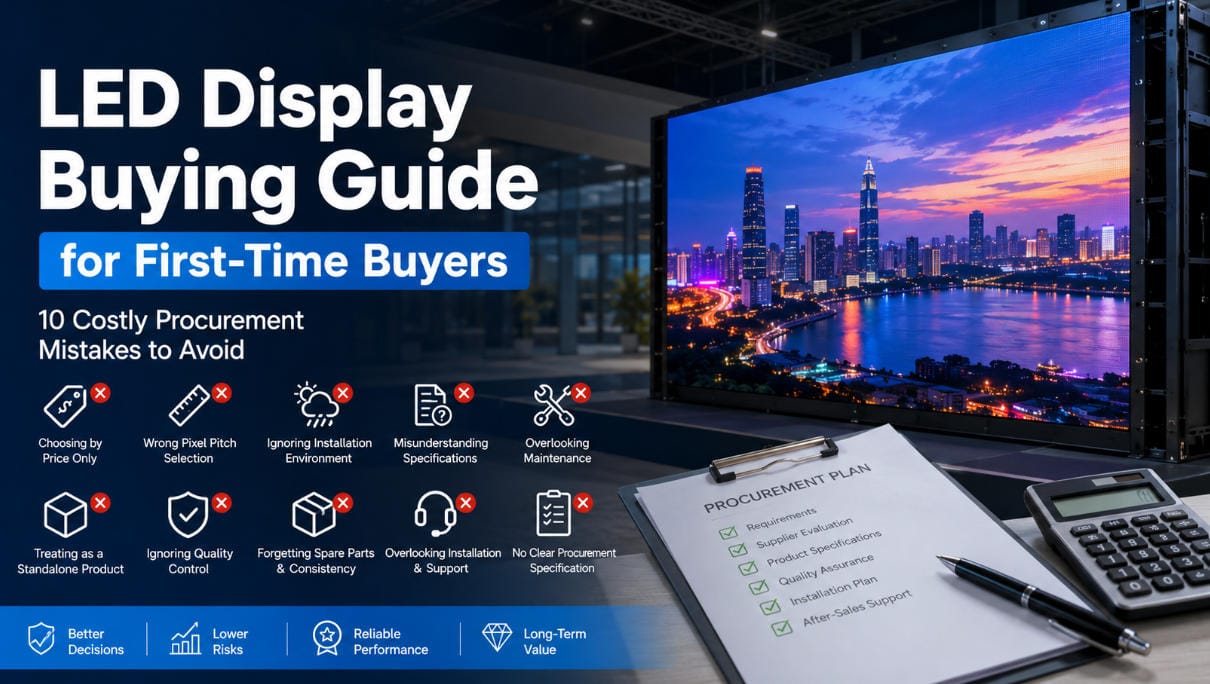
This is why comparing LED displays only by pixel pitch and brightness provides an incomplete picture. Meitec’s LED Display Buying Guide explains the broader system-level factors that should be checked when comparing LED display configurations.
Frequently Asked Questions
Is an LED cabinet the same as an LED panel?
The terminology is not completely standardized. In the LED display industry, “LED panel” is sometimes used to describe a complete cabinet and sometimes more generally to describe part of an LED screen. When reviewing quotations or technical drawings, it is better to confirm the exact dimensions and components included rather than relying on the term “panel.”
How many LED modules are inside one cabinet?
There is no fixed number. It depends on module dimensions, cabinet dimensions, pixel pitch, and product architecture. A cabinet may contain several modules arranged horizontally and vertically.
What is the standard LED cabinet size?
There is no universal standard size. Rental displays commonly use formats such as 500 × 500 mm and 500 × 1000 mm, while fixed-installation and specialized displays may use many other dimensions.
Are aluminum LED cabinets better than steel cabinets?
Not necessarily. Aluminum generally offers advantages in weight and thermal performance, while steel can provide a strong and economical solution for certain permanent installations. The better option depends on structural requirements, environment, transportation, maintenance, and budget.
Can different LED cabinets be mixed in one screen?
Only when the product system is specifically designed for compatibility. Cabinet dimensions, pixel pitch, module alignment, electrical interfaces, control configuration, and mechanical locking systems must match. Cabinets from unrelated product families should not be assumed to be interchangeable.
Conclusion
An LED display cabinet is far more than just a metal box behind the LED screen.
It is precisely the structure and integration unit that combines LED modules, power supplies, receiving cards, wiring, connectors, and mechanical components into a self-contained section that can be installed in large displays.
Its design affects screen flatness, installation speed, maintenance access, thermal management, transportation, environmental protection, and long-term mechanical stability.
For this reason, the right cabinet cannot be selected independently from the application.
A rental screen needs a lightweight and repeatable assembly system. A permanent outdoor display places greater emphasis on structural and environmental requirements. A fine-pitch indoor video wall requires high mechanical precision and appropriate maintenance access.
Understanding these differences makes it easier to evaluate an LED display as a complete engineered system rather than simply comparing pixel pitch, brightness, or price.