Author: Meitec Technical Team
Reviewed by: LED Display Product Specialist
Category: Product Basics
Last Updated: September 2026
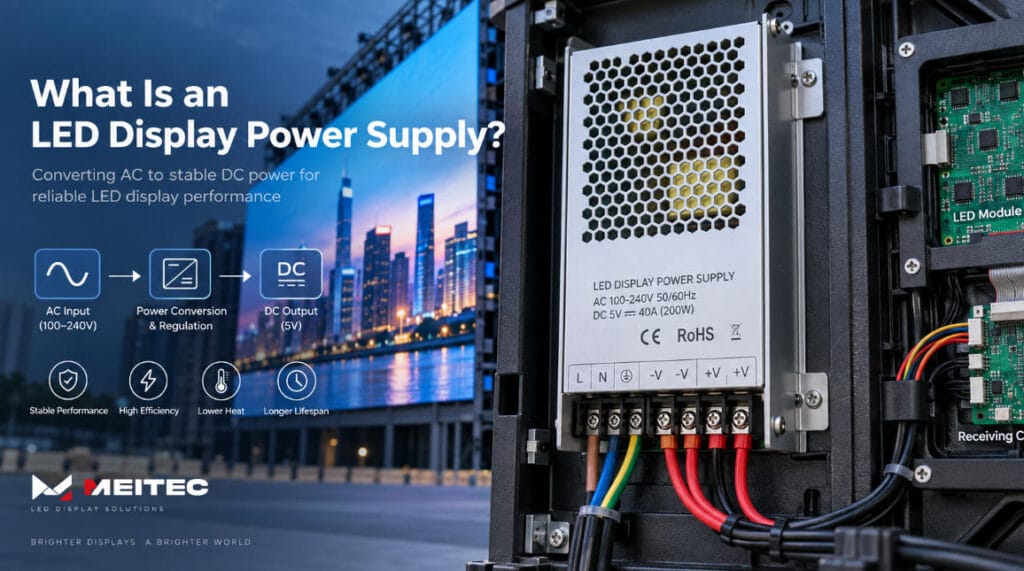
An LED display power supply is the component that converts incoming AC electricity into the stable low-voltage DC power required by LED modules, receiving cards, driver ICs, and other electronic components inside an LED display.
Although it is usually hidden inside the cabinet, the power supply directly affects display stability, heat generation, energy consumption, and long-term reliability. A poorly selected or overloaded power supply can cause flickering, abnormal brightness, module shutdown, excessive heat, or repeated system failures.
For this reason, understanding LED display power supplies is important when designing, installing, or troubleshooting an LED screen.
What Does an LED Display Power Supply Do?
Commercial electrical systems normally provide alternating current, commonly 100–240V AC depending on the region. LED display modules, however, operate on much lower DC voltages.
The power supply performs three basic functions:
- AC-to-DC conversion – converts mains AC power into usable DC output.
- Voltage regulation – maintains a stable output voltage when the load or input voltage changes.
- Power distribution – provides electrical power to the LED modules and related cabinet electronics.
In many conventional LED displays, a switching power supply converts AC input into approximately 5V DC. Some newer energy-saving designs use alternative voltage architectures or multiple output voltages to improve conversion efficiency and reduce unnecessary power loss.
The specific power architecture depends on the LED module, driver circuit, cabinet design, brightness requirement, and overall display configuration.
Where Is the Power Supply Located?
In a modular LED display, power supplies are normally installed inside the LED cabinet or power box.
A typical cabinet contains:
- LED modules
- One or more receiving cards
- Power supplies
- HUB boards or adapter boards
- AC and DC wiring
- Signal cables
- Cooling and protection components
The power supply receives electricity through the cabinet’s AC input and distributes low-voltage DC power to the LED modules.
The receiving card has a different function. It processes display data received from the control system and distributes image data to the LED modules. For a detailed explanation of that component, see What Is an LED Display Receiving Card?.
In simple terms:
Power supply = electrical power
Receiving card = display data
Both must operate correctly for the cabinet to display an image.
How Does an LED Display Power Supply Work?
Most modern LED displays use switch-mode power supplies, often abbreviated as SMPS.
Instead of regulating voltage by dissipating large amounts of excess electrical energy as heat, an SMPS switches electricity at high frequency and uses electronic conversion circuits to generate a controlled DC output.
The basic process is:
AC mains → rectification → high-frequency switching → voltage conversion → regulated DC output
This design allows LED display power supplies to be relatively compact while supplying high current.
For example, a 5V 40A power supply has a nominal output capacity of:
5V × 40A = 200W
However, this does not mean an LED cabinet should continuously operate exactly at the power supply’s maximum rated output. Engineering margin is normally required to account for temperature, component tolerances, load changes, and long-term reliability.
Important LED Display Power Supply Specifications
Several specifications should be checked when evaluating a power supply.
Input Voltage
Input voltage specifies the AC supply range the unit can accept.
A common specification is:
AC 100–240V, 50/60Hz
A wide input range is useful for LED display products supplied to multiple international markets.
The display’s complete electrical design must still match the local mains voltage, circuit breakers, distribution system, connectors, and wiring requirements.
Output Voltage
Output voltage must match the electrical requirements of the LED modules and associated electronics.
Traditional LED modules commonly use approximately 5V DC, but not every LED display uses the same architecture.
Connecting a module to an incorrect output voltage can cause unstable operation or permanent damage. Power supply replacement should therefore be based on the original electrical specification rather than physical appearance alone.
Output Current
Output current indicates the maximum current the power supply can deliver under specified operating conditions.
For example:
- 5V 20A = 100W
- 5V 30A = 150W
- 5V 40A = 200W
- 5V 60A = 300W
The required current depends on the number of LED modules connected to the power supply and their maximum electrical load.
Rated Power
Rated power is calculated approximately as:
Power (W) = Voltage (V) × Current (A)
However, power supply sizing should be based on the actual module configuration rather than simply selecting a unit with the highest wattage.
Higher capacity alone does not guarantee better reliability.
Efficiency
Power conversion is never completely lossless.
If a power supply consumes 220W from the AC side but delivers 200W to the load, part of the difference is converted into heat.
Higher conversion efficiency can reduce:
- wasted electricity
- internal cabinet temperature
- cooling requirements
- long-term operating costs
Efficiency becomes particularly important in large outdoor LED displays containing hundreds or thousands of power supplies.
Why Do LED Displays Need Multiple Power Supplies?
A large LED display cannot normally be powered by a single power supply.
Instead, electrical loads are divided across modules, cabinets, or groups of modules.
For example, one cabinet may contain several LED modules and two or three power supplies. Each power supply powers a defined group of modules.
This distributed architecture provides several advantages.
It keeps DC cable lengths relatively short, helps distribute electrical load, simplifies maintenance, and prevents the entire LED wall from depending on one extremely large low-voltage power source.
When one power supply fails, the affected area may therefore be limited to part of a cabinet rather than the whole screen.
The exact configuration varies significantly between LED display designs.
How Is LED Display Power Supply Capacity Calculated?
Power supply selection should start with the maximum consumption of the connected modules.
Suppose four modules have a maximum power consumption of 35W each.
The theoretical load is:
4 × 35W = 140W
A 150W power supply would technically appear sufficient, but it leaves very little operating margin.
In practice, designers normally avoid running a power supply continuously at its absolute maximum rating. Additional capacity helps accommodate temperature changes, manufacturing tolerances, transient loading, and aging.
The calculation must also consider the load on individual DC output terminals and cables.
A high-capacity power supply does not solve a wiring problem if one cable or connector carries excessive current.
Maximum Power vs Average Power Consumption
Two different power figures are commonly listed on LED display specifications:
Maximum power consumption represents a high-load condition, such as bright content with many LEDs operating at high output.
Average power consumption represents a more typical operating level based on normal image content and brightness settings.
These values should not be confused.
Maximum power is particularly important when determining:
- AC distribution capacity
- cable size
- circuit breaker rating
- power supply capacity
- generator or UPS requirements
Average power is more useful when estimating normal electricity consumption and operating cost.
As an example of how the electrical architecture influences overall consumption, Meitec’s MTO Pro Series Outdoor Fixed LED Display uses an energy-saving power architecture and specifies both maximum and average cabinet power consumption rather than treating power as a single fixed value.
What Is a Dual-Voltage LED Display Power Supply System?
Some energy-saving LED displays use dual-voltage power technology.
The basic idea is that different parts of the LED circuit do not necessarily need to operate at the same voltage.
Supplying every component from one higher DC voltage can cause unnecessary voltage drop across the driver circuitry. That unused electrical energy becomes heat.
A dual-voltage architecture supplies different voltage levels according to circuit requirements, reducing unnecessary power loss.
Potential benefits include:
- lower power consumption
- reduced heat generation
- improved energy efficiency
- lower cabinet temperature
However, dual-voltage systems require compatible LED modules and electrical designs. They are not simply interchangeable with conventional 5V power supplies.
How Does the Power Supply Affect LED Display Reliability?
The power supply operates whenever the screen is operating, often under considerable electrical and thermal stress.
Its quality therefore affects several areas of display performance.
Voltage Stability
Unstable output voltage may cause modules to behave inconsistently, particularly when screen brightness or electrical load changes.
Heat Generation
Power supplies generate heat during AC-to-DC conversion.
High cabinet temperature can accelerate the aging of power supplies, capacitors, driver components, and LEDs.
Good cabinet ventilation and thermal design are therefore part of electrical reliability.
Load Stability
An overloaded power supply may enter protection mode, experience excessive temperature, or fail prematurely.
Correct load distribution is especially important for high-brightness outdoor displays.
Long-Term Component Quality
Power supplies contain capacitors, switching devices, transformers, control ICs, and protection circuits. The quality and operating temperature of these components influence service life.
For this reason, LED display quality assessment should include electrical testing rather than evaluating image quality alone. Meitec’s LED Display Quality Control process includes power testing, functional verification, aging tests, and other inspections before shipment.
Common LED Display Power Supply Problems
Power-related faults can produce several different symptoms.
A Section of the Screen Is Completely Black
If multiple modules powered by the same supply suddenly turn off, check the corresponding power supply, AC input, DC output, connectors, and wiring.
A completely black module is not always a signal-system problem.
Screen Flickering or Unstable Brightness
Possible electrical causes include:
- unstable DC voltage
- loose power terminals
- overloaded power supply
- insufficient cable capacity
- poor grounding
- abnormal voltage drop
Signal-system problems can produce similar symptoms, so troubleshooting should separate power and signal paths.
Power Supply Repeatedly Shuts Down
Many switching power supplies include over-current, short-circuit, or over-temperature protection.
Repeated shutdown may indicate excessive load, a short circuit, abnormal cabinet temperature, wiring failure, or a defective downstream component.
Replacing the power supply without identifying the underlying cause may only temporarily solve the problem.
Excessive Heat
Some heat is normal during operation, but unusually high temperature should be investigated.
Possible causes include poor ventilation, excessive load, high ambient temperature, blocked airflow, or deteriorating internal components.
Can You Replace an LED Display Power Supply With Another Model?
Yes, but only when the replacement is electrically and mechanically compatible.
Check at least:
- input voltage range
- output voltage
- rated output current
- total wattage
- connector and terminal configuration
- physical dimensions
- mounting method
- cooling requirements
- protection characteristics
The replacement output voltage must match the original system.
Using a higher-current power supply at the correct voltage may sometimes be acceptable when the electrical design supports it, but changing the output voltage is fundamentally different and may damage the LED modules.
For project maintenance, keeping compatible spare power supplies from the original configuration is usually safer than sourcing visually similar units after a failure occurs.
What Should Be Checked During Installation?
Power supply reliability depends not only on the component itself but also on installation quality.
Technicians should verify correct AC input wiring, secure terminal connections, proper DC polarity, appropriate cable size, balanced electrical loads, cabinet grounding, ventilation, and insulation.
Loose connections are especially important because high-current low-voltage circuits can generate considerable heat at a poor electrical contact.
After installation, cabinets should be tested under realistic operating loads rather than only displaying a low-brightness test pattern.
LED Display Power Supply vs Power Distribution System
These terms are related but not identical.
The LED display power supply converts AC power into low-voltage DC inside the cabinet.
The power distribution system manages how AC electricity is delivered to multiple cabinets or display sections.
A large LED wall may therefore include:
Main electrical supply → distribution panel → circuit protection → cabinet AC input → internal power supply → LED modules
Large projects may also include surge protection, contactors, monitoring systems, remote switching, UPS equipment, or generators depending on application requirements.
Power supply design should therefore be considered as one part of the complete display electrical system.
Conclusion
An LED display power supply is responsible for converting mains electricity into the stable low-voltage DC power required by the display’s electronic components.
Its role may appear simple, but power supply voltage, current capacity, efficiency, thermal performance, load distribution, and installation quality directly influence the reliability of the entire LED screen.
For LED display projects, power supplies should therefore be selected as part of the complete electrical and cabinet design rather than treated as generic interchangeable components.
Correct power architecture helps reduce heat, prevent unexpected shutdowns, improve energy efficiency, and support stable long-term LED display operation.