Choosing a packaging technology for a fine-pitch LED project is becoming more complicated.
A few years ago, many buyers could define the required screen size, viewing distance and pixel pitch, then select an SMD solution from several suppliers. Today, COB has become increasingly common at ultra-fine pixel pitches, while GOB offers another option for projects requiring greater surface protection.
That creates a practical question:
Which technology actually makes sense for your project—COB, GOB or SMD?
The answer cannot be determined by pixel pitch alone.
A control room operating 24/7, a corporate boardroom used several hours per week, and an interactive showroom may all specify P1.2 displays, yet the best packaging technology for each project can be different.
Effective COB GOB SMD LED selection therefore requires buyers to evaluate the complete operating environment: viewing distance, physical exposure, image requirements, maintenance strategy, expected service life and total cost of ownership.
This guide focuses on those decision factors rather than basic technology definitions, helping integrators and buyers determine where each fine pitch LED technology makes practical sense.
Start With the Project, Not the Packaging Technology
One of the most common mistakes in fine-pitch LED procurement is deciding on a technology before defining the application.
Specifications such as “P0.9 COB” or “P1.2 GOB” may sound precise, but they still leave many important questions unanswered.
Before comparing technologies, establish:
- Minimum and typical viewing distance
- Required screen dimensions and resolution
- Daily operating hours
- Ambient lighting conditions
- Whether viewers can touch the screen
- Content type
- Camera or broadcast requirements
- Front-service or rear-service requirements
- Acceptable downtime
- Expected project lifespan
- Available maintenance resources
These factors often reveal which technology is appropriate before price comparisons even begin.
For example, an executive meeting room with controlled lighting and limited operating hours has very different requirements from a security command center operating continuously.
Even if both use the same pixel pitch, they should not automatically use the same display architecture.
Pixel Pitch Is Important—but Don’t Let It Make the Decision for You
Pixel pitch remains one of the strongest influences on COB GOB SMD LED selection, particularly below P1.5.
SMD continues to be practical across many conventional fine-pitch installations. At P1.5 or P1.8, for example, a well-designed SMD display can provide excellent visual performance without forcing the project into a more expensive packaging architecture.
As the project moves toward P1.2, P0.9 and below, however, COB becomes increasingly attractive.
Higher pixel density means more components must fit into a smaller area. COB’s chip-level architecture is particularly suitable for these ultra-fine-pitch configurations and can also provide a more protected display surface.
But smaller is not automatically better.
If viewers are several meters away, specifying P0.9 instead of P1.5 may increase cost significantly without creating a proportional improvement in perceived image quality.
A better approach is:
Viewing distance → required resolution → suitable pixel pitch → packaging technology.
Not:
Latest technology → smallest pixel pitch → project specification.
For projects requiring extremely high pixel density, Meitec’s COB LED display solutions are designed for premium indoor applications where close viewing, fine detail and long-term reliability are priorities.
The Real COB vs GOB vs SMD Decision Comes Down to Six Factors
Rather than comparing technologies through marketing claims, buyers should evaluate them against six practical project variables.
1. How Much Physical Protection Does the Screen Need?
This is one of the clearest differences between the three approaches.
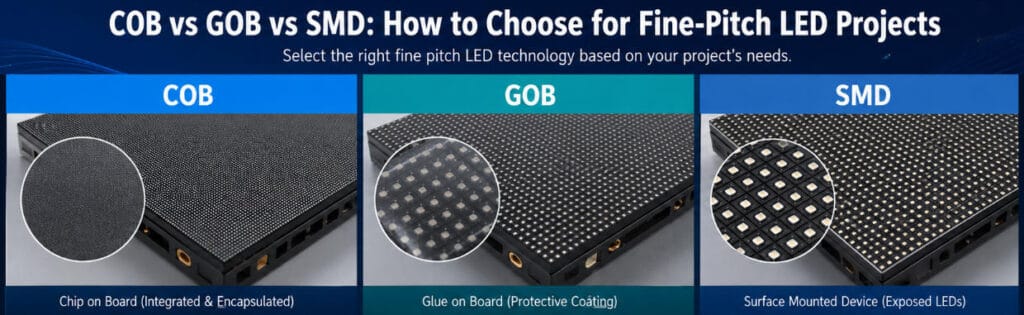
In a conventional SMD module, the LED packages remain relatively exposed. This is normally acceptable when the screen is installed in a controlled location and is unlikely to be touched.
The situation changes when the display is installed in:
- Showrooms
- Retail environments
- Training centers
- Exhibition spaces
- Public areas
- Low-level installations
- Rental or frequently handled applications
Here, accidental impact becomes a real lifecycle consideration.
GOB can significantly improve surface protection while retaining an SMD-based architecture. For buyers asking COB or GOB LED, this is one of the situations where GOB deserves serious consideration.
COB provides an even more integrated protected surface and becomes particularly attractive when physical durability is combined with very small pixel pitch requirements.
The correct question is therefore not simply “Which technology is stronger?”
It is:
How likely is physical damage in this specific installation, and what would that damage cost to repair?
2. How Close Will People Actually View the Display?
Fine-pitch displays are increasingly used at distances where users can easily notice pixel structure, surface reflection and module inconsistencies.
This changes the value of different technologies.
At longer viewing distances, a high-quality SMD screen may be visually indistinguishable from a more expensive solution for the intended content.
At very close distances, however, characteristics such as surface uniformity and perceived black level become increasingly important.
COB can offer advantages in these environments because its encapsulated surface can help create a smoother visual appearance and control surface reflection.
This is particularly relevant for:
Control rooms: Operators may spend entire shifts directly in front of the video wall.
Boardrooms: Participants may sit relatively close while viewing text, spreadsheets, presentations and video.
Broadcast environments: Screens may appear on camera, making refresh rate, consistency and surface behavior important.
Premium retail: Customers may approach the display closely enough to examine the screen surface.
The closer the viewer, the more important the quality of the entire display surface becomes—not just the nominal resolution.
3. What Type of Content Will the Screen Display?
Not every fine-pitch LED wall displays cinematic video.
Many professional installations primarily show:
- Dashboards
- Maps
- Surveillance feeds
- Financial information
- CAD drawings
- Data visualization
- Presentation slides
- Small text
- Multi-window interfaces
These applications can place greater emphasis on contrast, fine detail and visual consistency than conventional advertising content.
A control-room operator reading small labels on a dashboard for eight hours needs a different visual experience from someone watching a promotional video for thirty seconds.
When evaluating fine pitch LED technology, buyers should therefore test displays using their actual content whenever possible.
Do not rely exclusively on manufacturer demonstration videos. Highly saturated 4K promotional footage can make almost any premium display look impressive.
Instead, test:
- Small white text on dark backgrounds
- Fine lines
- Gray gradients
- Low-brightness content
- Large uniform color areas
- Dark scenes
- Real dashboards or interface layouts
These tests often reveal differences that specification sheets cannot.
4. How Critical Is Continuous Operation?
Operating hours dramatically change the economics of a display.
A corporate presentation screen operating three hours per day and a command-center wall operating 24/7 should not be evaluated using the same procurement logic.
For continuous-operation projects, consider:
Thermal performance.
Heat affects LEDs, driver ICs, power supplies and other electronic components over time.
Brightness and color consistency.
A professional video wall must maintain uniformity across modules and cabinets as operating hours accumulate.
Failure management.
If a module fails, how quickly can it be replaced?
Calibration recovery.
Will a replacement module visually match the surrounding modules?
Redundancy.
Does the project require redundant power or signal architecture?
For mission-critical installations, these factors can be more important than the difference between two quotations.
COB may offer meaningful advantages for demanding continuous-operation environments, but packaging technology alone does not guarantee reliability.
PCB quality, driver ICs, power supplies, thermal design, manufacturing control, aging tests and calibration procedures remain equally important.
That is why supplier engineering capability should be evaluated alongside the LED packaging method.
5. What Is Your Maintenance Strategy?
This is where many COB or GOB LED comparisons become oversimplified.
Buyers often ask:
“Which technology is easiest to repair?”
A more useful question is:
“How will this display actually be maintained over the next five years?”
Traditional SMD servicing may allow technicians familiar with LED repair to work at component level.
GOB introduces an encapsulation layer, which can change component-level repair procedures depending on the product design.
COB often makes module-level replacement a more practical maintenance strategy.
For many permanent fine-pitch installations, that can be perfectly acceptable—or even preferable.
Imagine a command center where a technician can remove a front-service module, install a calibrated spare and restore the wall quickly.
In this environment, rapid module replacement may be more valuable than the ability to repair an individual LED directly at the installation site.
Before purchasing, ask the manufacturer:
- How are failed modules replaced?
- Can modules be serviced from the front?
- How is calibration data stored?
- Will replacement modules match after several years?
- How many spare modules are recommended?
- What components should be stocked locally?
- How long will spare parts remain available?
A good maintenance strategy should be established before installation, not after the first failure occurs.
6. What Does the Project Really Cost Over Five Years?
Initial purchase price remains one of SMD’s strongest advantages.
For projects where conventional fine-pitch performance is sufficient, selecting SMD can be economically sensible.
GOB adds additional manufacturing processes but may reduce the risk of surface damage.
COB may require a higher initial investment, especially at ultra-fine pixel pitches, but can offer benefits in durability, visual performance and high-density applications.
The mistake is comparing only the quotation.
A more realistic calculation is:
Total Cost of Ownership = Purchase + Installation + Energy + Maintenance + Spare Parts + Downtime + Replacement Risk
Suppose one solution costs 15% less initially but operates in an environment where exposed LEDs are frequently damaged.
The cheaper purchase price may disappear after several years of maintenance.
On the other hand, using an ultra-fine COB display in an application viewed from six meters away may represent unnecessary investment.
The best technology is not the one with the lowest purchase price or the most advanced specification.
It is the one that delivers the required performance at the lowest acceptable lifecycle cost.
When SMD Is Still the Smarter Choice
The growth of COB does not mean SMD has become obsolete.
SMD remains a strong choice when:
- Pixel pitch is not extremely small
- Viewing distance is moderate
- The environment is controlled
- The screen is unlikely to be touched
- Budget efficiency matters
- Conventional maintenance capability is available
- The application does not require extreme surface protection
For many corporate, commercial and indoor visualization projects, high-quality SMD still provides an excellent balance between performance and investment.
Meitec’s SIM Pro Series Indoor Small Pixel Pitch LED Display, for example, covers pixel pitches from P0.9375 to P1.875 and is designed for professional indoor fine-pitch applications.
The lesson is simple: do not eliminate SMD simply because a newer technology exists.
When GOB Makes More Sense Than Standard SMD
GOB becomes particularly interesting when a project needs greater durability but does not necessarily require the complete transition to COB.
Consider GOB when:
- The screen can be touched
- Installation handling creates additional damage risk
- The project requires improved surface protection
- The required pixel pitch remains compatible with the product architecture
- Buyers want additional protection without moving directly to a premium COB platform
GOB can therefore occupy an important middle position.
However, buyers should pay close attention to encapsulation quality.
Not all GOB processes are equal. Transparency, consistency, material stability and thermal behavior can influence long-term visual performance.
Instead of asking whether a supplier “has GOB,” ask how the finished product performs after aging, thermal cycling and extended operation.
When COB Becomes the Strongest Candidate
COB becomes increasingly compelling when several demanding requirements appear together.
For example:
Ultra-fine pixel pitch + close viewing + continuous operation + high reliability requirement.
This combination is common in:
- Command and control centers
- Security monitoring rooms
- Broadcast studios
- Data visualization centers
- Executive boardrooms
- High-end corporate installations
- Premium visualization environments
In these cases, the value of COB extends beyond pixel density.
Surface protection, contrast behavior, close-range viewing quality and long-term stability can all contribute to the business case.
Meitec’s COB product range includes solutions aimed at these professional indoor environments, including ultra-fine pixel-pitch configurations for applications where conventional fine-pitch performance is no longer sufficient.
Don’t Compare COB, GOB and SMD Using Specification Sheets Alone
One of the biggest procurement mistakes is treating an LED display as a collection of numbers.
Two P1.2 displays can have the same:
- Resolution
- Brightness
- Refresh rate
- Cabinet dimensions
- Gray scale
and still perform very differently in real-world operation.
Why?
Because specifications do not fully reveal:
- LED chip quality
- Driver IC performance
- PCB design
- Power architecture
- Thermal behavior
- Calibration quality
- Manufacturing consistency
- Encapsulation quality
- Quality-control procedures
This is particularly important when comparing quotations from multiple manufacturers.
“P0.9 COB” is not a complete product specification.
Neither is “P1.2 GOB.”
The packaging technology tells you how the pixels are constructed. It does not tell you how well the complete display system has been engineered.
Questions to Ask Your LED Display Supplier Before Making a Decision
A professional supplier should be able to explain why a particular technology fits your project rather than simply recommending the highest-priced option.
Before confirming your COB GOB SMD LED selection, ask:
Why is this pixel pitch appropriate for my viewing distance?
What advantage will COB/GOB/SMD provide in my specific application?
What happens if a module fails after three years?
How are replacement modules calibrated?
What spare parts should we purchase with the screen?
What aging and quality-control tests are performed?
How does the screen perform at low brightness?
Can we test our actual content on the display?
What is the recommended maintenance procedure?
What components determine the expected operating lifetime?
If a supplier cannot answer these questions clearly, the technology label itself should not provide confidence.
For buyers who are still defining screen size, viewing distance and core specifications, Meitec’s LED Display Buying Guide provides a broader framework before moving into packaging-technology selection.
A Simple Selection Framework
If you need a practical starting point, the decision can be simplified.
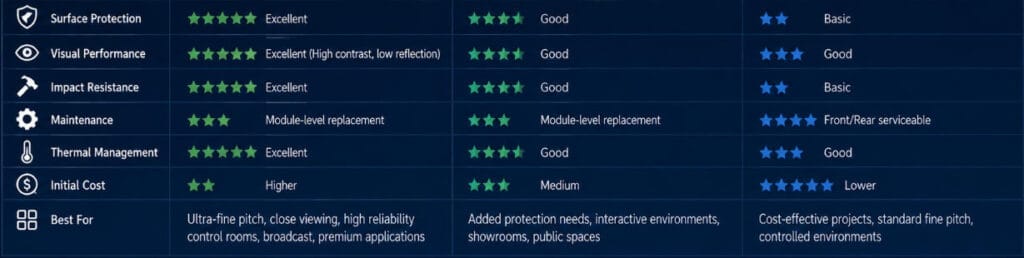
Choose SMD when the environment is controlled, the required pitch is relatively conventional, physical damage risk is low and cost efficiency is a major priority.
Consider GOB when you like the economics and architecture of an SMD-based solution but need greater protection against contact, impact or environmental exposure.
Consider COB when the project combines ultra-fine pixel pitch, close viewing, demanding visual performance, high reliability expectations and long operating hours.
There will always be exceptions.
The purpose of this framework is not to declare a winner but to eliminate technologies that do not solve the project’s actual problems.
Final Thoughts: Select for the Application, Not the Technology Trend
The LED industry naturally promotes newer technologies, but procurement decisions should not be driven by technology trends alone.
SMD, GOB and COB can all be the correct solution.
A well-engineered SMD display can outperform a poorly manufactured COB display. A high-quality GOB solution can be more appropriate than COB when physical protection is important but ultra-fine pixel density is not. And COB can provide clear advantages when the project pushes toward P1.2, P0.9 and below with demanding close-viewing and reliability requirements.
The most effective COB GOB SMD LED selection process therefore begins with four questions:
What will viewers see?
How close will they be?
How demanding is the operating environment?
How will the screen be maintained throughout its service life?
Once those answers are clear, selecting the right fine pitch LED technology becomes much easier.
For professional projects, Meitec can evaluate pixel pitch, viewing distance, display dimensions, resolution, operating environment, maintenance requirements and packaging technology together—helping buyers select a system based on measurable project requirements rather than specification-sheet competition.