Author: Meitec Technical Team
Reviewed by: LED Display Product Specialist
Category: Product Basics
Last Updated: September 2026
The viewing angle of an LED display describes the range of positions from which the screen can be viewed while maintaining acceptable brightness, color, contrast, and overall image quality.
It is normally expressed in degrees and specified separately as horizontal and vertical viewing angles. A common specification such as 160° horizontal / 160° vertical means the display is designed to remain visible across a wide range of positions rather than only when the viewer stands directly in front of the screen.
Viewing angle is especially important for LED screens installed in shopping malls, stages, control rooms, exhibition spaces, stadiums, transportation facilities, and public areas where viewers may approach the display from different directions.
However, the viewing-angle number on a specification sheet does not mean that image quality is completely identical at every position within that range. Understanding what the specification actually represents is important when comparing LED displays.
What Does LED Display Viewing Angle Mean?
An LED display produces its strongest and most uniform image when viewed close to the perpendicular direction of the screen surface. This position is usually called the normal viewing direction or on-axis position.
As a viewer moves toward the side, above, or below the display, the viewing position becomes increasingly off-axis.
At larger angles, several changes may occur:
- perceived brightness decreases;
- contrast can become weaker;
- colors may shift slightly;
- individual LED packages or masks may block part of the emitted light;
- image uniformity can become less consistent.
The viewing angle defines the usable angular range before these changes become significant according to the manufacturer’s measurement criteria.
For example, a display specified at 160° horizontal viewing angle generally provides approximately 80° of usable viewing range to the left and 80° to the right of the screen’s centerline.
The same principle applies vertically.
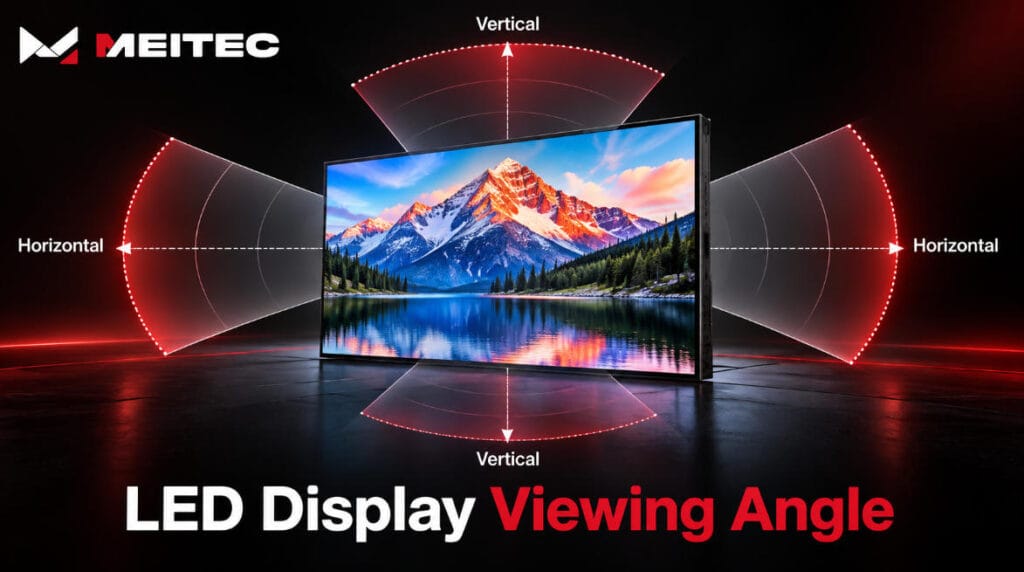
Horizontal vs. Vertical Viewing Angle
LED display specifications usually provide two viewing-angle values.
Horizontal Viewing Angle
The horizontal viewing angle describes how far viewers can move to the left or right while maintaining acceptable image visibility.
This is usually the more important value for applications where audiences are distributed across a wide area.
Typical examples include:
- conference rooms;
- retail stores;
- shopping-center atriums;
- stages and concerts;
- sports venues;
- command and control rooms;
- public information displays.
A wide horizontal viewing angle allows people positioned away from the center of the screen to see the same content more clearly.
Vertical Viewing Angle
The vertical viewing angle describes acceptable visibility when the display is viewed from above or below.
This becomes particularly important when the screen is installed:
- high on a building;
- above an audience;
- below an elevated viewing platform;
- inside a multi-level atrium;
- on a stage with viewers at different elevations.
A screen mounted several meters above eye level can theoretically have a wide horizontal viewing angle but still perform poorly if its vertical viewing angle is limited.
Both values therefore need to be considered during project planning.
What Does 160°/160° Viewing Angle Mean?
A specification such as:
Viewing Angle: H160° / V160°
means approximately:
- 160° horizontal viewing range;
- 160° vertical viewing range.
This does not mean viewers should intentionally watch the screen from an 80° side position.
Image quality is normally best when the viewer is closer to the center axis. The purpose of a wide viewing angle is to maintain practical visibility for people positioned outside the ideal central viewing area.
For many professional LED displays, a wide viewing angle provides more flexibility in real installations where audience positions cannot be perfectly controlled.
Meitec LED display configurations can provide viewing angles around 160° horizontally and vertically depending on the product and LED package used.
How Is LED Display Viewing Angle Measured?
The viewing angle is related to the light distribution characteristics of the LED package and the complete display structure.
A photometric measurement is normally taken while the display is viewed from different angular positions.
Brightness is strongest close to the central axis and gradually decreases as the measurement point moves away from the center.
One common engineering method defines the viewing boundary based on the angle at which measured brightness falls to approximately 50% of the on-axis value.
This is sometimes referred to as the half-brightness angle.
However, viewing-angle measurement methods can vary between LED manufacturers and component suppliers.
For this reason, two products both specified as 160° may not necessarily produce exactly the same visual performance at extreme angles.
The specification should be considered together with real image quality, color consistency, LED package design, mask structure, brightness, and contrast.
What Determines the Viewing Angle of an LED Display?
Viewing angle is not determined by one component alone. Several elements of the LED display affect off-axis performance.
1. LED Package Design
The LED package is one of the most important factors.
Different SMD, COB, and other LED packaging structures distribute light differently.
The optical structure of the package controls how emitted light spreads in horizontal and vertical directions.
Some LED packages produce a relatively broad light distribution, while others concentrate more output toward the front.
This means the LED type selected during module design directly affects usable viewing angle.
2. LED Mask and Module Structure
On conventional LED modules, a mask is often installed over the module surface.
The mask improves contrast, protects the LEDs, and helps control reflected ambient light.
However, its physical structure can also influence viewing angle.
If the mask or louver extends too far around the LED package, it may partially block light when the screen is viewed from extreme side or vertical positions.
Good module design therefore requires a balance between contrast improvement, mechanical protection, and angular visibility.
3. COB Encapsulation
COB LED displays have a different surface structure from conventional SMD modules.
LED chips are integrated onto the PCB and protected by an encapsulated surface rather than relying on individually packaged SMD LEDs protruding from the module.
Depending on the optical design, this structure can support smooth surface appearance and wide-angle visibility.
This can be useful in meeting rooms and control rooms where several people view the same fine-pitch LED wall from different workstation positions.
4. Surface Flatness
Cabinet and module flatness also affect practical viewing performance.
If modules are not perfectly aligned, small differences in surface angle can become more noticeable when the screen is viewed from the side.
A display that looks uniform directly from the front may show brightness bands or module boundaries from an oblique angle if mechanical tolerances are poor.
Viewing-angle performance therefore depends not only on LED specifications but also on manufacturing and installation accuracy.
Why Does Brightness Decrease at Wide Viewing Angles?
LED light emission is directional rather than perfectly uniform in every direction.
When viewers stand directly in front of the screen, they receive a relatively high amount of emitted light.
As they move toward the side, the effective light intensity reaching their eyes decreases.
The physical LED structure, optical lens, encapsulation material, mask, and screen geometry all contribute to this behavior.
Ambient lighting can make the effect more noticeable.
For example, an outdoor screen may remain technically visible from a large angle, but strong sunlight can reduce perceived contrast when the viewer is far off-axis.
This is why viewing angle should be considered together with LED display brightness rather than treated as an isolated specification.
Viewing Angle and Color Shift
Brightness reduction is not the only possible off-axis effect.
Color can also change as viewing angle increases.
Ideally, red, green, and blue LEDs should maintain a similar light-distribution pattern. If their angular characteristics differ, the relative intensity of each color can change as the viewer moves away from the center.
This can create a visible color shift.
For example, white content may appear slightly warmer, cooler, greener, or more reddish from extreme viewing positions.
Accurate LED selection, binning, calibration, and optical design help minimize these differences.
For applications where image consistency is particularly important—such as broadcast studios, control rooms, premium retail spaces, or corporate environments—off-axis color performance may be more meaningful than the viewing-angle number alone.
Does a Wider Viewing Angle Always Mean a Better LED Display?
Not necessarily.
A large viewing-angle specification is useful only when the application requires people to view the display from different positions.
For example, a screen mounted at the end of a narrow conference room may have almost all viewers positioned within a relatively small central angle. Increasing the theoretical viewing angle beyond what the room requires may provide little practical benefit.
By contrast, a large LED display in a shopping-center atrium may be approached from many directions, making wide-angle performance considerably more important.
The correct specification should therefore be based on audience distribution and installation geometry.
Higher specification numbers should not automatically be interpreted as better performance.
Viewing Angle vs. Viewing Distance
Viewing angle and viewing distance describe two different aspects of LED display design.
Viewing angle defines where viewers can stand relative to the direction of the screen.
Viewing distance defines how far viewers are positioned from the screen.
Viewing distance is strongly related to pixel pitch. A smaller pixel pitch generally allows detailed content to be viewed from shorter distances.
For example, an indoor P1.5 display may be appropriate for much closer viewing than an outdoor P8 billboard.
However, both products may still provide a wide horizontal viewing angle.
When selecting an LED display, pixel pitch and viewing distance should therefore be evaluated separately from angular visibility.
Why Viewing Angle Matters for Different Applications
Indoor Commercial Displays
Indoor retail and commercial screens are frequently viewed while people walk past the display rather than stand directly in front of it.
A wide viewing angle helps content remain visible as customers move through the space.
Rental and Stage LED Displays
For rental LED displays, viewers may be distributed across a large venue.
Audience members near the left and right sides of a stage can have significantly different viewing positions from people in the center.
Wide-angle visibility is therefore important for concerts, conferences, exhibitions, product launches, and live events.
Control Rooms
Control rooms often use large LED video walls shared by multiple operators.
Operators sitting at side workstations may view the screen from significant horizontal angles.
Good off-axis color and brightness consistency therefore contribute to a more practical shared visualization environment.
Outdoor Advertising
Large outdoor displays are often designed for moving audiences.
Pedestrians and vehicles may see the screen from different angles while approaching or passing the installation.
In these projects, viewing angle needs to be evaluated together with brightness, screen orientation, viewing distance, sunlight direction, and content size.
How to Evaluate Viewing Angle Before Buying an LED Display
Do not compare products using the angle number alone.
When possible, evaluate the display from actual side positions.
Check several types of content, including:
- full white;
- solid red, green, and blue;
- grayscale gradients;
- human skin tones;
- dark images;
- text;
- high-contrast graphics.
Look for brightness reduction, color shift, inconsistent modules, visible seams, and unusual reflection.
Also ask the supplier how the stated viewing angle is defined and whether the value refers to half-brightness angle or another measurement condition.
For projects with unusual audience positions, provide the installation drawing, screen height, viewing distance, and expected audience locations to the LED supplier before finalizing the product.
A viewing-angle specification is most useful when it is connected to the actual project geometry.
Common Misunderstandings About LED Viewing Angle
“160° means the image is identical across the entire 160°.”
No. Brightness, contrast, and color can gradually change as the viewer moves farther away from the center.
“The largest viewing-angle number is automatically the best.”
No. The required angle depends on where the audience is located.
“Viewing angle and viewing distance are the same thing.”
No. Viewing distance is mainly related to screen size, resolution, and pixel pitch, while viewing angle describes the direction from which the screen is observed.
“Only the LED lamp determines viewing angle.”
No. LED packaging is important, but masks, encapsulation, module structure, cabinet alignment, installation accuracy, and ambient light also affect practical performance.
What Viewing Angle Should You Choose?
For many modern indoor and outdoor LED display applications, approximately 140°–160° horizontal viewing angle provides sufficient flexibility.
Displays designed for wide public viewing areas commonly target around 160° horizontally, and many professional products also provide similar vertical performance.
However, there is no universal value that every project must use.
The project designer should consider:
- audience position;
- screen mounting height;
- horizontal audience width;
- minimum and maximum viewing distance;
- indoor or outdoor environment;
- ambient light;
- screen orientation;
- content type.
For a conventional installation where viewers remain mostly in front of the screen, moderate viewing angles may be completely adequate.
For atriums, control rooms, stages, public spaces, and other multi-directional environments, wider and more consistent off-axis performance becomes much more important.
Final Takeaway
LED display viewing angle defines the range of positions from which a screen can maintain usable visual performance.
Values such as 160° horizontal / 160° vertical describe a broad viewing range, but they should not be interpreted as guaranteeing identical brightness and color at every angle.
Practical viewing performance depends on LED package design, optical structure, module mask, COB or SMD architecture, cabinet flatness, calibration, brightness, contrast, ambient light, and installation geometry.
When comparing LED displays, buyers should therefore evaluate more than the viewing-angle number shown on the specification sheet.
The most useful question is not:
“Which display has the largest viewing angle?”
It is:
“Will this display maintain sufficient brightness, color consistency, and readability from the actual positions of my audience?”
Matching the viewing-angle requirement to the real installation environment provides a more reliable basis for LED display selection.