Choosing the right LED Display Brightness is not simply a matter of selecting the screen with the highest nit rating.
A display that is too dim may lose visibility under strong ambient light, but a display that is unnecessarily bright can create glare, reduce viewing comfort, increase power consumption, and make it more difficult to reproduce natural colors—especially in indoor environments.
For buyers, integrators, and project planners, the better approach is to match brightness to the actual installation environment.
This means considering not only whether the display is indoor or outdoor, but also sunlight exposure, window locations, viewing distance, operating hours, content type, screen orientation, and whether ambient lighting changes throughout the day.
This guide explains how to Choose LED Display Brightness for Different Environments and how to avoid paying for brightness your project does not actually need.
Why the Highest Brightness Is Not Always the Best Choice
Brightness is normally expressed in nits, or cd/m². In practical LED display procurement, however, the important question is not:
“How many nits can this display produce?”
The better question is:
“How much usable brightness does this installation need during its most demanding operating conditions?”
A screen installed in a dark control room and a digital billboard facing afternoon sunlight solve completely different visibility problems.
Using the same brightness specification for both would make little engineering sense.
Excessive brightness can introduce several disadvantages.
First, extremely bright screens can become uncomfortable at short viewing distances. This is particularly important in conference rooms, command centers, studios, retail stores, showrooms, and corporate lobbies where viewers may remain close to the display for extended periods.
Second, higher operating brightness generally means higher electrical demand. For installations operating 12, 16, or even 24 hours per day, unnecessary brightness can significantly affect lifetime energy costs.
Third, running LEDs continuously near their maximum output can contribute to faster brightness depreciation over time compared with operating them at an appropriate level.
The objective should therefore be sufficient brightness with reasonable operating headroom—not maximum brightness at all times.
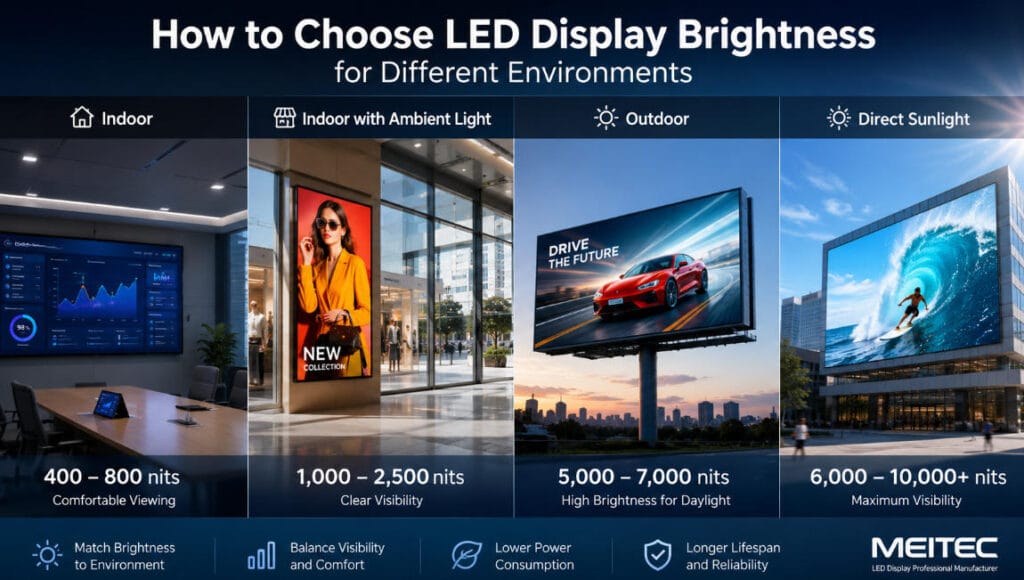
Recommended LED Display Brightness by Environment
There is no single brightness number that applies to every project, but the following ranges provide a practical starting point.
| Environment | Typical Brightness Range | Main Consideration |
|---|---|---|
| Dark indoor control room | 400–800 nits | Comfortable long-term viewing |
| Conference room / corporate space | 500–1,000 nits | Balanced image quality and comfort |
| Indoor retail / exhibition | 800–1,500 nits | Stronger ambient lighting |
| Indoor area near windows | 1,000–2,500+ nits | Daylight entering the room |
| Semi-outdoor / covered entrance | 2,000–4,000 nits | High ambient light without full sunlight |
| Outdoor shaded installation | 4,000–5,500 nits | Daytime visibility |
| Outdoor advertising | 5,000–7,000 nits | Strong daylight exposure |
| Direct-sunlight outdoor display | 6,000–10,000+ nits | Maximum daytime readability |
These values should be treated as engineering guidelines rather than rigid purchasing rules.
Actual requirements depend heavily on orientation, local climate, surrounding buildings, reflective surfaces, screen size, content design, and the distance from which viewers see the display.
1. Indoor LED Displays: Prioritize Visual Comfort
Indoor LED screens usually require substantially less brightness than outdoor displays.
For many conference rooms, reception areas, corporate meeting spaces, control rooms, and indoor auditoriums, approximately 500–1,000 nits is sufficient.
In these environments, contrast, grayscale performance, color accuracy, refresh rate, and low-brightness image quality can be more important than maximum brightness.
Consider a meeting room where users sit only several meters from the LED wall. A 3,000-nit display running at high output would provide no practical advantage. Instead, viewers may experience excessive glare, particularly when presentations contain large white backgrounds.
For professional indoor installations, it is therefore important to evaluate how well the screen performs after brightness is reduced.
A quality LED display should maintain good grayscale transitions, color consistency, and visual detail even when operating well below its maximum brightness.
Meitec’s SIM Pro indoor small-pixel-pitch platform, for example, includes configurations ranging from approximately 600 nits to higher-brightness options depending on the model, giving system designers greater flexibility for different indoor lighting environments.
For projects requiring close viewing, control-room visualization, conference applications, or high-resolution indoor installations, buyers can evaluate Meitec’s SIM Pro Series Indoor Small Pixel Pitch LED Display as part of the system-selection process.
2. Retail Stores and Shopping Centers Need More Flexibility
Retail environments are more complicated because ambient lighting varies considerably.
A display located deep inside a shopping center may operate effectively at around 800–1,200 nits.
A screen installed beside a glass storefront, however, may require significantly higher brightness because daylight can dramatically reduce perceived contrast.
This is why specifying a single brightness value for an entire retail project can be a mistake.
During site evaluation, determine:
- whether the display faces large windows;
- whether direct sunlight reaches the screen;
- whether the storefront faces east or west;
- what type of artificial lighting surrounds the display;
- whether brightness conditions change significantly between morning and afternoon.
For window-facing installations, 1,500–2,500 nits or more may be appropriate depending on the severity of daylight exposure.
However, brightness alone should not be used to compensate for poor placement. Screen orientation, contrast ratio, surface reflection, and content design should also be optimized.
3. Exhibition and Event Displays Require Adaptability
Event LED displays operate in highly variable environments.
One rental screen may be used inside a dark ballroom one week and under strong exhibition lighting the next.
This makes brightness flexibility especially important.
Typical indoor events may need approximately 800–1,500 nits, while stages exposed to strong professional lighting can require higher output.
Outdoor rental applications may need 4,500–6,000 nits or more.
Rather than focusing only on peak brightness, event companies should evaluate how easily brightness can be adjusted through the control system.
A versatile rental display should provide sufficient maximum output for demanding conditions while remaining visually comfortable when operated indoors.
High refresh rate should also be considered alongside brightness when cameras are used, because stage events, broadcasts, product launches, and concerts are frequently recorded.
4. Outdoor LED Advertising Usually Requires 5,000 Nits or More
Outdoor advertising is where LED Display Brightness becomes one of the most important specifications.
Daylight is vastly stronger than typical indoor illumination. Without sufficient luminance, colors appear washed out and advertising content becomes difficult to read.
For general outdoor billboards, roadside screens, building façades, shopping-center exterior displays, and public information screens, approximately 5,000–7,000 nits is a common design range.
But the installation orientation matters.
A north-facing display that remains shaded for much of the day may not require the same output as a west-facing billboard receiving direct afternoon sunlight.
Before choosing brightness, evaluate the screen’s worst-case sunlight condition rather than its average condition.
If the display must remain clearly visible during intense direct sunlight, additional brightness headroom becomes valuable.
Meitec’s MTO Plus Series High-Brightness Energy-Saving Outdoor LED Display is designed for these demanding applications. Depending on configuration, the series offers approximately 5,500–10,000 nits, with selected DIP models reaching 10,000 nits for installations requiring particularly strong outdoor visibility.
5. Direct Sunlight Requires More Than Just a High Nit Number
Direct sunlight is one of the most difficult environments for any digital display.
For these projects, buyers sometimes assume that specifying 8,000 or 10,000 nits automatically guarantees good visibility.
It does not.
Effective outdoor readability depends on the relationship between brightness and contrast.
An extremely bright screen with a highly reflective surface may still appear less impressive than a display with optimized contrast and lower reflection.
Black LED packages, mask design, cabinet flatness, module consistency, and content contrast all influence perceived image quality.
This is especially important for outdoor advertising where viewers may see the screen from hundreds of meters away.
The correct approach is to evaluate the complete optical system instead of comparing one number on competing specification sheets.
6. Semi-Outdoor Areas Often Get Overspecified
Covered entrances, transportation terminals, stadium concourses, covered walkways, loading areas, open-air shopping centers, and building canopies are neither fully indoor nor fully outdoor.
These projects are frequently overspecified.
A buyer may assume that because the display is technically outdoors, it automatically needs 6,000–8,000 nits.
In reality, many sheltered installations receive strong ambient daylight but little direct sunlight.
Approximately 2,000–4,000 nits may therefore provide sufficient visibility depending on the location.
Reducing unnecessary peak brightness can lower power demand and potentially allow a different display configuration while still achieving the required visual performance.
This is a good example of why an accurate site assessment can reduce project cost without sacrificing performance.
7. Control Rooms and Broadcast Environments Need Excellent Low-Brightness Performance
Control rooms, monitoring centers, studios, broadcast environments, and command centers create another special requirement.
These spaces often use dark software interfaces, maps, dashboards, surveillance feeds, or graphics containing large black areas.
Here, extreme brightness is rarely the goal.
High contrast, detailed grayscale reproduction, uniformity, accurate colors, and consistent performance at reduced brightness are often more valuable.
Ambient lighting should also be controlled wherever possible.
If operators work in front of the display for eight or twelve hours per shift, excessive luminance can cause unnecessary visual fatigue.
The best specification is therefore not the display with the largest nit number, but the display that maintains stable image quality at the brightness level operators actually use.
How Ambient Light Changes Perceived Brightness
A major purchasing mistake is evaluating LED displays in a showroom without considering the final installation.
A 1,000-nit screen can appear extremely bright inside a dim demonstration room and surprisingly weak beside a sunlit glass façade.
The screen itself has not changed.
The viewer’s perception has.
As ambient illumination increases, the apparent contrast between bright and dark areas decreases.
This is why installation environment should be documented before suppliers recommend a display.
Useful project information includes:
Installation type: indoor, semi-outdoor, or outdoor.
Orientation: north, south, east, or west facing.
Sun exposure: none, indirect daylight, partial sunlight, or direct sunlight.
Operating schedule: daytime only, nighttime only, or 24/7.
Viewing distance: close-range, medium-distance, or long-distance.
Content: advertising, presentations, video, text, dashboards, or broadcast content.
Giving this information to the manufacturer produces a much more reliable recommendation than simply requesting “a high-brightness LED screen.”
Do Not Forget Nighttime Brightness
Outdoor screens designed for daytime sunlight create a different problem after sunset.
A billboard capable of 7,000 nits during the afternoon should not necessarily remain at the same brightness at midnight.
Excessive nighttime brightness can create glare, reduce content quality, disturb nearby properties, and potentially conflict with local signage regulations.
For this reason, outdoor LED projects should normally support scheduled or automatic brightness adjustment.
A light sensor can allow the control system to modify brightness according to surrounding conditions.
The screen might operate near higher output during strong daylight, reduce output during cloudy conditions, and operate at much lower brightness after dark.
This improves viewing comfort while also reducing unnecessary energy consumption.
Brightness and Energy Consumption Should Be Evaluated Together
Brightness should never be separated from operating cost.
A large outdoor screen can contain hundreds of thousands—or millions—of LEDs.
Even relatively small improvements in power efficiency become meaningful when multiplied across the entire display and thousands of annual operating hours.
When comparing products, buyers should therefore request both:
- maximum power consumption;
- typical or average power consumption.
They should also ask how those figures change at realistic operating brightness.
A screen advertised at 10,000 nits may rarely operate at 10,000 nits continuously. What matters financially is how efficiently the display operates at the brightness levels the project uses most often.
Energy-saving architecture is particularly valuable for outdoor advertising networks, transportation displays, stadium installations, and other large screens operating for extended periods.
Brightness Should Be Considered Together With Pixel Pitch
Brightness and pixel pitch are often treated as separate purchasing decisions, but they influence the same viewing experience.
A roadside billboard viewed from 100 meters away may use a relatively large pixel pitch and high brightness.
A conference-room screen viewed from three meters away may need a fine pixel pitch but much lower brightness.
Paying for both an unnecessarily fine pixel pitch and excessive brightness is one of the easiest ways to increase LED project cost without improving the final result.
The correct configuration comes from combining viewing distance, content resolution, ambient light, screen size, and operating environment.
Buyers comparing fixed indoor and outdoor solutions can review Meitec’s Standard LED Displays to evaluate different display configurations for commercial advertising, information displays, public spaces, and professional indoor projects.
Five Questions to Ask Before Choosing LED Display Brightness
Before finalizing a specification, answer these questions:
- What is the strongest ambient light the screen will experience?
- Will direct sunlight actually hit the display surface?
- How close will the nearest viewers be?
- Does the display need the same brightness during daytime and nighttime operation?
- Can the selected display maintain good grayscale and color performance when brightness is reduced?
If these questions cannot be answered, the project probably needs a more detailed site assessment before the LED configuration is finalized.
How Meitec Approaches Brightness Selection
At Meitec, LED display selection is based on the complete application rather than a single specification.
For indoor projects, factors such as viewing distance, pixel pitch, ambient lighting, visual comfort, grayscale performance, refresh rate, installation structure, and maintenance access should be considered together.
For outdoor projects, additional factors include direct sunlight, weather exposure, IP protection, operating temperature, energy consumption, service access, and required viewing distance.
This application-focused approach helps prevent two common procurement problems:
Under-specification, where the screen lacks sufficient visibility.
And over-specification, where the customer pays for performance that provides little real benefit.
The goal is not to recommend the brightest LED display available. It is to identify the brightness range that delivers reliable visibility, comfortable viewing, efficient operation, and appropriate long-term performance for the actual environment.
Final Thoughts
Choosing the correct LED Display Brightness is ultimately an environmental engineering decision.
For controlled indoor spaces, moderate brightness combined with excellent contrast and low-brightness image quality is usually the better choice.
Retail environments and window-facing screens need additional brightness to compete with daylight.
Semi-outdoor areas should be evaluated carefully rather than automatically treated as full-sun outdoor installations.
Outdoor advertising screens generally require substantially higher brightness, while direct-sunlight applications may justify 6,000–10,000 nits or more depending on screen orientation and project requirements.
Most importantly, do not purchase brightness in isolation.
Consider ambient light, contrast, pixel pitch, viewing distance, operating schedule, energy efficiency, brightness control, and long-term usage together.
When these factors are correctly balanced, the result is not simply a brighter LED display—it is a display that performs correctly in the environment for which it was designed.