Author: Meitec Technical Team
Reviewed by: LED Display Product Specialist
Category: Product Basics
Last Updated: September 2026
Contrast ratio is one of the key specifications used to describe LED display image quality. It indicates how clearly a display can separate bright image areas from dark ones.
A high contrast ratio helps an LED screen produce deeper blacks, brighter highlights, stronger image depth, and better separation between different brightness levels. A low contrast ratio can make the same content appear flatter, especially when dark scenes, shadows, text, or fine visual details are displayed.
However, contrast ratio should not be evaluated as an isolated number on a specification sheet. LED package structure, screen surface, ambient light, brightness, calibration, driving settings, and measurement conditions can all affect actual contrast performance.
This guide explains how LED display contrast ratio works, what affects it, how it is measured, and what buyers should consider when comparing LED screens.
What Is Contrast Ratio in an LED Display?
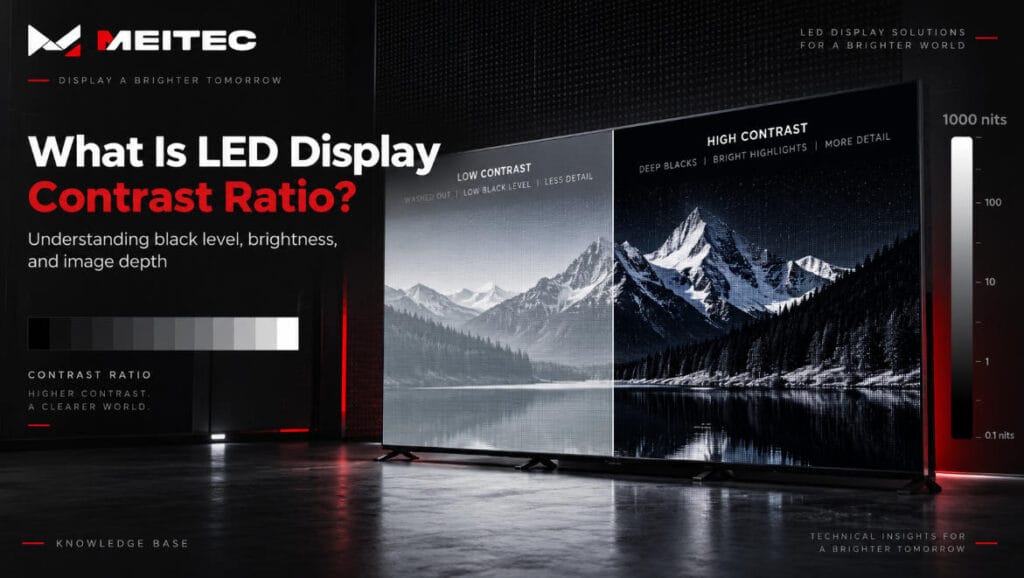
Contrast ratio describes the difference between the brightest white and the darkest black that an LED display can reproduce under a defined measurement condition.
It is normally written in a format such as:
5,000:1
10,000:1
15,000:1
A contrast ratio of 10,000:1 means that the measured white luminance is 10,000 times the measured black luminance under the specified test conditions.
The basic relationship can be expressed as:
Contrast Ratio = White Luminance ÷ Black Luminance
For example, if the screen produces a white level of 1,000 cd/m² while the measured black level is 0.1 cd/m²:
1,000 ÷ 0.1 = 10,000
The resulting contrast ratio is therefore 10,000:1.
In practical viewing, the number represents how strongly bright objects can stand out against dark areas of an image.
Why Is Contrast Ratio Important?
Contrast affects how easily viewers distinguish image information.
When contrast is strong, bright elements remain clearly separated from dark backgrounds. Shadows contain more visible structure, text stands out more clearly, and images generally appear to have greater depth.
This becomes particularly important for content containing:
- dark backgrounds;
- surveillance footage;
- movie or broadcast material;
- control-room interfaces;
- black presentation backgrounds;
- detailed product photography;
- maps and data visualization;
- stage graphics;
- high-dynamic visual content.
For example, a control room interface may contain dark gray panels, black backgrounds, colored warning indicators, and small white text. If the display’s black level is poor, dark areas can appear gray and the visual separation between interface elements becomes weaker.
Contrast therefore contributes not only to visually impressive images but also to information readability.
Contrast Ratio Is Not the Same as Brightness
Brightness and contrast are closely related but describe different characteristics.
Brightness describes how much visible light the LED display produces and is normally expressed in nits or cd/m².
Contrast ratio describes the difference between the display’s bright and dark levels.
Increasing brightness does not automatically produce better contrast.
For example, a screen can produce very high brightness while also having a relatively bright black level. In this case, the contrast ratio may still be limited.
Another display may operate at lower peak brightness but have a much darker screen surface and lower black level, resulting in stronger perceived contrast indoors.
This distinction is especially important when selecting screens for indoor environments. Maximum brightness is often less important than maintaining a good black level, grayscale performance, and low surface reflection.
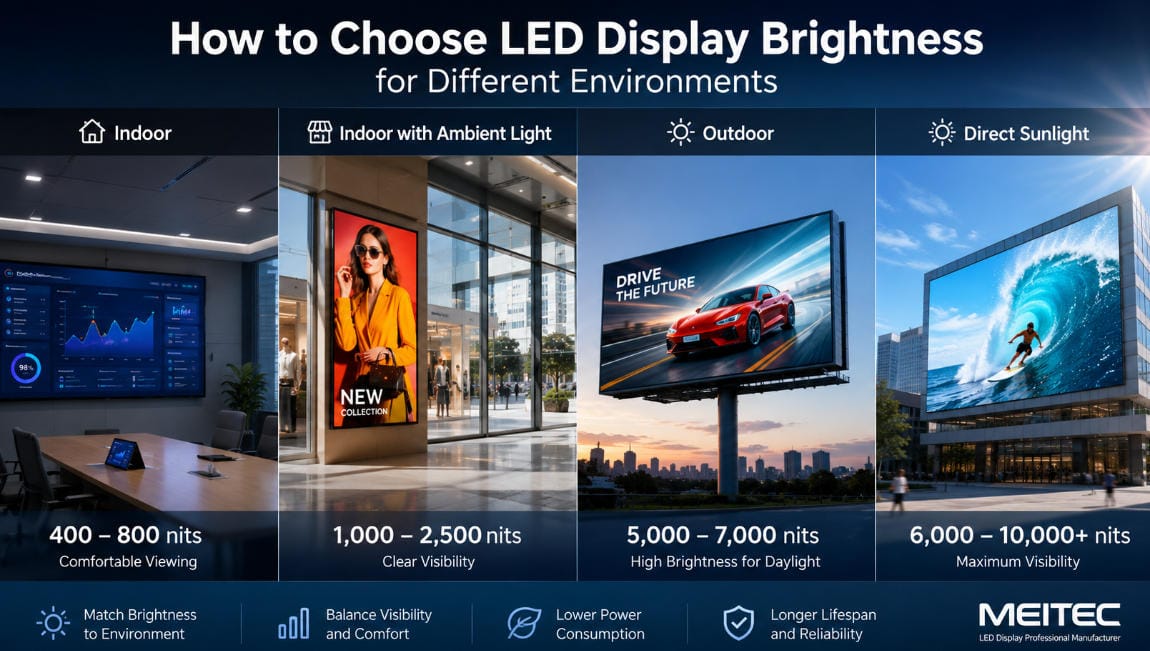
For a more detailed explanation of matching brightness to installation conditions, see Meitec’s LED Display Brightness Guide.
What Determines LED Display Contrast Ratio?
Several parts of an LED display influence its final contrast performance.
1. Black Level
Black level is one of the most important factors.
When an LED pixel is displaying black, ideally very little light should come from that area. However, the viewer may still see reflected ambient light, PCB surfaces, masks, LED packages, encapsulation materials, or residual light from adjacent pixels.
The darker the screen appears when displaying black, the greater the potential difference between black and white.
This is why the physical appearance of the LED module matters even when the LEDs themselves are switched off.
2. LED Package and Encapsulation
Different LED packaging technologies produce different optical characteristics.
Traditional SMD LED displays contain individually packaged LEDs mounted on the PCB. The package body, spacing between LEDs, mask design, and PCB surface can all influence how much external light is reflected.
COB technology integrates multiple LED chips directly onto the board and covers the display surface with an encapsulation layer. Depending on the optical treatment and material, this construction can reduce visible pixel gaps and improve surface blackness.
Meitec’s COB LED Displays are designed for fine-pitch indoor applications where black uniformity, low reflection, color consistency, and high contrast are particularly important.
3. Surface Reflection
An LED screen does not operate in complete isolation from its surroundings.
Light from windows, ceiling lamps, stage lighting, or sunlight can strike the display surface and reflect toward the viewer.
Reflected light makes black areas appear brighter.
As the apparent black level increases, perceived contrast decreases.
This explains why the same LED display may look extremely high-contrast in a dark showroom but noticeably flatter when installed next to a large glass wall.
Anti-reflective surface treatment, dark encapsulation materials, module masks, and installation orientation can therefore affect real-world contrast.
4. LED Brightness
The white level also contributes to the contrast ratio.
Within reasonable operating limits, increasing peak luminance can increase separation between bright and dark image areas.
However, simply increasing LED output is not always an effective solution.
If ambient light is also raising the perceived black level, excessive brightness may increase power consumption and viewing discomfort without solving the underlying reflection problem.
The objective is therefore not maximum brightness, but an appropriate balance between white luminance, black level, ambient conditions, and viewing distance.
5. Driver IC and Low-Brightness Performance
Driver IC performance influences how precisely LED current can be controlled.
Professional displays need to reproduce extremely small differences between low grayscale levels without introducing color shift, flicker, or abrupt brightness transitions.
This becomes particularly important in dark scenes.
A display can have a high measured maximum contrast ratio but still show poor shadow detail if its low-brightness grayscale control is weak.
Contrast ratio should therefore be considered together with grayscale depth and driving performance.
6. Calibration
LED modules do not naturally produce perfectly identical brightness and color.
Differences can develop between individual LEDs, modules, production batches, or cabinets.
Calibration measures these differences and compensates for them through the control system.
Good calibration does not simply increase the manufacturer’s specified contrast number. Instead, it helps ensure that brightness and color remain consistent across the display, allowing dark and bright image areas to appear more uniform.
You can learn more in Meitec’s LED Display Calibration Guide.
Native Contrast, Dynamic Contrast, and System Contrast
Not every contrast specification is measured in the same way.
Understanding the measurement method is essential when comparing products.
Native or Static Contrast
Native contrast generally compares a display’s bright level with its dark level without relying on artificial scene-by-scene brightness manipulation.
For LED display evaluation, this is normally more useful than a large marketing-oriented dynamic contrast figure because it better represents the optical characteristics of the display itself.
Dynamic Contrast
Dynamic contrast may involve changing brightness or driving conditions depending on the displayed content.
Because measurement methods vary considerably, very large dynamic contrast numbers should not automatically be compared directly with native contrast specifications from another product.
Always ask how the figure was measured.
System Contrast
Real installations are affected by the complete viewing environment.
Professional AV standards therefore also consider image-system contrast rather than treating the display panel alone as the entire system. Ambient illumination, screen position, surrounding surfaces, image content, and viewing conditions can all influence usable contrast.
This distinction is important because laboratory specifications and installed performance are not necessarily identical.
How Does Ambient Light Affect Contrast?
Ambient light is one of the most overlooked factors in LED display projects.
Imagine a screen whose physical surface appears nearly black in a dark room.
When strong daylight falls onto that same surface, some of the light is reflected. The screen may now appear dark gray instead of black.
The LED’s maximum output may not have changed, but the visible black level has increased.
The effective contrast experienced by the viewer therefore decreases.
This is why outdoor LED displays and window-facing installations require more than high brightness.
Engineers also need to consider:
- module surface reflectivity;
- LED mask design;
- screen orientation;
- direct sunlight;
- nearby windows;
- artificial lighting;
- viewing direction.
For outdoor screens, adequate luminance is essential for daytime visibility, but surface design and optical contrast remain important.
For indoor fine-pitch screens, reducing reflections can often provide more useful visual improvement than simply increasing peak brightness.
Does COB Technology Improve Contrast?
COB can provide several structural advantages that support high contrast, particularly for fine-pitch LED displays.
Because LED chips are integrated and encapsulated across the module surface, manufacturers can optimize the entire viewing surface for darker appearance and lower reflection.
This can contribute to:
- deeper apparent blacks;
- reduced visual gaps between pixels;
- lower surface reflection;
- better black uniformity;
- smoother close-range viewing.
However, COB alone does not guarantee a specific contrast level.
Encapsulation material, surface processing, driver design, calibration, LED architecture, and measurement conditions still matter.
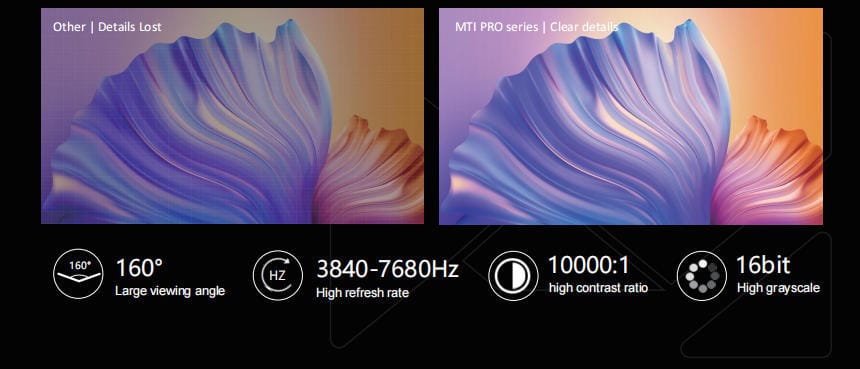
As one practical example, the Meitec NOC Pro Series COB Micro LED Display specifies contrast ratios of 10,000:1 for the P0.7 model and 15,000:1 for the P0.9 and P1.2 configurations. The same product family combines these values with 16-bit grayscale and brightness configurations ranging up to 2,000 nits depending on model.
The important point is not that one contrast value is universally required, but that optical performance should match the intended environment.
What Is a Good Contrast Ratio for an LED Display?
There is no single contrast ratio that is ideal for every LED display project.
Requirements depend on application, screen technology, ambient light, viewing distance, content, and measurement method.
A moderate-contrast outdoor display with sufficient daylight brightness may perform better in its intended environment than a laboratory-rated high-contrast indoor display that does not have adequate luminance for outdoor use.
Likewise, for a control room, broadcast studio, premium meeting room, or visualization center, deeper blacks and strong low-brightness performance may be more important than extreme peak brightness.
Instead of choosing a screen only because its specification sheet has a larger number, evaluate whether the product provides appropriate contrast under the actual operating conditions.
How Should You Compare Contrast Specifications?
When evaluating different LED displays, do not compare contrast figures until you know how they were obtained.
Ask the supplier:
- Is the stated value native, static, or dynamic contrast?
- Under what ambient-light conditions was it measured?
- What brightness setting was used?
- Was the measurement taken before or after calibration?
- Does the figure apply to the complete product series or only one configuration?
- What type of LED packaging and surface treatment is used?
- How does the display perform at normal operating brightness rather than maximum brightness?
If two manufacturers use different measurement methods, a direct numerical comparison may be misleading.
Whenever possible, compare screens under similar brightness, content, ambient lighting, and measurement conditions.
Contrast Ratio vs. Grayscale
Contrast ratio and grayscale are sometimes confused because both affect dark-scene image quality.
They are not the same specification.
Contrast ratio describes the range between the darkest and brightest measurable levels.
Grayscale describes how many intermediate brightness levels can be reproduced between black and full output.
A screen can theoretically have a strong maximum contrast ratio but poor grayscale transitions.
Conversely, high bit-depth processing cannot compensate for a physically gray black level caused by excessive surface reflection.
High-quality image reproduction therefore requires both sufficient contrast and accurate grayscale control.
Contrast Ratio vs. Refresh Rate
Refresh rate is another independent specification.
Contrast determines the separation between bright and dark image information.
Refresh rate describes how frequently the LED display updates the image.
High refresh rates are especially important for camera recording, broadcast applications, virtual production, and fast-moving content.
A display should therefore not be described as having better image quality based on any single parameter. Contrast ratio, grayscale, refresh rate, brightness, color accuracy, pixel pitch, calibration, and viewing conditions work together.
Practical Selection Advice
For most LED display projects, contrast ratio should be treated as part of a complete visual-performance evaluation.
For indoor close-viewing applications, pay particular attention to black level, low reflection, grayscale performance, color uniformity, and viewing comfort.
For outdoor installations, evaluate contrast together with brightness, sunlight exposure, screen orientation, weather protection, and power consumption.
For control rooms and professional visualization, examine dark-scene detail, black uniformity, calibration, grayscale, and continuous operating stability.
For rental and stage applications, contrast must also remain usable under changing stage lighting and camera conditions.
A specification sheet provides useful initial information, but a high contrast number alone does not guarantee superior real-world image quality.
Frequently Asked Questions
Is a higher LED display contrast ratio always better?
Under comparable measurement conditions, a higher contrast ratio generally provides stronger separation between dark and bright image areas. However, values from different manufacturers may not be directly comparable if their test methods differ.
Does higher brightness mean higher contrast?
Not necessarily. Contrast depends on both white luminance and black luminance. Increasing brightness without maintaining a low black level may provide only limited improvement.
Why does an LED screen look lower-contrast in sunlight?
Ambient light reflects from the screen surface and makes dark areas appear brighter. This raises the perceived black level and reduces effective contrast.
Can calibration improve contrast?
Calibration primarily improves brightness and color consistency rather than changing the physical black level. However, accurate calibration can improve dark-scene uniformity and overall image reproduction.
Is contrast ratio important for outdoor LED displays?
Yes, but it must be evaluated together with brightness and surface reflection. Outdoor visibility depends on the relationship between emitted light, reflected ambient light, and surrounding illumination.
Conclusion
LED display contrast ratio describes the difference between the brightest white and darkest black that a screen can reproduce under defined conditions.
A higher ratio can improve image depth, dark-scene clarity, text separation, and overall visual definition, but the number should never be evaluated alone.
LED packaging, surface reflectivity, black level, brightness, driver performance, grayscale, calibration, and ambient lighting all influence real-world results.
For LED display selection, the most useful question is therefore not simply “Which screen has the highest contrast ratio?”
It is:
“Which display maintains sufficient contrast under the actual conditions in which it will be installed and viewed?”
That approach provides a much more reliable basis for comparing LED display performance.