Author: Meitec Technical Team
Reviewed by: LED Display Product Specialist
Category: COB LED Display Technology
Last Updated: October 2026
Contrast is one of the factors that determine how clearly an LED display reproduces images, particularly when bright highlights and dark backgrounds appear together. In fine-pitch indoor applications, insufficient contrast can make black areas look gray, reduce shadow detail, and weaken the distinction between neighboring image elements.
COB (Chip-on-Board) LED displays can improve contrast through dark encapsulation materials, controlled surface reflections, and integrated optical structures that reduce unwanted light returning toward the viewer.
However, COB packaging does not automatically guarantee a higher contrast ratio. Actual performance depends on the encapsulation design, LED emission characteristics, surface reflectivity, driving system, and measurement conditions.
Understanding these factors explains how COB technology contributes to high-contrast LED displays and what engineers should verify when comparing products.
1. What Does Contrast Mean in a COB LED Display?
Contrast ratio describes the relationship between the luminance of a bright image area and that of a dark image area.
In a simplified on/off measurement:

For example, if a display produces 600 cd/m² in its white state and 0.06 cd/m² in its black state, the calculated contrast ratio is 10,000:1.
This is an illustrative calculation rather than a measured Meitec product result.
Direct-view LED technology differs from backlit LCD technology because its pixels are self-emissive. When an LED pixel is turned off, it does not require a continuously illuminated backlight.
Nevertheless, an inactive LED display does not necessarily appear completely black.
Ambient light can reflect from the screen surface, PCB areas, encapsulation materials, and other optical interfaces. In illuminated environments, these reflections can become a major contributor to the visible black level.
Consequently, contrast performance must be considered under both dark-room and ambient-light conditions.
2. How Does COB Packaging Affect Contrast?
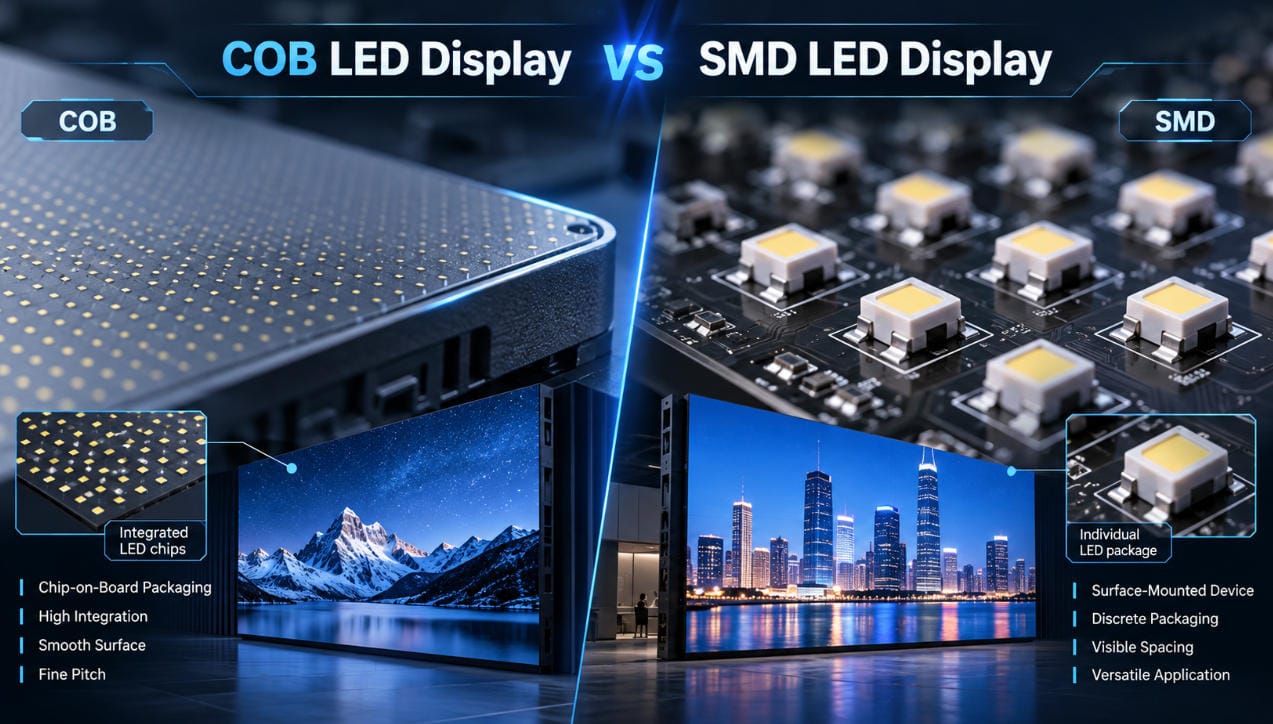
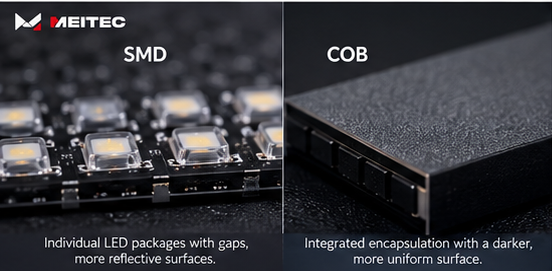
In a conventional SMD LED display, individually packaged LED devices are mounted onto a printed circuit board. Their package surfaces, surrounding materials, and exposed gaps create multiple optical interfaces.
COB packaging uses LED chips mounted directly onto the substrate, followed by protective encapsulation. This creates a more integrated display surface.
The structural difference provides opportunities to control how light interacts with the screen.
Dark Encapsulation Materials
A major contribution to COB contrast comes from the optical properties of its encapsulation layer.
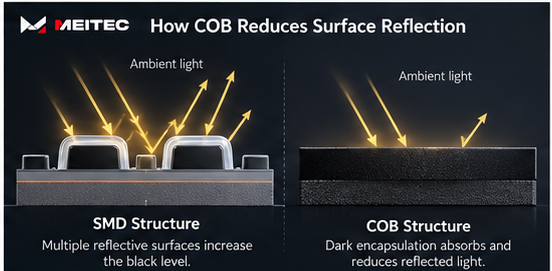
Conventional transparent encapsulation may allow ambient light to reach underlying structures and reflect back toward the viewer.
Darkened encapsulation materials or specially engineered black optical treatments can reduce unwanted reflected light.
When the display is showing black content, a lower-reflectance surface appears darker under the same ambient illumination.
This improves the visible separation between illuminated pixels and inactive image areas.
However, darker encapsulation must be carefully engineered.
Excessive light absorption can reduce useful emitted brightness, affecting luminous efficiency or requiring higher driving power to achieve the same output.
A well-designed COB display therefore balances black-level performance with light transmission, brightness, color consistency, and thermal requirements.
Integrated Surface Structure
The integrated surface of a COB module allows manufacturers to control the optical characteristics of the display more consistently across densely arranged pixels.
Depending on the design, it can help reduce reflections from exposed package features and substrate regions.
This does not mean that every COB surface reflects less light than every SMD surface.
A glossy COB encapsulation can still produce strong specular reflections, while an SMD display with black packages, optical masks, and effective surface treatments may achieve excellent contrast.
The relevant difference is the finished optical design, not simply the packaging category.
3. How Does Reduced Surface Reflection Improve Perceived Contrast?
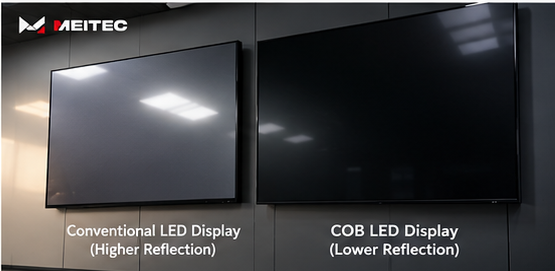
One of the most significant advantages of effective COB optical design appears in rooms with ambient lighting.
Overhead lights, windows, ceiling fixtures, and other light sources illuminate the display surface.
Some of that light is reflected toward viewers, increasing the luminance of areas intended to appear black.
The resulting image may appear washed out even when the display has a high advertised contrast ratio.
A simplified representation is:

This model assumes the reflected luminance is approximately equal in the measured white and black states.
Consider an illustrative display with:
| Measurement | No added reflection | With reflected light |
|---|---|---|
| White luminance | 600 cd/m² | 605 cd/m² |
| Black luminance | 0.06 cd/m² | 5.06 cd/m² |
| Calculated contrast | 10,000:1 | Approximately 120:1 |
The example demonstrates why ambient reflection has such a strong effect on contrast.
Even a relatively small amount of reflected light can substantially increase the measured black luminance.
COB displays using effective low-reflection treatments can reduce this additional light contribution, helping preserve image contrast under realistic indoor illumination.
Diffuse and Specular Reflection
Two forms of reflection are particularly important.
Specular reflection produces mirror-like highlights from localized light sources, such as ceiling fixtures.
Diffuse reflection scatters incident light across a wider range of directions, potentially making dark image regions appear brighter.
Matte encapsulation treatments can reduce disturbing mirror-like highlights, but they may also scatter light more broadly.
Therefore, a matte surface should not automatically be interpreted as having lower total reflectance.
Engineers should evaluate both reflection intensity and angular distribution when selecting a display for a specific installation.
4. How Do Black Optical Treatments Improve COB Contrast?
Some fine-pitch COB displays incorporate dedicated black-surface technologies in addition to the basic encapsulation process.
These may involve black optical coatings, selective darkening of non-emitting areas, or specialized printing techniques designed to improve the appearance of inactive pixels.
Their function is to reduce light reflected from the screen without excessively blocking light emitted by active LEDs.
For example, Meitec’s MTCOB Pro Series describes the use of 3D black inkjet printing technology to improve black-surface consistency and specifies a contrast ratio of 13,000:1.
This illustrates how a dedicated black-treatment process can form part of the overall contrast design.
The reported value is specific to that product series and should be interpreted according to its measurement conditions.
Black treatments also require manufacturing consistency. Differences in coating thickness, surface texture, or material properties can create visible variations in black appearance across modules.
For large video walls, consistent optical processing across the complete display surface is essential.
5. Does Flip-Chip COB Technology Directly Increase Contrast?
Flip-chip COB and high-contrast optical encapsulation are related but distinct technical concepts.
Flip-chip describes how LED chips are electrically connected to the display substrate.
In a flip-chip architecture, chip contacts connect directly to the mounting structure without conventional top-side bonding wires.
This arrangement can support dense chip layouts and different optical and thermal designs.
However, eliminating bonding wires does not independently establish a particular contrast ratio.
The black-level performance of a completed flip-chip COB module still depends primarily on its optical materials, surface structure, emission characteristics, and surrounding light conditions.
For a detailed explanation of the electrical and packaging architecture, see Meitec’s guide to Flip-Chip COB LED displays.
When comparing conventional COB and flip-chip COB products, contrast should be evaluated using actual product measurements rather than inferred from the chip connection method.
6. How Does COB Contrast Compare With SMD LED Displays?
COB and SMD displays can both achieve high contrast when their optical structures are properly engineered.
The most useful comparison considers specific physical characteristics rather than assuming that one packaging method is universally superior.
| Factor | COB LED Display | SMD LED Display |
|---|---|---|
| LED packaging | Chips mounted and encapsulated on substrate | Individually packaged LED components |
| Surface structure | Integrated encapsulation | Separate packages and inter-package regions |
| Black treatment | Dark encapsulation, coating, or printing | Black packages, masks, and dark PCB treatments |
| Reflection control | Depends on encapsulation finish | Depends on package and mask design |
| Fine-pitch capability | Particularly suitable for very fine pixel pitches | Available across a wide pitch range |
| Contrast performance | Product-dependent | Product-dependent |
COB can offer practical advantages when manufacturers optimize the integrated display surface to reduce reflections.
However, well-designed SMD displays can also produce deep black appearance and high contrast.
The comparison becomes especially relevant in fine-pitch indoor applications, where viewers can observe the screen from short distances and unwanted reflections can interfere with detailed content.
For a broader analysis of the technologies, refer to Meitec’s COB LED Display vs SMD LED Display comparison.
7. What Else Determines the Contrast Performance of a COB Display?
COB packaging and surface reflectivity are important, but they do not completely determine image contrast.
LED Brightness and Driving Accuracy
Contrast depends partly on the available white luminance and the display’s ability to maintain appropriate output at low brightness.
Increasing maximum brightness may improve visibility in certain environments, but it does not necessarily produce a proportional improvement in useful contrast.
Excessive brightness may also be inappropriate for close-viewing installations.
A display should be configured according to its operating environment rather than permanently driven at its maximum output.
Low-Grayscale Performance
Contrast ratio and grayscale performance are separate characteristics.
Contrast describes the difference between bright and dark luminance levels, while grayscale describes the display’s ability to reproduce intermediate brightness levels.
A display may have a high nominal contrast ratio but still lose shadow information if its driver or processing system reproduces near-black levels poorly.
This distinction is important for surveillance video, medical visualization interfaces, cinematic content, and dark-themed control systems.
Pixel and Module Uniformity
Uneven black appearance can reduce perceived image quality even when the display’s nominal contrast specification is strong.
Manufacturing differences, color inconsistencies, module alignment, and calibration errors may produce visible boundaries or uneven regions.
Calibration helps improve brightness and color consistency, although it cannot eliminate reflections caused by the physical surface.
Meitec explains these correction mechanisms in its LED display calibration guide.
Environmental Lighting
The position, intensity, and direction of ambient light can substantially affect perceived contrast.
A COB display may perform well in one room but exhibit noticeable reflections when installed opposite windows or concentrated overhead lights.
Therefore, display evaluation should account for the intended installation environment.
8. What Contrast Ratios Can COB LED Displays Achieve?
There is no single standard contrast ratio that applies to all COB LED displays.
Values vary with product design, optical treatment, measurement method, brightness configuration, and lighting conditions.
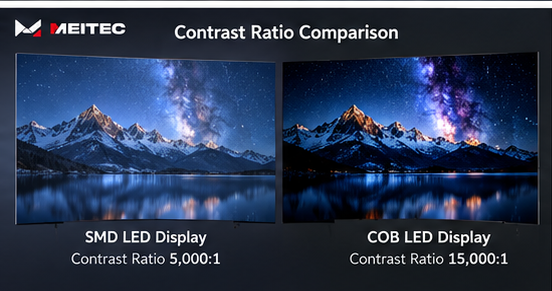
For example, Meitec publishes a contrast ratio of 15,000:1 for its NOC Plus COB Micro LED Display series.
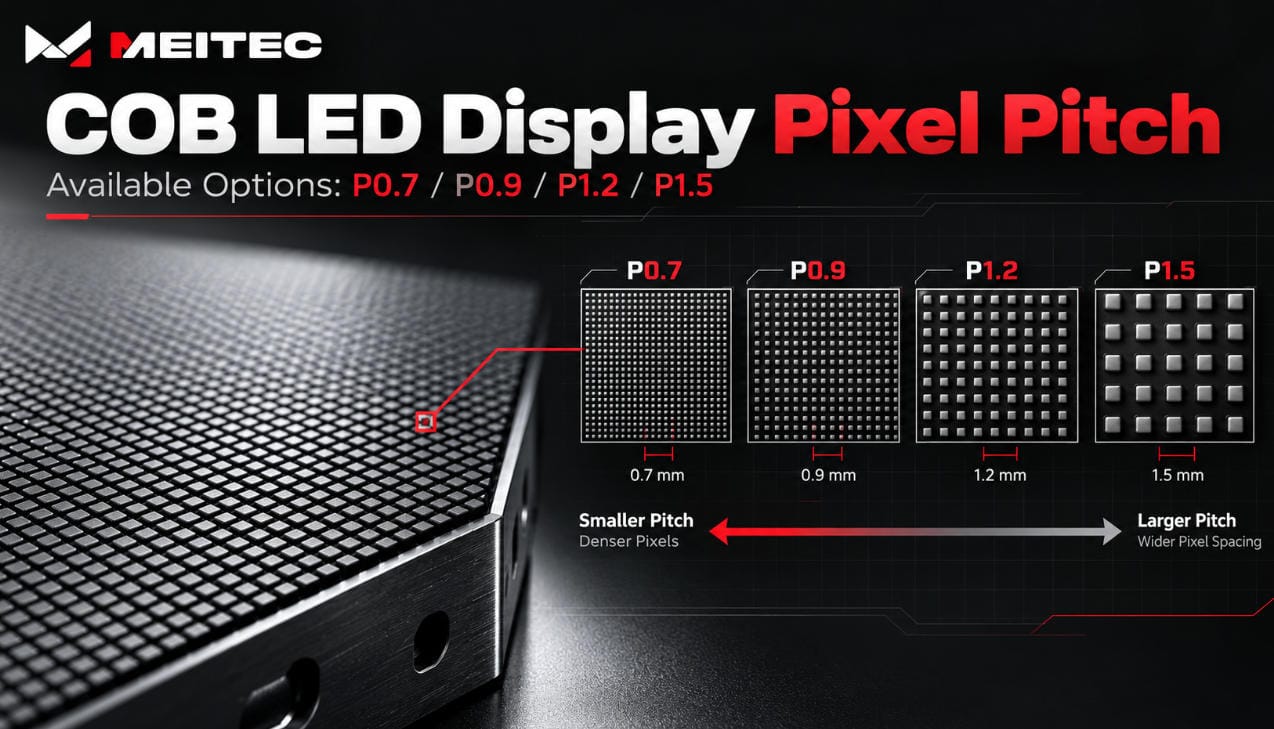
The series combines Full Flip-Chip COB packaging with 3D black printing technology and is available in fine-pitch configurations including P0.9, P1.2, and P1.5.
These are published product specifications, not independent measurements conducted for this article.
The technical specifications of the Meitec NOC Plus COB Micro LED Display provide a practical reference for comparing contrast alongside brightness, pixel pitch, refresh rate, and grayscale performance.
A ratio such as 15,000:1 should not be interpreted as a guarantee of identical contrast under all lighting conditions.
When evaluating products, request the measurement method and applicable operating conditions.
9. How Should COB LED Contrast Be Measured?
A meaningful contrast evaluation should include both controlled measurement and practical visual assessment.
On/Off Contrast
Measure the luminance of a full-white screen and a full-black screen under specified conditions.
This provides a basic indication of the display’s luminance range.
However, extremely low black readings require suitable instrument sensitivity and careful control of stray light.
Simultaneous Contrast
A test pattern containing bright and dark areas evaluates how well the display maintains their separation within the same image.
This method can reveal optical and electronic interactions that are not apparent from separate full-white and full-black measurements.
Results depend on the test-pattern geometry and should be reported with the method used.
Ambient-Light Contrast
Measure the display under representative room illumination.
Record the ambient illuminance, light-source positioning, observation angle, screen brightness setting, and test pattern.
This provides information that is often more useful for real installations than dark-room contrast alone.
Off-State Reflectance
Measuring the reflected luminance or reflectance of an inactive display surface helps characterize how the optical finish responds to external light.
Where possible, measurements should distinguish between diffuse and directional reflection.
A complete evaluation should also check uniformity across different modules and viewing positions.
10. Where Does High COB Contrast Matter Most?
Contrast improvement is particularly useful in applications that display dark backgrounds alongside relatively bright information.
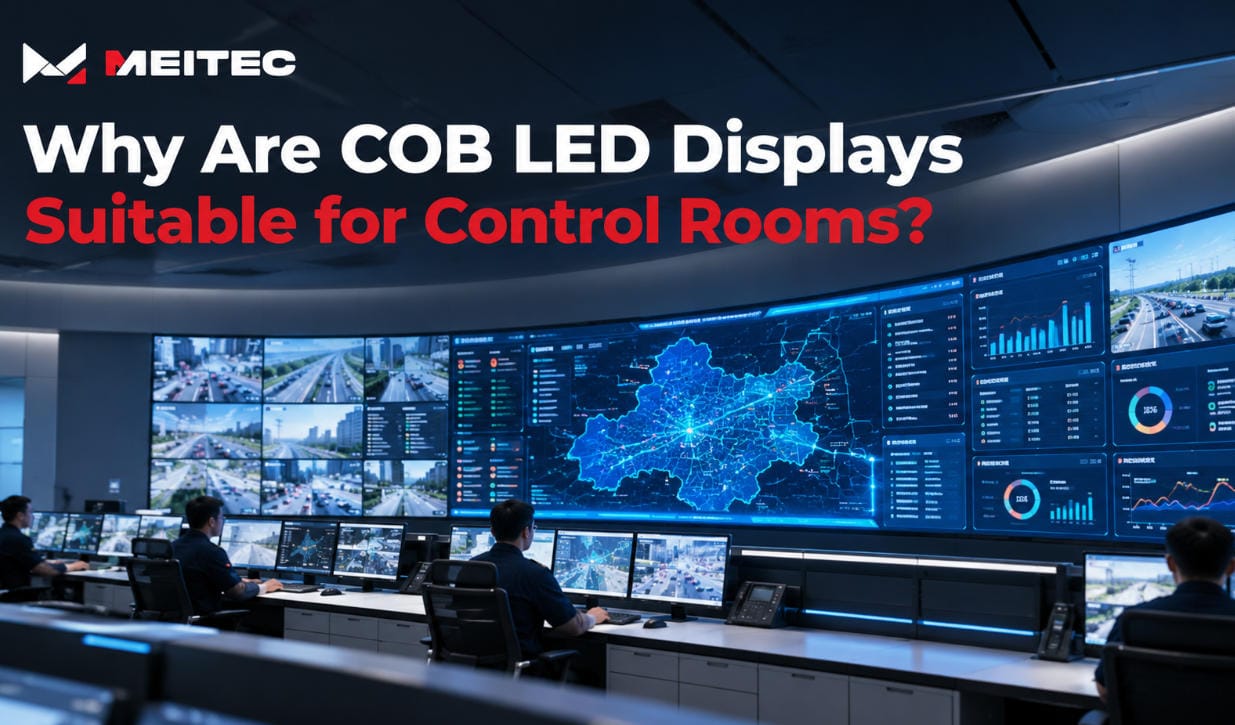
Control rooms: Monitoring interfaces commonly combine dark maps, surveillance images, status indicators, and warning graphics. Low-reflection surfaces help preserve information visibility under room lighting.
Broadcast studios: Controlled black appearance and reduced unwanted reflections can improve image presentation, although on-camera results also depend on the camera and display configuration.
Corporate meeting rooms: Dark slide backgrounds, charts, and video content benefit from consistent black appearance under typical meeting-room illumination.
Professional visualization: Detailed images containing shadows, gradients, and low-luminance elements require both adequate contrast and accurate grayscale reproduction.
In each environment, effective contrast is a system-level characteristic. Optical design, ambient lighting, brightness configuration, and image processing all contribute to the final result.
11. What Should Engineers Check When Selecting a High-Contrast COB Display?
A useful technical evaluation should address the following questions:
- Is the stated contrast ratio measured in a dark room or under ambient light?
- What test pattern and luminance settings were used?
- Does the module use dark encapsulation, low-reflection treatment, or black printing?
- How does the surface respond to overhead lighting and off-axis viewing?
- Is shadow detail preserved at the intended operating brightness?
- Does the display maintain uniform black appearance across modules?
- Can the supplier provide consistent measurements for competing products?
These questions provide a more reliable basis for selection than comparing contrast-ratio figures without context.
For professional projects, testing a representative sample under realistic lighting is preferable whenever practical.
Frequently Asked Questions
Why do COB LED displays often appear blacker than conventional LED displays?
COB displays can use dark encapsulation and optical surface treatments to reduce ambient-light reflection. Lower reflected luminance makes inactive image areas appear darker, improving perceived contrast.
Does a higher COB contrast ratio always mean better image quality?
No. Image quality also depends on grayscale reproduction, brightness, color accuracy, uniformity, viewing angle, and environmental lighting. Contrast is one performance parameter, not a complete image-quality measure.
Is matte COB better than glossy COB for contrast?
Not necessarily. Matte finishes can reduce mirror-like reflections, while glossy surfaces may create stronger localized highlights. Total reflectance and the distribution of reflected light should be measured before determining which surface performs better.
Can COB technology eliminate reflections completely?
No. Optical treatments can reduce unwanted reflections, but real display surfaces retain some level of reflectance. The amount depends on material properties, surface finish, lighting geometry, and viewing position.
Does a smaller COB pixel pitch increase contrast?
Not directly. Pixel pitch determines pixel density, while contrast depends primarily on luminance, black-level performance, and reflection control. Two COB displays with the same pixel pitch may have different contrast ratios.
Conclusion
COB LED displays improve contrast primarily through optical design rather than chip packaging alone.
Dark encapsulation materials, black-surface treatments, and controlled surface reflections can reduce the luminance of inactive display areas, helping bright and dark image regions remain visually distinct.
The integrated COB structure provides a useful platform for these optical treatments, particularly in fine-pitch indoor displays.
However, actual contrast remains dependent on material properties, driver performance, calibration, and ambient lighting.
For a technically meaningful comparison, engineers should evaluate measured black levels, surface reflectance, simultaneous contrast, and performance under realistic operating conditions—not simply the advertised contrast ratio.