COB (Chip-on-Board) LED displays generally provide better surface protection against moisture and dust than conventional uncoated SMD LED displays. However, COB packaging does not automatically make an entire LED display waterproof.
The encapsulation layer protects the LED chips on the display surface, while the overall water resistance depends on the module structure, cabinet sealing, electrical connections, and installation conditions.
Some COB displays feature an IP65-rated front surface, but this does not necessarily mean their rear cabinets or internal electronics have the same protection level.
Understanding the difference between surface water resistance and complete-system waterproofing is essential when selecting COB LED displays for indoor, humid, or outdoor environments.
1. Why Do COB LED Displays Have Better Moisture Resistance?
The water-resistance characteristics of COB displays are closely related to their packaging structure.
In conventional SMD LED displays, individual LED packages are soldered onto a printed circuit board. The spaces between components and exposed solder connections can create potential paths for contamination and moisture.
COB technology uses a different construction method.
Bare LED chips are mounted directly onto the substrate and covered with an integrated encapsulation layer. This protective layer creates a comparatively continuous display surface.
How COB Encapsulation Protects the LED Chips
The encapsulation material acts as a barrier between the chip array and the external environment.
Depending on the materials and manufacturing process, it can help reduce exposure to:
- Surface moisture and accidental water splashes
- Dust and airborne contaminants
- Accidental contact with LED components
- Surface contamination during routine maintenance
The protective layer also reduces direct exposure of the chip interconnections to environmental contamination.
However, COB encapsulation is not necessarily hermetically sealed. Moisture may still enter through module edges, substrate interfaces, defects in the protective layer, or unprotected rear components.
For a deeper explanation of the packaging structure, see Meitec’s guide to Flip-Chip COB LED display technology.
2. What Is the Difference Between Waterproof and Water-Resistant COB LED Displays?
Although the terms waterproof and water-resistant are often used interchangeably in commercial descriptions, they should not be treated as equivalent technical specifications.
Water resistance describes a product’s ability to withstand a defined degree of moisture or water exposure.
Waterproofing is a broader term commonly used to describe equipment designed to prevent harmful water ingress under specified conditions.
Neither term independently establishes an acceptable operating environment.
For LED displays, an ingress protection rating provides a more useful reference.
| Protection concept | Technical meaning |
|---|---|
| Moisture-resistant surface | Reduces direct moisture exposure to protected components |
| Splash-resistant display | Designed to withstand specified water splashes |
| IP65-rated enclosure | Dust-tight and protected against water jets under defined test conditions |
| IP67-rated enclosure | Dust-tight and protected against temporary immersion under specified conditions |
| Fully outdoor-rated display | Designed for the intended outdoor environment, considering water ingress, temperature, sunlight, corrosion, and electrical safety |
Importantly, an IP65 rating does not indicate that a display can be submerged in water.
Likewise, a display that tolerates occasional cleaning or splashing may not be suitable for continuous outdoor exposure.
The correct description depends on the actual protection rating, its scope, and the manufacturer’s operating instructions.
3. What IP Rating Do COB LED Displays Have?
There is no universal IP rating for COB LED displays.
COB describes the LED packaging method, while an IP rating describes the protection provided by a specified enclosure or assembly.
The IP classification system is defined by IEC 60529.
An IP code normally contains two digits:
- The first digit indicates protection against access to hazardous parts and solid foreign objects, including dust.
- The second digit indicates protection against the harmful effects of water ingress.
The following ratings are relevant when evaluating LED display protection.
| IP rating | Dust protection | Water protection |
|---|---|---|
| IP30 | Protection against solid objects of 2.5 mm or larger | No rated water protection |
| IP54 | Dust-protected | Protection against splashing water |
| IP65 | Dust-tight | Protection against water jets |
| IP66 | Dust-tight | Protection against powerful water jets |
| IP67 | Dust-tight | Protection against temporary immersion |
These descriptions are based on IEC 60529 classifications. JRC Publications+1
An IP rating applies to the tested assembly and configuration. It should not be extended to unrelated components or the entire installed system without supporting evidence.
Furthermore, IP67 should not be interpreted as automatically covering every type of water-jet exposure. The applicable tests and exposure conditions must be checked separately.
Does IP65 Mean a COB LED Screen Is Completely Waterproof?
No.
IP65 indicates that the rated enclosure is protected against dust ingress and water jets under standardized test conditions.
It does not automatically establish resistance to water immersion, prolonged flooding, high-pressure cleaning, or every possible outdoor exposure.
If only the front display surface is rated IP65, the rating cannot be assumed to apply to the rear electronics.
This distinction is particularly important for fine-pitch indoor COB video walls.
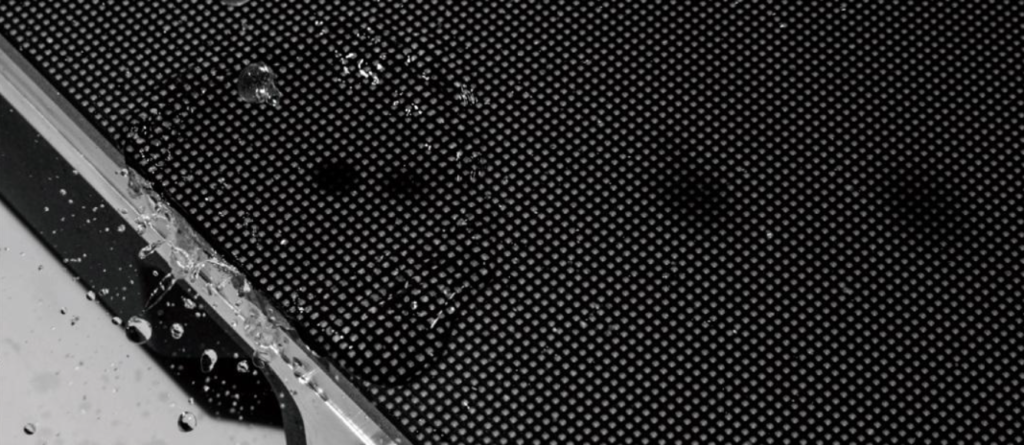
4. Is the Front Surface of a COB LED Display Waterproof?
Some COB LED displays can achieve high levels of front-surface water resistance through integrated encapsulation.
Unlike a traditional uncoated SMD module, a COB module does not expose individual LED packages in the same way.
The protective surface can reduce the likelihood of water reaching the LED chip array during limited incidental exposure.
Nevertheless, the front face should be evaluated as a complete assembly rather than only as an encapsulated material.
Potential water-entry points include:
- Module edges and sealing interfaces
- Joints between adjacent modules
- Cabinet-to-module connections
- Areas damaged by impact or improper servicing
- Openings around mechanical components
Water may also travel along interfaces through capillary action, particularly when sealing is incomplete.
Therefore, an encapsulated display face alone does not prove that the entire assembled video wall has an IP65 rating.
The relevant test should represent the actual configuration being claimed.
5. Why Can the Front and Rear of a COB LED Display Have Different IP Ratings?
Many indoor fine-pitch LED displays use different protection designs for their front and rear surfaces.
The front contains the encapsulated LED modules. The rear typically contains electrical connections, receiving cards, power supplies, ventilation pathways, and service-access structures.
These components may have different environmental protection requirements.
For example, Meitec’s NOC Plus Series COB Micro LED Display lists a protection grade of IP65/IP30 in its published specifications. Its product description explicitly identifies an IP65-rated display surface.
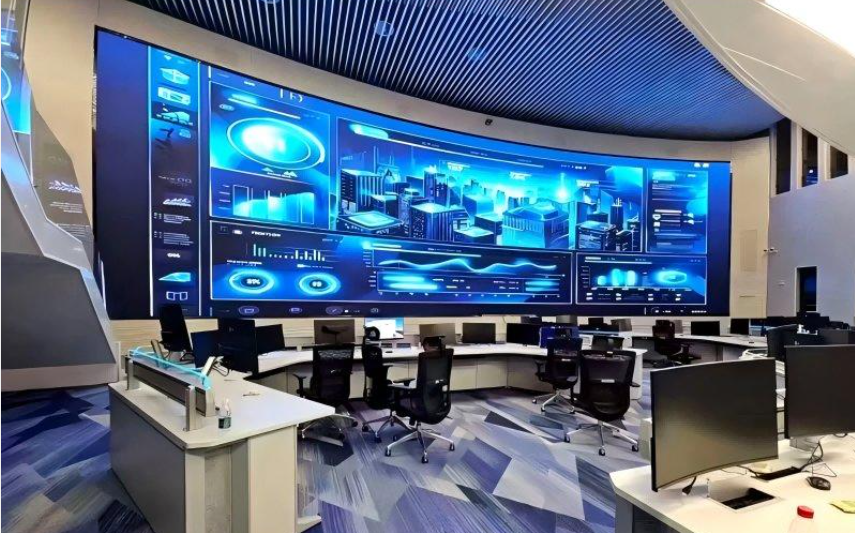
The product is positioned for professional indoor applications, including control rooms and corporate meeting spaces.
Understanding IP65/IP30 in Meitec COB Displays
The published rating demonstrates why identifying the protected portion of a display matters.
The IP65 surface protection should not be interpreted as an IP65 rating for every side of the display. The IP30 designation also does not provide rated protection against water ingress.
When evaluating a particular project, buyers should verify the exact front/rear assignment and tested assembly configuration against the manufacturer’s technical documentation.
The Meitec NOC Plus Series COB Micro LED Display provides a practical example of how surface protection and complete-system installation requirements differ.
A display can offer strong front protection while still requiring a controlled indoor environment.
6. Can COB LED Displays Be Used Outdoors?
COB LED technology is not inherently restricted to indoor applications.
However, a COB display must be specifically engineered and qualified for outdoor conditions before it can be considered suitable for an outdoor installation.
Outdoor operation introduces environmental challenges beyond direct water contact.
Rain and Wind-Driven Water
Outdoor display cabinets may experience rain from multiple directions, wind-driven spray, and water accumulation around mounting structures.
The sealing design must account for the exposed surfaces, cabinet joints, and cable entrances.
A front-surface IP65 rating alone is insufficient evidence of full outdoor suitability.
Temperature Changes and Condensation
Outdoor displays experience temperature fluctuations that can cause condensation within unsealed or poorly ventilated compartments.
Condensation can occur even when there is no direct rain exposure.
Temperature differences between the display, surrounding air, and structural surfaces may create conditions in which water vapor condenses on electronic components.
Environmental design must therefore consider humidity, ventilation, thermal management, and condensation control together.
UV Exposure and Material Aging
Encapsulation materials used in indoor COB displays are not necessarily designed for prolonged ultraviolet exposure.
UV radiation and temperature cycling can alter the physical or optical properties of some polymers.
Material degradation may cause discoloration, cracking, adhesion loss, or changes in surface performance.
Outdoor COB products require materials validated for the intended environmental exposure.
Electrical and Structural Protection
A weather-resistant outdoor display also requires appropriate electrical connections, cable glands, enclosure sealing, corrosion protection, drainage design, and installation practices.
For an exposed installation, the protection of power supplies and receiving cards is just as important as the LED surface.
A COB display intended for indoor use should not be installed outdoors solely because its front surface has an IP65 rating.
7. Are COB LED Displays Suitable for Humid Indoor Environments?
COB displays can be suitable for humid indoor environments when their specified operating conditions are respected.
The encapsulation layer provides an additional barrier against surface contamination and incidental moisture exposure.
This can be useful in commercial facilities, transportation environments, and other indoor spaces where humidity may fluctuate.
However, humidity tolerance and water-ingress protection are separate considerations.
A display may tolerate a specified relative humidity range without being protected against direct water exposure.
Manufacturers often specify operating humidity together with temperature limits and condensation conditions.
For example, Meitec publishes an operating humidity range of 10%–80% RH for the NOC Plus Series in its current specifications. That range should be evaluated alongside actual ambient temperature, condensation risk, and the permitted installation environment.
Why Condensation Matters
Condensation can form when a surface cools below the dew point of the surrounding air.
If moisture accumulates on internal electrical connections, it may contribute to leakage currents, corrosion, or electrical faults.
COB encapsulation protects the front chip array but does not independently eliminate these risks.
For humid installations, environmental control and appropriate enclosure design remain essential.
8. Is COB More Waterproof Than SMD or GOB LED Displays?
COB, SMD, and GOB technologies differ in how they protect LED components.
COB integrates bare LED chips beneath a protective encapsulation layer.
Conventional SMD displays use individually packaged LED components mounted onto a PCB.
GOB (Glue-on-Board) technology generally applies an additional protective resin layer over assembled SMD modules.
| Feature | COB | Conventional SMD | GOB |
|---|---|---|---|
| LED construction | Bare chips bonded to substrate | Individually packaged LEDs | Usually SMD packages with added resin |
| Surface encapsulation | Integrated | Not necessarily continuous | Applied over assembled modules |
| Direct chip exposure | Reduced by encapsulation | Chips protected inside individual packages | Reduced by additional surface protection |
| Surface moisture resistance | Generally good when properly encapsulated | Depends on package and module protection | Generally improved through resin coating |
| Full-screen waterproofing | Depends on enclosure | Depends on enclosure | Depends on enclosure |
| Outdoor suitability | Product-dependent | Product-dependent | Product-dependent |
COB and GOB both provide opportunities to improve surface protection.
However, neither technology guarantees a particular IP rating.
A properly sealed outdoor SMD LED display may provide better overall protection against rain than an indoor COB display with an exposed rear cabinet.
The more meaningful comparison is between complete products with documented environmental ratings.
For a detailed explanation of packaging differences, refer to COB LED Display vs GOB LED Display.
9. How Is COB LED Display Water Resistance Tested?
Water-resistance verification should follow an appropriate testing procedure for the claimed protection level.
For IP-rated products, IEC 60529 provides standardized methods for assessing protection against water ingress.
The actual procedure depends on the required IP code.
Water-Jet Testing
For an IPX5 water-ingress assessment, the enclosure is exposed to water jets under defined test conditions.
The evaluation determines whether water enters in quantities that could cause harmful effects.
This is not the same as simply spraying a loose COB module and observing whether the LEDs continue to operate.
Testing must consider the relevant enclosure boundaries and the condition of the equipment after exposure.
Post-Test Inspection
After exposure, the assembly should be evaluated according to the applicable test criteria.
Depending on the equipment and test requirements, inspection may include checking:
- Water penetration into protected electrical compartments
- Insulation and electrical safety
- Abnormal display operation
- Moisture accumulation at critical interfaces
- Damage to seals or protective structures
A functioning image immediately after water exposure does not by itself establish compliance with an IP rating.
Reliability Testing Beyond IP Protection
Additional environmental verification may be necessary for demanding installations.
Such testing can include temperature cycling, damp heat, corrosion exposure, and aging of encapsulation materials.
These tests investigate different reliability mechanisms and should not be presented as substitutes for an IP test.
Likewise, successful IP testing does not independently demonstrate long-term resistance to every form of environmental aging.
10. Can You Clean a COB LED Display With Water?
COB displays often have smoother and more protected surfaces than conventional exposed SMD modules, which can simplify routine cleaning.
However, water resistance does not automatically mean that spraying or washing the display is permitted.
Cleaning methods should follow the manufacturer’s product-specific maintenance instructions.
For routine indoor cleaning, appropriate methods may include a clean, soft, lint-free cloth and approved cleaning materials.
The display should be powered down before cleaning when required by the manufacturer’s procedure.
Avoid directing water toward module seams, rear electronics, power connections, and ventilation openings.
High-pressure washing, excessive liquid application, and unapproved chemical cleaners may damage the display surface or allow moisture to reach unprotected components.
Even an IP65-rated front surface should not be assumed to withstand unrestricted cleaning methods.
11. What Should Buyers Check Before Choosing a Water-Resistant COB Display?
When evaluating a COB LED display for an environment where moisture may be present, technical documentation is more useful than a general waterproofing claim.
The following questions help establish whether a product is suitable:
- What is the specified IP rating? Confirm the exact rating rather than relying on the term “waterproof.”
- Which components are protected? Determine whether the rating applies to the front surface, rear cabinet, individual module, or complete assembled system.
- Has the protection level been tested? Request applicable test documentation and identify the tested configuration.
- What environmental conditions are permitted? Review temperature, relative humidity, condensation restrictions, and exposure limitations.
- Is the display intended for indoor or outdoor installation? Verify the approved environment independently of the packaging technology.
- How are electrical connections protected? Check power supplies, receiving cards, cables, cabinet joints, and service openings.
- Will maintenance affect the seal? Confirm how protection is restored after module replacement or cabinet servicing.
For buyers comparing different configurations, Meitec’s COB LED display product range provides a starting point for reviewing product structures and specifications.
The final selection should be based on the actual installation environment and documented product capabilities.
COB LED displays can provide strong surface moisture resistance because their LED chips are protected beneath an integrated encapsulation layer.
However, surface protection and complete-display waterproofing are different engineering requirements.
An IP65-rated COB surface does not mean that the rear cabinet, electrical components, or assembled video wall can withstand identical water exposure.
For indoor installations, COB protection can improve durability and reduce the vulnerability of exposed LED components. For humid or outdoor environments, the complete system must be evaluated against the intended conditions.
The most reliable approach is to verify the specified IP rating, its application scope, environmental operating limits, and supporting test documentation before selecting a COB LED display.